
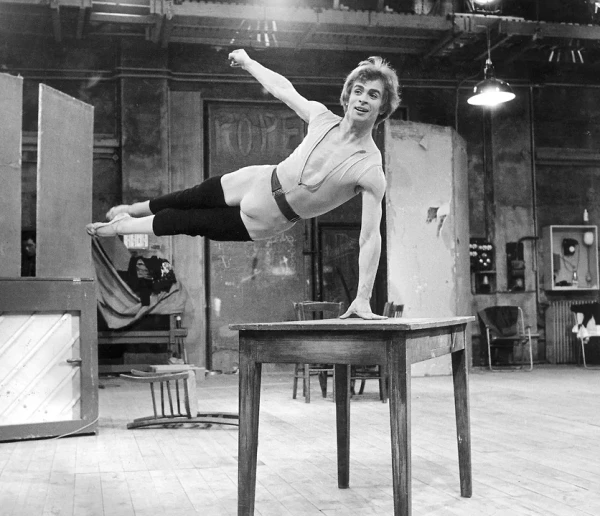
In the last period of his life, he held Austrian citizenship.
Rudolf Khamitovich Nureyev was born on a train, where his mother Farida was traveling to Vladivostok, where her husband was serving. The child was registered at the Razdolnoye station on March 17, 1938. For the first time, Rudik saw ballet at the age of six in Ufa, and, according to him, "from that unforgettable day, I could think of nothing else. I was obsessed." This boy was destined to become a millionaire and an idol for millions, the first Soviet "refusenik" and the main global ballet star of the second half of the 20th century.
"Following the Muslim custom that children's names should start with the same letter as the name of the first child, Farida named her son Rudolf," Diana Solovey wrote in the book "Nureyev: His Life."
In 1941, Farida and her children found themselves in evacuation in a Bashkir village. They lived for about a year in a hut with a dirt floor, which they shared with other refugee families. Later, they moved to Ufa.
"The feeling of hunger, a constant gnawing hunger, never left me. I remember those endless, six-month winters in Ufa without light and almost without food," Nureyev recalled of his childhood.
He called that period the potato period—there was no other food. His mother worked to exhaustion to feed four children. On his first day at kindergarten, Rudolf was laughed at because his mother had dressed him in his sister's coat. Nureyev was a sensitive child.
In 1946, his father returned home, but the children could not get used to him for a long time. At first, Khamet, used to commanding soldiers, frightened his son and could not win the trust of his daughters.
With the return of their father, the family acquired a two-room apartment. Khamet refused the position of deputy political commissar in the Ministry of Internal Affairs in Ufa and took a job as deputy director of a vocational school near their home to spend more time with his children.
In 1943, Farida took her children to the opera and ballet theater for a performance of "The Crane Song." The Ufa prima ballerina Zaituna Nasretdinova impressed Rudolf.
"Everything I saw there took me out of the miserable world and lifted me straight to the heavens. As soon as I entered this magical place, I felt that I had left the real world, and I was captured by a dream; I was at a loss for words," Nureyev said.
He became passionate about the idea of going into ballet. In 1948, he was accepted into a children's folklore ensemble. His teachers were ballerinas Elena Voytovich and Anna Udaltsova.
From 1953 to 1955, the future celebrity studied at the ballet studio of the Bashkir Opera and Ballet Theater with teachers Zagida Bakhtiyarova and Viktor Pyari, where his career began. With the money he earned, the 17-year-old boy went for an audition at the Leningrad Choreographic School—there he was accepted with a warning. "You will either become a magnificent dancer or a failure. Most likely, a failure," the institution stated.
Nureyev desperately tried to catch up with his peers and danced all day long. He was frustrated by technical problems; in the middle of a rehearsal, he could burst into tears and run away. But late at night, he would return to the class and work until he mastered the movement.
At the graduation performance, Nureyev delivered an excellent result, and he was invited to sign a contract with the Kirov (now Mariinsky) and Bolshoi theaters. He chose the Kirov, where he first performed in the ballet "Laurencia" with the famous ballerina Natalia Dudinskaya.
A Bright Future for Rudolf Nureyev
In "Laurencia," Nureyev demonstrated confident mastery of "complex, sharp portraiture of dance," noted critic Valeria Chistyakova. The artist was predicted a bright future, and he was seen as a rising star.
In three years at the Kirov Theater, Nureyev performed 14 roles. He played leading roles in the ballets "Giselle," "Don Quixote," "Swan Lake," "The Nutcracker," "Sleeping Beauty," and "La Bayadère." He performed with leading ballerinas such as Alla Shelest, Irina Kolpakova, Irina Zubkovskaya, and Ninel Kurgapkina.
Shortly after starting work at the theater, Nureyev tore a ligament, and doctors predicted a long recovery. However, just a month later, Nureyev returned to the stage and began rehearsals. Rudolf's mother cried as she watched the audience's love for her son. Nureyev earned 250 rubles a month, and he sent half to his parents.
Scenes of Paris
Nureyev took every opportunity to get acquainted with foreign art and violated the ban on communication with foreign artists. The dancer met American actress Lola Fisher.
In May 1961, Nureyev arrived in Paris with the troupe. The tour was successful, and the artist, despite the rules, communicated with French dancers Claire Mott, Claude Bess, and Pierre Lacotte. The French press called Nureyev "a diamond in the crown," but while he basked in the rays of fame abroad, clouds were gathering over him in the USSR.
"Reports from Paris indicated that Nureyev Rudolf Khamitovich was violating the rules of conduct for Soviet citizens abroad, going out into the city alone and returning to the hotel late at night. Despite preventive conversations with him, Nureyev did not change his behavior," reported secretary Alexander Shelepin at a meeting of the CPSU Central Committee.
Nureyev was urgently summoned to Moscow to participate in a government concert, but the artist understood that they were only trying to lure him back to his homeland. He feared that there he would be deprived of foreign trips and consigned to complete oblivion.
The artist turned to the police for political asylum. The press called this step "a leap to freedom," for which the dancer was sentenced to seven years under the article on treason to the motherland.
Life in Europe
French communists tried to boo Nureyev—this news reached Leningrad. But the scandal only increased public and press interest in the artist, and tickets for his performances were completely sold out.
In France, the dancer was denied political asylum, and he moved to Denmark. In November 1961, he debuted in London and soon received an invitation to the Royal Ballet of Great Britain. For more than 15 years, Nureyev was its star. In 1964, he performed the lead role with Margot Fonteyn in "Swan Lake"—the ovations were so prolonged that the curtain was raised more than 80 times.
Over time, Nureyev obtained Austrian citizenship and began to perform actively around the world. He appeared in films and on television, choreographed ballets, and edited performances.
Personal Life
Nureyev is believed to have been homosexual, although he had relationships with the opposite sex in his youth. Despite numerous connections, he remained close to Danish dancer Erik Bruhn.
In 1983, Nureyev was diagnosed with HIV. On his birthday, March 17, 1986, he learned that Bruhn was dying of cancer. At the first opportunity, the artist flew to America; on March 27, they talked late into the night, and three days later, Bruhn died.
Trips to the USSR and Final Years
In 1987, Nureyev received permission to enter the USSR to say goodbye to his dying mother. Farida passed away on February 5, 1988, at the age of 80.
In the last years of his life, Nureyev lost the ability to dance and performed as a conductor. In 1992, he conducted the Vienna Residence Orchestra during a European tour. In the spring of that year, he was invited to Kazan to the Tatar Opera Theater. This was the dancer's last visit to his homeland.
Nureyev passed away on January 6, 1993, from complications of AIDS. He was buried in the Russian cemetery of Saint-Geneviève-des-Bois near Paris.






Leave a comment