
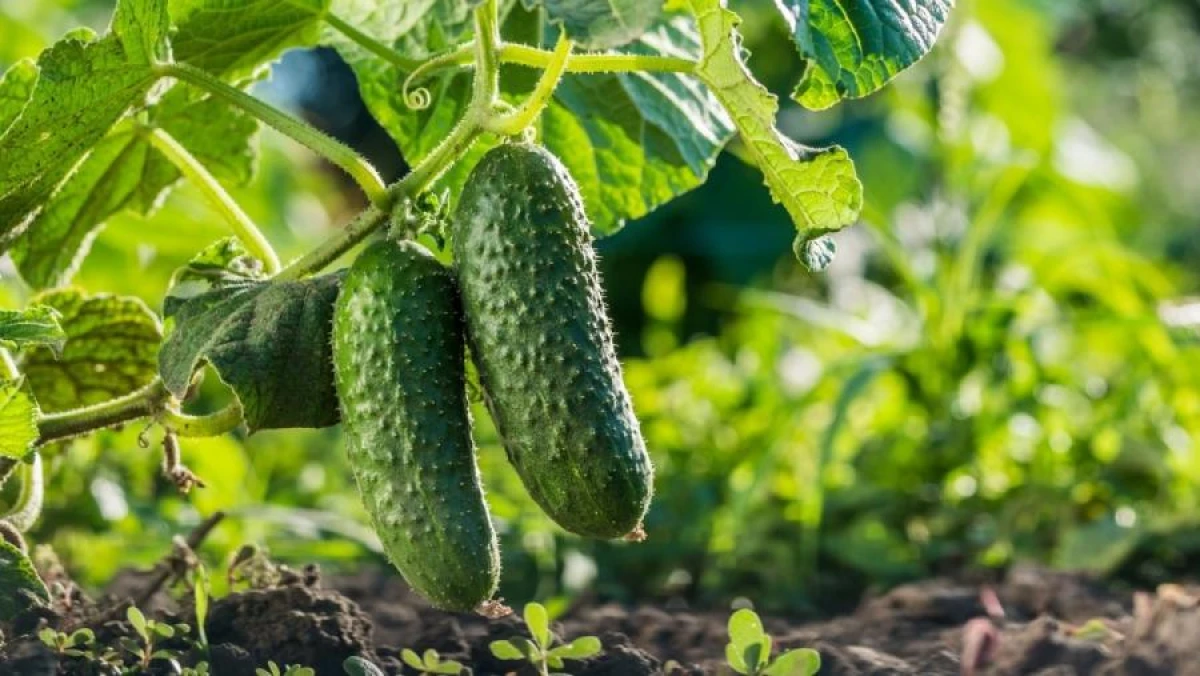
For successful cucumber planting, it is important not only to prepare the holes but also the entire bed. Cucumbers actively absorb organic matter.
Therefore, the beds for cucumbers should be carefully prepared. The holes are dug to a depth of at least 40 cm and filled with various waste, from branch trimmings to decayed straw and weeds.
To improve the decomposition of plant residues, a little ammonium nitrate can be added.
It is recommended to sprinkle a little superphosphate at the bottom of the hole. The granules of this fertilizer hardly move into the lower layers of the soil over time, and when the roots grow, they will receive the necessary support.
The prepared bed is generously watered to compact it and left for 14 days for the soil to settle.
Various fertilizers can be added to the cucumber holes, but potassium will provide the greatest benefit.
When there is a deficiency, the leaves of the cucumbers begin to dry at the edges, and the fruits may become crooked. To eliminate this problem, potassium fertilizers should be applied, preferably potassium sulfate.
Complex fertilizers containing nitrogen and other elements, such as azofoska, are also often distributed in the holes.
These compositions are convenient because their dosage is already calculated by the manufacturer, helping to avoid overdosing and nutrient deficiencies. The results from their use are stable and positive.
Additionally, it is beneficial to add urea to the planting holes.
If it is simply scattered on the surface of the bed, almost all the nitrogen will evaporate, so it is better to incorporate it deeper into the soil. This way, urea will provide all its benefits to the seedlings.
This is the most economical and effective way to apply it. However, it is important to remember that the granules should not come into contact with the young roots.
They should be spread at the bottom and covered with a five-centimeter layer of soil before planting the seedlings. Otherwise, root burns may occur.













Leave a comment