
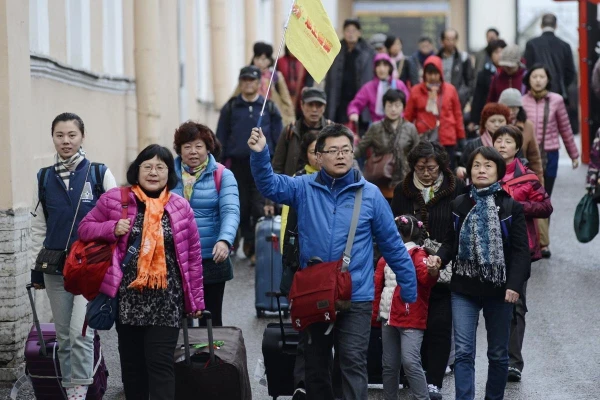
Hotel staff are already learning the language of Mao and Xi.
The cheapest visit to Petersburg, found by the media on the Chinese aggregator ctrip.com, will cost a tourist from the Middle Kingdom about 300 euros for 2 days — and this is without tickets.
This option consists only of accommodation in a hotel and breakfast, with the price indicated for several days. However, unlike the usual booking service, a detailed program for each day is provided for guests — where to go, what to see (though the tourist will have to take care of museum tickets, transportation to the suburbs, as well as lunches and dinners on their own). But they have already thought about how to spend the time. For example, in a tour for two nights and three days, recommended attractions include the Winter Palace, the Church of the Savior on Spilled Blood, St. Isaac's and Kazan Cathedrals, the Peter and Paul Fortress, as well as trips to Pushkin, to the Catherine Palace with the Catherine Park and the Amber Room.
A trip to Petersburg for five nights, including direct flights from Shanghai to Petersburg, costs 29,966 yuan for two (3500 euros) — for dates after the New Year holidays. The price includes accommodation on Ligovsky Avenue with breakfasts, a transfer from Pulkovo with a Chinese driver, and excursions with paid tickets (Hermitage, Church of the Savior on Spilled Blood, Peterhof, Catherine Palace). Thus, calculated per person, the trip will cost 167,000 rubles.
Hotels may have different pricing policies for direct sales on the hotel website and through aggregators, but there are no special prices for the Chinese market, he emphasizes. Each link in the chain receives its commission — hence the price differences. However, for example, "Yandex.Travel" raises the commission it takes from hotels but lowers the commission it takes from guests. "This undermines our pricing as well, but that’s how the market works," hotel owners lament.
TOURISM "Premium hotels receive crumbs here." Why tours to Petersburg for Chinese tourists are so expensive December 24, 2025, 20:08 16,607 88 comments "Premium hotels receive crumbs here." Why tours to Petersburg for Chinese tourists are so expensive | Source: Sergey Ermokhin / TASS Source: Sergey Ermokhin / TASS The cheapest visit to Petersburg, which "Fontanka" found on the Chinese aggregator ctrip.com, will cost a tourist from the Middle Kingdom 27,000 rubles for two days — and this is without tickets. "Fontanka" asked hotel owners why it is so expensive and how much they themselves earn from this.
An overview of the options that the Chinese site of the international platform Trip.com offers residents of the Middle Kingdom for a visit to Petersburg was previously published by "Fontanka."
It is important to emphasize that not all of them are classic tours in the literal sense of the word. Essentially, the service automatically "forms" packages by combining prices uploaded to Trip.com by the hotels themselves, the cost of flights from aviation aggregators, and sometimes adds additional services — for example, excursions.
The cheapest option consists only of accommodation in a hotel and breakfast, with the price indicated for several days. However, unlike the usual booking service, a detailed program for each day is provided for guests — where to go, what to see (though the tourist will have to take care of museum tickets, transportation to the suburbs, as well as lunches and dinners on their own). But they have already thought about how to spend the time. For example, in a tour for two nights and three days, recommended attractions include the Winter Palace, the Church of the Savior on Spilled Blood, St. Isaac's and Kazan Cathedrals, the Peter and Paul Fortress, as well as trips to Pushkin, to the Catherine Palace with the Catherine Park and the Amber Room.
The cost for two for the nearest dates and with accommodation in the Indigo or Domina hotel is 5,000 yuan. Converted per guest, it is 2,500 yuan, or 27,900 rubles, which is about 14,000 per night. For comparison: on the Indigo hotel’s own website, the price for a double room starts from 9,000 rubles, but if breakfast is added, the price rises to 10,800 rubles per night, and with free cancellation — to 12,700 rubles, making the price comparable. On the Domina website, a room with breakfast and free cancellation costs 22,300 rubles for two nights. However, when calculating the cost for two, the Chinese aggregator simply multiplies the price by two, while when booking on the hotel’s website, the surcharge will only be for additional breakfasts.
A trip to Petersburg for five nights, including direct flights from Shanghai to Petersburg, costs 29,966 yuan for two (334,000 rubles) — for dates after the New Year holidays. The price includes accommodation at the Ibis on Ligovsky with breakfasts, a transfer from Pulkovo with a Chinese driver, and excursions with paid tickets (Hermitage, Church of the Savior on Spilled Blood, Peterhof, Catherine Palace). Thus, calculated per person, the trip will cost 167,000 rubles.
According to the Ibis website, the hotel alone will cost 30,000 rubles for double occupancy (with breakfast and free cancellation). Flight tickets on aggregators can be purchased for about 80,000 rubles per person. In total, each of the traveling couple will have to pay more than 70,000 rubles for transfer and excursion services!
Why is it so expensive "Fontanka" asked premium hotels in the Northern Capital how they work with Chinese guests. The investor of the Hotel Indigo St. Petersburg Tchaikovskogo, Victoria Shamlikashvili, believes that the offers on ctrip cannot be considered a full-fledged tour, as the service simply provides the cost of accommodation that the hotels upload to booking services and sums up the payment for several days of accommodation. "It becomes a tour only when additional services are added to it," she emphasizes. Price comparisons can only be made if the comparable category of room and set of services (including free cancellation, etc.) are taken into account, Victoria Shamlikashvili emphasizes.
According to her, Russian hotels receive from Chinese tourists the price they indicated in rubles when making an offer on the booking service. "Individual tourists pay the aggregator, and we receive payment by bank transfer from their representative in Russia," explains Victoria Shamlikashvili. The price difference may also be explained by the fact that there are several exchange rates for yuan to rubles in China, and they may not match the Russian rate. Moreover, booking services may charge a commission.
The Helvetia hotel works with Chinese tourists through "Ostrovok" and "Yandex.Travel." "They are quite aggressively entering the Chinese market, allowing payment with local cards and Visa and Mastercard through their foreign representations," says its owner, Yunis Teymurkhanly. Trip.com, as an aggregator, receives prices from there and forms its ctrip packages based on this. However, such tours are a very small niche. Meanwhile, mass Chinese tourism is organized through classic tours from tour operators and through travel agents. But they work with more budget hotels.
The scale of premium Chinese tourism is still quite modest. "The Chinese market is a budget market, so premium and luxury segment hotels receive crumbs here," explains Yunis Teymurkhanly. For example, at Helvetia, after the introduction of the visa-free regime, there were only two bookings from China — but for luxury rooms. In his opinion, demand is dampened by a strong ruble and the inability for guests to pay with cards. "Those foreigners who come to us carry cash. This also scares away many," notes Yunis Teymurkhanly.
There are no problems with receiving money for bookings made through Chinese platforms. "The end consumer sees the prices on Trip.com, but in reality, he (the Chinese service — ed.) is reselling this to direct sellers who have contracts with us — 'Ostrovok' and 'Yandex', to which we upload our prices ourselves," says the entrepreneur.
Hotels may have different pricing policies for direct sales on the hotel website and through aggregators, but there are no special prices for the Chinese market, he emphasizes. Each link in the chain receives its commission — hence the price differences. However, for example, "Yandex.Travel" raises the commission it takes from hotels but lowers the commission it takes from guests. "This undermines our pricing as well, but that’s how the market works," the hotelier laments.
Premium hotels are trying to become China-friendly. "We write greetings in Chinese. I personally approach tourists because word-of-mouth works for them," says hotel manager Yunis.













Leave a comment