
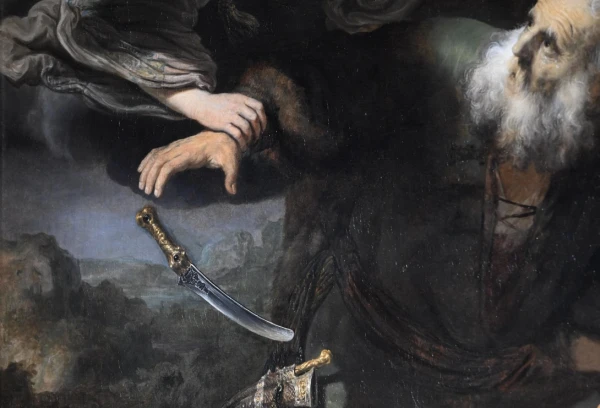
The painter was able to achieve a special expressiveness in his works.
On December 9, one of the most valuable works of Rembrandt in the Hermitage collection, "The Sacrifice of Abraham," was presented after restoration in the Apollo Hall. The painting will remain here until January 18, and on the information boards to the right of it, visitors can see photo documentation of the changes made during the restoration process and read about what was revealed to the restorer and curator and what difficulties arose. After the exhibition, the canvas will return to the main display.
The painting, nearly 400 years old (it was painted in 1635), has endured much, including restorations, the traces of which have emerged on the surface, changing tone over the years, with the edges of the craquelure rising and the varnish yellowing. As early as 1850, it was transferred from a deteriorating canvas (specifically, two canvases, as Rembrandt used two) to a new one. In the 20th century, the painting was evacuated twice during the world wars.
Victor Korobov, a top-level restorer and head of the Laboratory of Scientific Restoration of Easel Painting, confessed to journalists that this work was the most challenging for him in his 23 years at the museum.
"The most difficult stage was to uncover the monument from the layered restoration layers that had fused with the author's painting and were structurally much stronger and more durable than the painting itself," Korobov said. "It was necessary to select the methodology and restoration materials so as to remove these late mastic layers, records that covered the author, without damaging the artist's painting itself."
Unexpected revelations also emerged during the restoration.
"A challenging moment was related to the phalanx of Abraham's right thumb," the restorer continued. "Because it turned out to be not the author's painting, but a later retouch (from the 18th century), made due to loss. There was a through hole, a mastic layer, and a free addition. At the same time, it should be understood: this detail cannot be removed; it has already become one with the image, it is integrated into the author's painting. But it differed in shape, color, and tone. And this is a complex task. I spent sleepless nights figuring out how to resolve this situation because I needed to preserve this detail while also connecting it with the revealed author's painting."
As a result, the specialist treated the finger from all sides using reversible light retouching techniques so that the detail "integrated" into the image.
Irina Sokolova, the chief researcher of the Department of Western European Fine Arts and curator of Dutch painting of the 17th–18th centuries, stated: "This painting has always held a special place in the Hermitage, as does the entire collection of Rembrandt. And this is one of the most precious Rembrandts in the Hermitage. It is a signed painting, dated by the artist himself, belonging to a very interesting period of his life — one could call it the period of 'storm and stress,' because it is dated 1635, and in 1631, Rembrandt moved from Leiden to Amsterdam.
Imagine: Leiden is a university city, full of intellectuals, yet it is a city that was not central. And now Rembrandt moves to the 'trading Babylon' of Holland — Amsterdam, where vast fortunes are instantly created and at the same time people go bankrupt, where wealthy merchants play a significant role, where various congregations live, representatives of different religions, and where goods from all over the world converge. Within just a few decades, the city's population doubles. So it was a thriving center of Holland, and there were certainly many artists there.
Suddenly, a young, 29-year-old artist arrives from the province, whom no one knows (at least in Amsterdam), and within a few years, from 1631 to 1635, he manages to gain fame as the most famous painter in Amsterdam.
He begins working for Hendrick van Eijlenburgh, a well-known art dealer, in a workshop where commissioned portraits were made. He paints his first portraits — one of them is in the Hermitage, the so-called "Portrait of a Scholar" — and signs them with an early monogram consisting of three letters: R — Rembrandt, H — Harmenszoon, L — Leiden, meaning "Rembrandt of Leiden." A little later, he begins to sign his works only with the name Rembrandt, as this painting is signed. He does this in imitation of the great masters of the Italian Renaissance. And this name has forever been etched in people's memories.
This painting was created during one of the most interesting and creative periods of his life. In 1634, he marries Saskia van Eijlenburgh and gains a completely different status because she came from a patrician family, although she lost her parents at the age of 12, was an orphan, and was raised by relatives. This marriage gives him a completely different path to fame.
And in 1635, he creates several large historical paintings. In this case, Rembrandt refers to the famous story from the Old Testament — not only famous but also very cruel, because we see the climactic moment when the patriarch Abraham must prove the strength of his faith and sacrifice his beloved son Isaac.
As is known, Rembrandt was able to achieve a special expressiveness in his works and storytelling in the painting through very precisely found poses, gestures, and facial expressions of his characters. And all of this is manifested here. The three figures — the Angel, Abraham, and Isaac, whose face is not visible — are connected by gestures: the angel grabs Abraham's hand, and with the other hand, Abraham covers Isaac's face. They form a whole. And such groups are a very strong part of Rembrandt's historical works.
The restoration, which began four years ago and was carried out at the Hermitage by top-level restorer Viktor Anatolyevich Korobov, yielded remarkable results. They exceeded our initial expectations because it was very daunting to start the restoration of such a masterpiece, and first and foremost, the painting was studied on various levels. A large complex of research was analyzed, and only after that was it decided to proceed with the restoration.
Of course, the painting had been restored before and many times. Probably in the 18th century, when it was still in England in the collection of Sir Robert Walpole, and later. We know of one restoration that was carried out in 1850 at the Imperial Hermitage, conducted by Fyodor Tabuntsov, who was also a very well-known restorer at that time. He was entrusted with transferring the painting from the old canvas to the new one. This is a very difficult operation, and the results of this operation, of course, affected its condition.
Over time, restorers, regularly inspecting the condition of the painting, saw a hard craquelure with raised edges, threatening to flake off, a seam at the junction of the two parts of the canvas that became relief, color changes because pigments age, and over time the color palette changes. Finally, individual parts of the composition became poorly visible due to darkening.
We previously perceived it as almost monochromatic — it seemed very voluminous in terms of the illuminated figures. But now it turned out to be much richer, with a more complex, cooler color palette than we had assumed. Because here appears the azure — the drapery of the angel's cloak, which flies behind this figure. This is a remarkable transmission of the swiftness of the flying angel.
For the first time, it was revealed that in the depiction of hair, Rembrandt used his favorite technique, where he drew expressive lines directly across the fresh, undried layer of paint with the tip (probably, the handle of a fine brush). These lines add even greater effect of movement. If you walk through the halls of the Hermitage, you will see that both Rembrandt's students and his contemporary and friend Jan Lievens also used graphic lines in the depiction of beards or hair, and sometimes parts of clothing, to emphasize expressiveness.
The gesture is remarkable: on one hand, the angel stops Abraham, grabs him by the hand, warns him. And this gesture made a very strong impression not only on contemporaries. Even in the Hermitage, there is an English painting that uses the gesture of this angel because the artist knew "The Sacrifice of Abraham." The piece was copied just a year after its completion, in 1636: one of Rembrandt's students made a copy in the original size. It is located in Munich, in the Alte Pinakothek. In 2004, if anyone remembers, we held an exhibition where these pieces were displayed side by side.
During the restoration, other innovations were also discovered: details that were poorly visible and poorly read in the composition emerged. First of all, these are two remarkable landscapes (because these figures interact not only with each other but also with the surrounding world). Essentially, Rembrandt creates a scene that has a colossal universal, otherworldly character.
On the left, a view opens up to a panorama of some unclear mountains, plateaus — nothing like this exists in the landscape of Holland. Where does such a fantastic landscape come from, which resembles more the type of landscape from the 16th century, usually referred to in art history as Weltlandschaft, or "world landscape," where various elements and motifs are combined? It strongly resembles the landscapes of the strange Dutch artist Hercules Segers. One of his engravings is presented at the exhibition — take a close look and then you can compare. The fact is that Hercules Segers stands somewhat apart in the history of Dutch art: he is a visionary artist who had such strange, fantastic landscapes that Rembrandt greatly admired. His collection included eight works by Segers. He even completed one of them himself. This was not accidental.
On the right, first of all, a bowl with sacrificial fire has emerged. And the effect of this fire is remarkable. There you see the trunk of a tree, a huge twisted tree, with bent old branches and foliage. This is also a motif in Dutch art that is not accidental: almost all landscape painters of the early 17th century depict such an old tree, usually an oak with twisted branches, a dead oak, or with leaves, where old branches mix with new ones — this is a favorite motif of landscape painters, mannerists around 1600. Therefore, we have also included one of the engravings by the famous artist Hendrick Goltzius, whose works were well known to Rembrandt.
It should be noted that Rembrandt was a collector, and he had an amazing collection of graphics. He was well aware of the legacy of the old masters and contemporaries and often engaged in dialogues with them in his works, including in this painting.
If you look at the engraving based on the original by Peter Paul Rubens with the same subject, which is also presented to us, you will see how well Rembrandt studied this composition. And the beautiful naked body of Isaac, which here seems not only illuminated but even emits light itself — this figure is very close to the one used by Rubens. That is, the young artist, who is not yet thirty years old, declares himself as a great master who can stand on par with Peter Paul Rubens. And the painting indeed had a significant impact on Amsterdam society.
Another detail emerged, painted over by an 18th-century restorer. On Isaac's chest, a nipple had been moved to another part — where there was a loss. Everything has returned to its place.
Isaac's body lies on the wood, as is expected. According to the text of the Old Testament, Isaac carried this wood up the mountain, not knowing what would happen, and asked his father: where is the sacrifice, what is the wood for? And the father said that the Lord would provide the sacrifice. For the viewers of the 17th century, the parallel was absolutely clear that Isaac is a prefiguration of Christ. Christ carried the cross to Golgotha, and Isaac carried the wood.
Here, Rembrandt depicts an astonishing, in some modern sense, expressionistic still life in the foreground: these chaotically thrown logs with such a bluish-gray, covered with a patina structure. At the same time, the wood has glimpses of pink hues. Isaac's blue cloak and white shirt — we had not previously considered the significance and beauty of how this whole thing is conceived. It is so plastic and at the same time so grand — it is indeed a universal scene. Therefore, I will not dwell on the numerous details: the famous falling knife of Abraham — steel that shines in the air, double sheaths on Abraham's belt (the narrow second knife and its handle are visible), fur, silk tassels, golden chains on Abraham's leg — everything here is absolutely magnificent!
I am not even mentioning the psychology of the characters. Look at Abraham's head; its execution has always been highly valued, and it has always been described as particularly beautiful. Not only is this gaze full of fear and directed towards the heavens — the face is flooded with tears, one tear rolls down and gets tangled in the hair of his beard! Look at how the mouth is rendered, so mournful — one can almost feel the interrupted, heavy breathing!
Such a painterly language was unknown to European painting before Rembrandt. This opens a new page in world art.
We did not accidentally create a biographical section at the exhibition, where events from 1631, when Rembrandt arrives, to 1642, when Saskia dies, are detailed. He works a lot, he has enormous success, he buys a luxurious house where he arranges his cabinet of curiosities and workshop. He has children — and three children die. And finally, before Saskia's death, Titus is born — a boy, the only one of his children destined to reach adulthood, who also did not live long, dying at 26. So this painting inadvertently draws us to the life of the author himself.
And I believe that this piece is so profound, so stunningly beautiful, that I hope all the residents of the city, and not just the city, will rejoice and congratulate the Hermitage and be amazed by such an extraordinary, wonderful gift for the New Year.













Leave a comment