
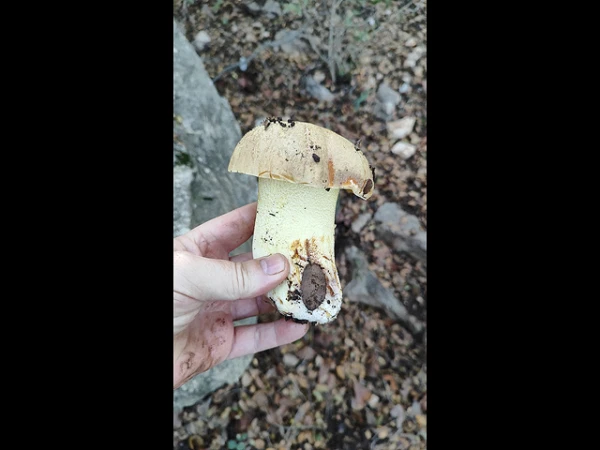
Unique representatives of the local flora have adapted to harsh conditions.
The mushroom season has begun in Israel. Mushrooms are collected in the forested areas of the north and center of the country after the rains that occurred in late November and early December.
The main mushroom of the forests of Israel is the slippery jack, or rather several species of slippery jacks: the non-ringed slippery jack (Suillus collinitus), the Mediterranean slippery jack (Suillus mediterraneensis), and Bellini's slippery jack (Suillus bellinii). The granular slippery jack (Suillus granulatus) is also likely to be found.
What distinguishes them from slippery jacks of the central region is the absence of a membranous ring under the cap. These mushrooms grow on sandy-stony soil in pine forests and like to hide among the grass and fallen needles. Typically, slippery jacks appear in groups – therefore, a mushroom picker who discovers one slippery jack should take their time to look around. Israeli slippery jacks have a slightly sweet taste. They can be pickled, used to make a stew, soup, or sauce.
In addition to slippery jacks, one can find oak mushrooms, moss mushrooms, champignons, rowan mushrooms, milk caps, undercaps, russulas, chanterelles, earthstars, and other species in the forests of Israel.
Experts note that in the forests of the Middle East, there are also inedible and poisonous mushrooms. Therefore, fans of quiet forest hunting are advised to only pick familiar, known edible mushrooms.














Leave a comment