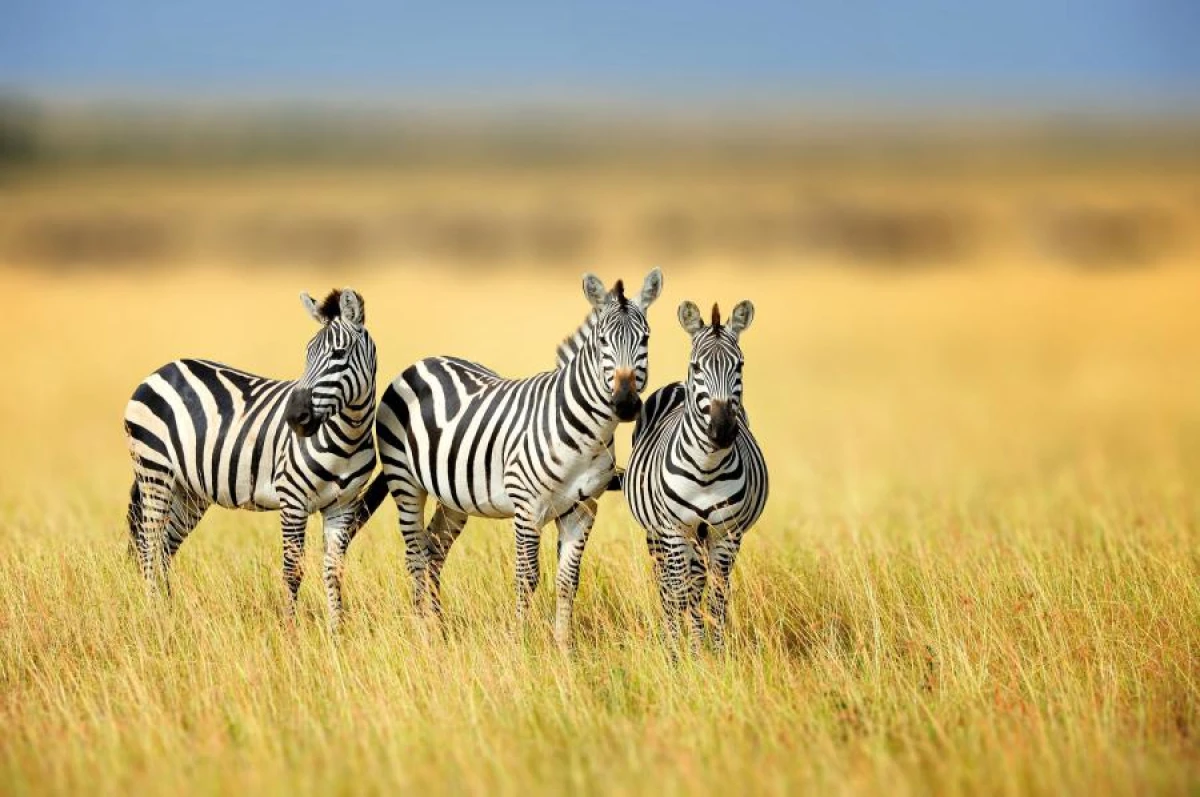
The hypothesis that the striped coat of zebras serves for their camouflage seemed quite logical and was not tested for a long time. However, when the study was eventually conducted, it turned out that this statement is incorrect. The stripes do not help zebras hide and are not a means of recognizing their kind from a distance.
In 2016, a group of scientists from the University of Calgary (Canada) conducted a series of experiments to determine how the main predators of zebras — lions and spotted hyenas — perceive their striped coats under various lighting conditions: in daylight, at dusk, and on a moonless night. The researchers modified digital images of zebras using different filters to understand how these animals are perceived by lions, hyenas, and other zebras.
The results showed that in the forest, zebras can be seen during the day from more than 50 meters away, and at dusk from 30 meters; however, predators are unable to distinguish them at such distances. In moonless night conditions, neither lions nor hyenas can recognize striped animals even from 9 meters away. At the same time, predators can easily identify their prey by smell.
Under ideal conditions, lions and hyenas can smell a zebra from a distance of up to 5–7 kilometers, but this distance can vary depending on many factors, such as humidity, wind direction, obstacles in the path of the scent, and individual characteristics of each animal.
Thus, the scientists disproved the theory that stripes help zebras camouflage in the forest by creating the illusion of gaps between tree trunks. In open terrain, predators distinguish zebras just as easily as other animals with uniform coloration.
Moreover, the experiments did not confirm the assumption that the alternating colors on the coat allow zebras to see their kind better from a distance. The scientists found that various animals, including non-striped ones, can successfully recognize members of their species.
5 Interesting Facts about Zebras
Zebras are fast and enduring runners, capable of reaching speeds of up to 65 kilometers per hour and covering significant distances throughout the day.
The coloration of each zebra is unique, like a human fingerprint.
Young zebras reach sexual maturity at about two years of age. Pregnancy lasts about 12 months, after which one or two offspring are born.
At birth, a zebra foal weighs about 30 kg, and its height at the withers is approximately 90 cm.
On average, the lifespan of a zebra in the wild is about 30–40 years.