
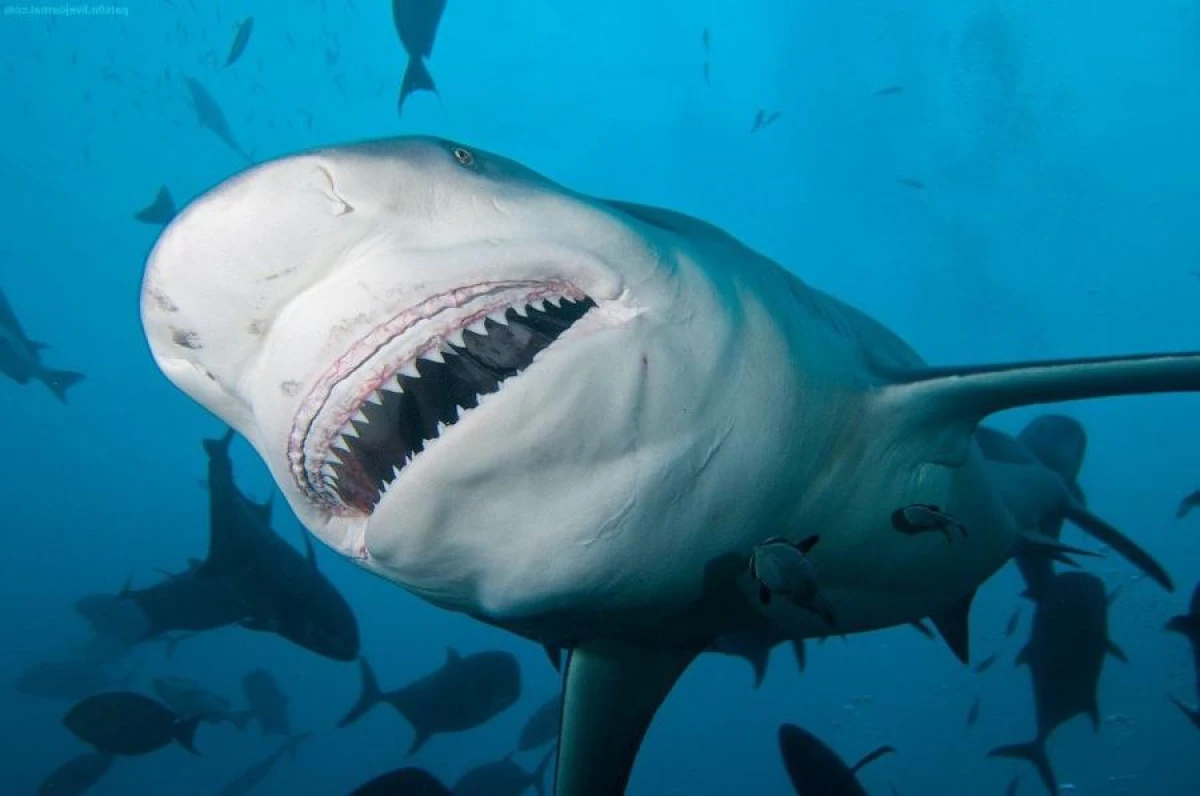
Sharks are often perceived as primitive predators whose sole purpose is to satisfy their hunger by devouring everything that moves, including unfortunate swimmers. However, in reality, their intelligence is comparable to that of cats.
The Art of Hunting: Shark Tactics
Many shark species possess impressive speed. For example, the great white shark can reach speeds of up to 40 km/h, while the tiger shark can reach up to 55 km/h. The mako shark also demonstrates similar figures, but in a sprint, it achieves a record of 70 km/h. Despite these achievements, sharks rarely employ the strategy of 'chase, catch, eat.' They prefer to act more thoughtfully to increase their chances of a successful catch.
Great white sharks, for instance, are masters of ambush hunting. They try to approach the shallows where seals or sea lions gather as stealthily as possible and wait for the moment when one of them swims too far away. Then follows a lightning-fast lunge. If the prey is too large, the shark first delivers a powerful head strike to stun the victim. The thresher shark uses a different approach: it attacks with its long tail, resembling a blade. The shortfin mako shark, or spindle shark, acts even more cunningly: it swims into a school of fish and begins to spin, creating a vortex that sucks in the prey, leaving the shark only to swallow the helpless victims.
Shark Community: Cooperation and Support
It is hard to imagine that such aggressive creatures can coexist with each other. In fact, many shark species cooperate remarkably well, especially during hunting. Predators gather in groups and exchange signals, distributing roles. Sharks communicate not only through sounds but also through threatening, warning, or greeting postures that are understood not only by their kin but also by orcas and dolphins.
Hammerhead sharks hunt in pairs: one distracts the prey while the other attacks from behind. They also consume the catch together. According to American biologist Peter Best, great white sharks sometimes drag the carcass of a dead whale from the shore to shallow waters, where they enjoy feeding on it.
Sharks can communicate not only with each other but also with humans. However, people do not understand this language, as the fish convey signals in a way familiar to them—through body movements. When an aggressive shark wants to approach a swimmer, it does not attack immediately but first warns by actively moving its body and tail. These 'bowing' gestures confirm that the shark does not view the human solely as prey. Unlike a seal, which the predator approaches stealthily and attacks swiftly without warning.
For a shark, a human is an unidentified floating object. Upon seeing a strange creature, it exhibits curiosity, which also indicates a high level of intelligence. However, if a person is injured, predatory instincts take over curiosity: a shark with an incredible sense of smell can detect 1 g of blood diluted in 600,000 liters of water. With a larger amount of blood, the detection range can increase to several kilometers. Sometimes a shark may confuse a human with a seal, and such mistakes can have serious consequences. Additionally, among sharks, as among humans, there are particularly aggressive individuals that attack without apparent reason.
Global Migrations: Shark Navigation
Everyone knows that birds cover vast distances without maps and navigators. However, few realize that sharks navigate just as well, if not better, than birds. Moreover, until recently, scientists did not notice large-scale migrations of sharks. For example, they believed that there were two subspecies of whale sharks—northern and southern—but later found out that these are the same fish moving over long distances.
Experts hypothesized that sharks undertake their remarkable journeys in search of food, following plankton (the largest fish on the planet is completely safe for humans and large animals). However, this hypothesis was not confirmed, and the reason likely lies not in hunger but in water temperature: in winter, sharks migrate to warmer waters and return in spring. This data was obtained using radio tags, which also disproved the hypothesis of shark hibernation. Another reason for the multi-kilometer migrations is the instinct to reproduce: males may follow a female for months in hopes of winning her favor or demonstrating their strength.
Learning to Hunt: Training Grounds
Although the hunting instinct is innate in sharks, young predators do not know how to hunt seals. Scientists observing sharks near Dyer Island off the coast of South Africa discovered that these waters serve as a training ground for juveniles.
Seals are abundant here, and inexperienced sharks attempt to attack but without success. However, the fish do not give up and continue their attempts until they begin to succeed. They take their mistakes into account and change their behavior each time: choosing different speeds, movements, and tactics. Sharks refine their hunting skills over many years, and ultimately, adult individuals are successful in about every second hunt on average.













Leave a comment