
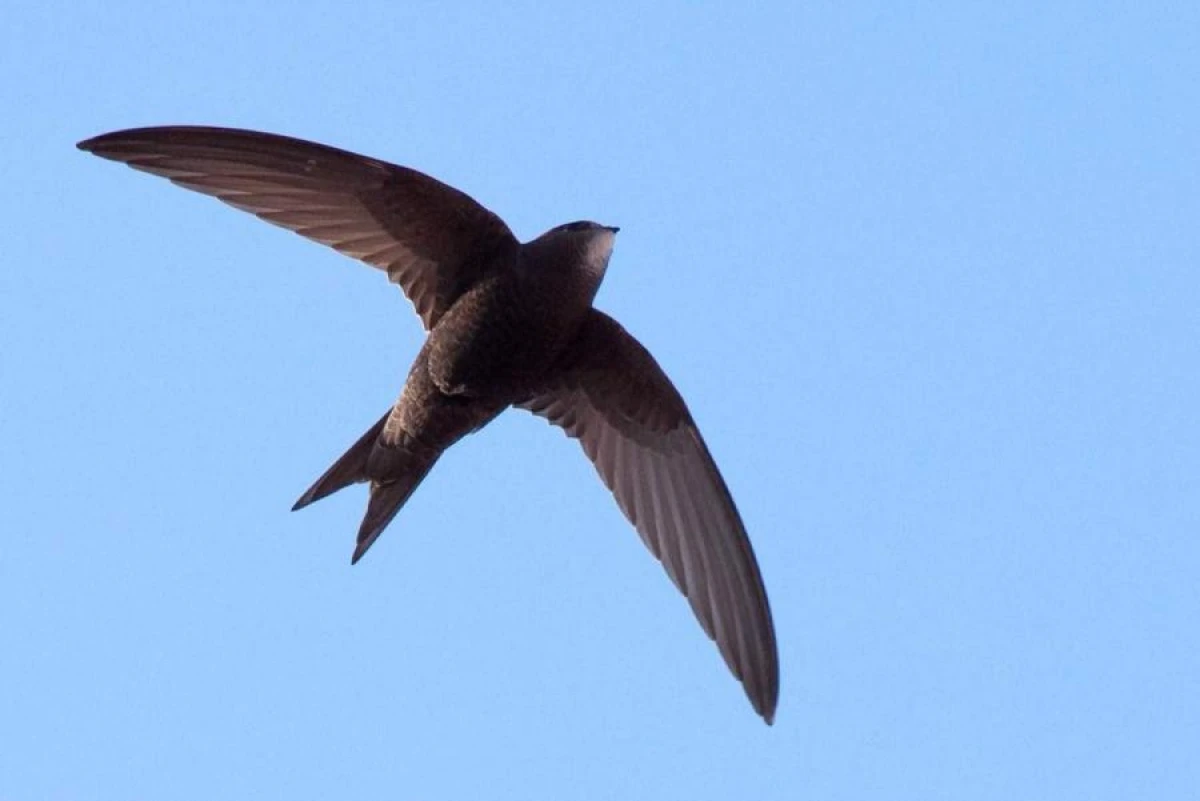
Research has shown that the migration of the northern black swift from the Rocky Mountains to the tropical forests of the Amazon depends on the level of illumination of the night sky. On dark nights, the birds fly lower, while during a full moon, they ascend to significant heights.
During full moons, trackers and sensors placed on northern swifts (Cypseloides niger Borealis) record that these birds ascend to impressive heights, sometimes reaching 5000 meters.
Scientists suggest that from such heights, swifts can dive for airborne insects, which are easier to catch in the moonlight.
When a lunar eclipse occurred during the eight-month migration of the swifts, the birds sharply descended, indicating a direct influence of moonlight on their flight altitude.
“The dynamics of flight altitude depending on the various phases of the Moon came as a complete surprise to us,” notes biologist Anders Hedenström from Lund University in Sweden. “We found that the black swift does not land at all during the eight and a half months of migration; it is constantly in the air.”
Researchers are still unsure whether this is related to moonlight or other factors. However, on dark nights, black swifts fly lower and become less active.
On darker nights, such as during the new moon, swifts typically flew at an altitude of about 700 meters above sea level.
Why does the flight altitude of the bird depend on moonlight?
It is possible that on bright nights, it is easier to avoid predators at high altitudes. Nevertheless, flying at heights of 2000 meters and above seems “excessive,” especially during long flights when energy conservation is crucial. Most likely, the ascent to great heights is related to foraging.
On darker nights, such as during the new moon, swifts typically flew at an altitude of 700 meters.
The influence of the lunar cycle on animal behavior is known as the “lunar effect,” which affects many living beings, including oysters, corals, zooplankton, sharks, seabirds, and lions.
Much of their behavior is related to moonlight, while some aspects are linked to tides.
Shark attacks, for example, increase during a full moon, although most attacks occur during the daytime. Previously, bird migration was associated with the lunar cycle, but never with altitude. European nightjars, for instance, rely on lunar signals when they begin their migration.










Leave a comment