
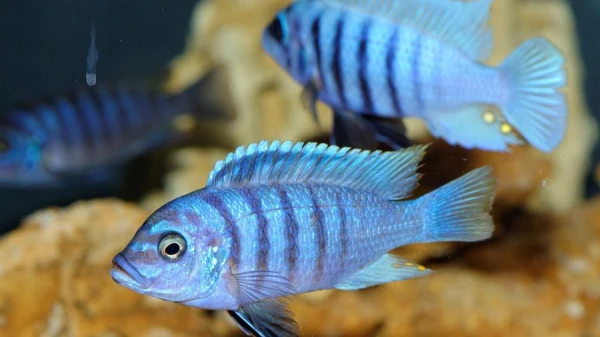
Your aquarium inhabitants may know you by face. Researchers from the University of Oxford and the University of Queensland found that mudskippers successfully recognize human faces from photographs.
Currently, there are two opposing theories about the mechanisms of face recognition in humans. The first asserts that this ability is innate and related to the features of the new cortex of the brain. The second suggests that face recognition is an acquired skill activated by neural circuits responsible for general object recognition. If animals without a new cortex can recognize faces, it calls the first theory into question. Therefore, researchers decided to train fish to remember people.
Previous similar experiments have shown positive results with pigeons. However, pigeons have lived alongside humans for a long time and may have developed specific mechanisms for recognizing human faces. For cleaner results, the researchers chose fish: firstly, they do not have a new cortex, and secondly, the ancestors of laboratory killifish likely did not encounter humans more frequently than shortly before their death. Human faces have much in common: one mouth, one nose, and two eyes. To distinguish individual features, it is necessary to accurately assess the spatial characteristics of objects. Therefore, the researchers focused on the mudskippers, which catch food by shooting jets of water at flying insects, requiring excellent vision and the ability to judge distances.
In the first experiment, the fish were shown colored images of faces, and in the second, black-and-white photographs with adjusted brightness. All images were concealed behind an oval mask to ensure that the fish recognized the features rather than just the geometric shape.
The fish were shown two images and trained to shoot a jet of water at the portrait of a specific person, testing whether the animals could distinguish facial features. As a result, all the fish learned to recognize the desired face. In the first experiment, the fish memorized 44 faces, and in the second, 18. While face recognition may seem like a complex task for humans, it is actually managed by animals with simpler nervous systems.













Leave a comment