
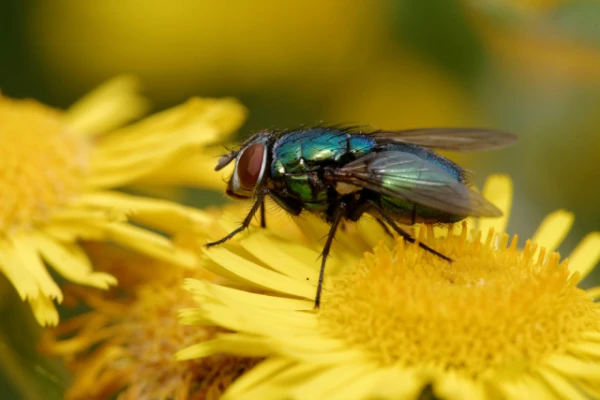
A team of physicists from the United States dedicated their research to the landing mechanism of the blue fly on the ceiling. It turned out that this process can be divided into four stages. It is characteristic of many flying insects; however, it is still not refined and requires non-trivial efforts from the creatures.
The main question that interested scientists was whether the fly flips over just before contacting the ceiling surface or does so in advance during flight.
As is known, insects are able to attach to a horizontal surface upside down thanks to special pads on their feet (pulvilli). A group of biophysicists led by Bo Chen found that the landing algorithm is constructed somewhat more complexly than previously thought.
A videograph was used for the study. The device recorded all movements of the wings, limbs, and body of the insect in detail during landing. Additionally, the visual perception of the surface by the fly and the mechanism for estimating the approximate time until contact with the ceiling were analyzed.
According to the scientists, the parameters of speed, body rotation angles, and wingbeat frequency turned out to be sporadic and not always effective. A number of patterns were also identified during movement. For instance, the lower the vertical speed and the higher the horizontal speed during landing, the less the insect needs to flip over. For example, if the insect "slows down" at 0.5 m/s, it only needs to turn 90 degrees instead of completely.
The scientists motivated the research by the potential benefits of the information obtained for further developments in the field of robotics.











Leave a comment