
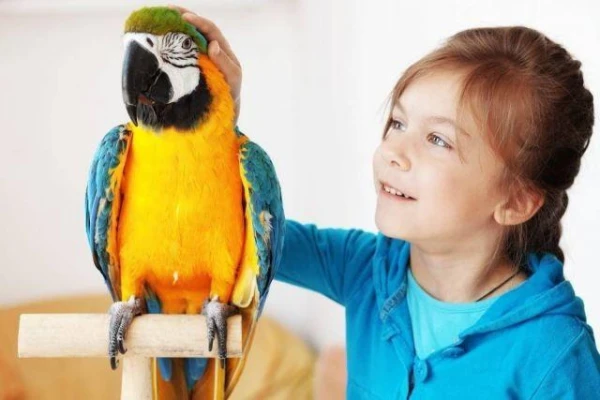
If you have never had birds before, it is worth paying attention to species that people have domesticated for centuries. These are canaries and budgerigars. They are easy to train, playful, and friendly.
The larger the bird, the more difficult it is to raise it. Inexperienced owners of African grey parrots, macaws, cockatoos, and other large parrots often encounter numerous problems. Due to improper care and upbringing, such pets can become aggressive and unmanageable. Birds prone to neuroses may even pluck their own feathers, which looks extremely unpleasant.
Coexisting with a bird that has a spoiled character and a frightening appearance can be extremely challenging. To avoid such a situation, it is better to 'practice' with smaller birds. In this case, it is useful to consult professionals who can help understand the behavioral traits of feathered friends.
A Cozy Home for the Bird
A cage is primarily a home for the bird, and only then an element of decor. For example, beautiful spherical cages may turn out to be inconvenient for birds. The simpler the shape (ideally a cube), the better. The cage should be made of eco-friendly, non-toxic materials. It should be placed so that several perches are at eye level of a standing person. If the cage is lower than this level, the bird will grow timid and withdrawn, while if it is higher, it will start to 'assert its rights' and display aggression. The hormonal cycle of birds is directly influenced by sunlight, so it is important for the pet to receive enough natural light. At the same time, there should be a shaded corner in the cage where the bird can hide from the heat.
Large birds in captivity can live longer than humans. For example, some sources mention that Churchill's beloved parrot lived to be 100 years old, and this happened in the 21st century. In contrast, the lifespan of miniature birds in the most favorable conditions is only 15-20 years.
Even 'simple' representatives of the parrot family require constant attention and interaction — in the absence of a flock, feathered friends need a constant companion and friend. In this case, the owner replaces their kind.
IN THEME
'Absolutely all parrots can talk, regardless of breed. And not just parrots — our starlings and crows learn the art of chatter just as well as African greys!' shares the opinion of ornithologist Nikolai ZHUKOV. 'Birds repeat phrases and intonations of their owners. The level of their conversational skills depends only on the time spent with them by the owner.'
However, there is a gradation in conversational abilities. Leading this list are African greys — their vocabulary can contain up to two thousand words and phrases. Blue-fronted and yellow-fronted Amazons can compete in conversation, although their vocabulary is slightly smaller, but their temperament is easier. Amazons are more affectionate, adapt more easily to new conditions, and are less sensitive. According to statistics, 60 out of 100 African greys or Amazons eventually start to mimic human speech.
Budgerigars also learn easily, but their speech is usually understood only by the owner — these birds do not express themselves very articulately.
On the other hand, the largest and most beautiful parrots, such as macaws and cockatoos, rarely talk (about 10 out of 100 individuals).











Leave a comment