Among the many shades that can be observed in minerals, plants and flowers, as well as in the fur, feathers, scales, and skin of animals, blue is surprisingly rare. Why is this happening? Is this color discriminated against, even though it is no different from others? Or are there indeed differences?
Blue animals and plants are extremely rare in nature. The survival of such species is possible only due to their conspicuousness, as it is difficult for nature to create pigments of this color or to form nanostructures for its reproduction.
When you admire the blue sky or the boundless ocean, it may seem that blue is widespread in nature. However, how often do you encounter blue animals, aside from rare cases? In fact, they are indeed much less common than others. Why is that?
We perceive color thanks to the presence of 6 to 7 million light-sensitive cells in each eye, known as cones. A person with normal color vision has three types of cones, each of which responds to a specific range of light wavelengths — red, green, or blue. Information from millions of cones is transmitted to the brain in the form of electrical signals, which then interprets them as different shades.
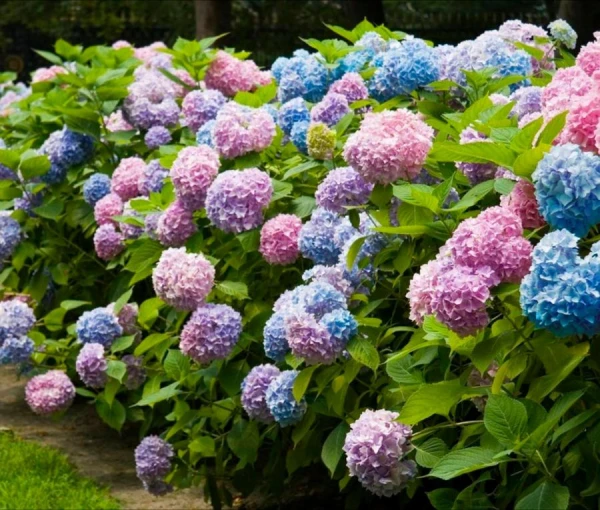
When we look at bright objects, such as a sparkling sapphire or a rich hydrangea flower, the object absorbs part of the white light falling on it, and the reflected light turns out to be different from the incoming light — the “remainder” of the light waves not absorbed by the object enters the eye. In the visible spectrum, red light has longer wavelengths, which means it has lower energy compared to other colors. In contrast, for an object to appear blue, it must produce molecules capable of absorbing minimal energy, “taking” the red part of the spectrum.
It is difficult for plants to create such molecules, as they are large and complex, which is why blue flowers make up less than 10% of nearly 300,000 species of flowering plants on the planet. One of the factors contributing to the emergence of blue flowers is that blue is well perceived by pollinators, such as bees, which aids their evolutionary success. However, for plants or minerals to produce blue pigments or create blue color through special nanostructures, nature needs to exert more effort than usual, as such structures are quite complex.