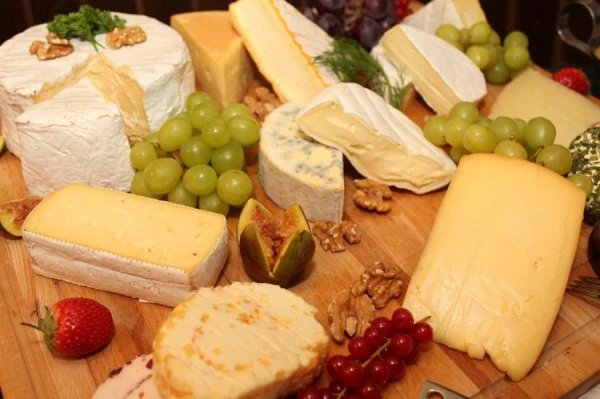
On New Year's tables, in addition to familiar dishes, one can also find less common products, such as mold cheeses.
Many people are wary of mold cheeses, fearing potential risks. However, according to microbiologist Heather Hallen-Adams from the University of Nebraska, when it comes to cheeses specifically made according to certain recipes, they are completely safe for health.
Among the many types of mold that exist in nature, most are harmful. The toxic substances they release can enter the body not only through the respiratory tract but also through the skin. Mold fungi can cause various serious diseases, including asthma, pneumonia, sinusitis, and digestive disorders.
Nevertheless, there is also harmless mold that is used to produce certain types of cheese. Some of these have blue mold, while others have white mold. Blue mold cheeses include Roquefort, Dorblu, Stilton, and Gorgonzola, while white mold cheeses include Brie and Camembert.
In the production of blue cheeses, a special mold is used, the spores of which are mixed with the curd. During the maturation process of the cheese mass, the fungi multiply, forming characteristic blue-green veins.
Cheeses with white mold are created naturally. In their formation, a special type of mold is used that covers the outer layer of the cheese with a specific bloom.
In an article published in Live Science, the microbiologist noted that safe types of mold cheese were developed as a result of numerous experiments. It was only in the 18th-19th centuries that the production of cheeses like Camembert began, following carefully crafted recipes that use food mold that does not release toxic substances.