

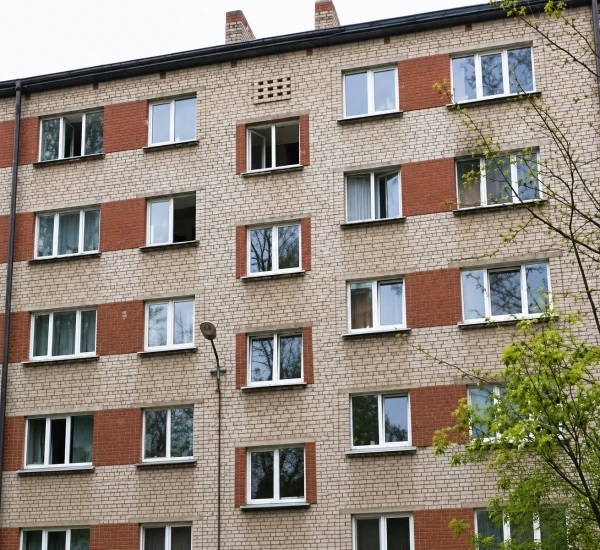
Vlad fell out of the window of the apartment on the seventh floor that he rented.
In the last five years, Russian courts have issued 52 sentences in cases of "setup dates" — a practice where perpetrators lure LGBTQ individuals to a meeting under the guise of dating, only to beat, rob, or blackmail them instead.
The motives for such attacks can vary: some pursue purely economic gain, others act out of religious beliefs, and some imitate the activities of neo-Nazi Maxim Martinkevich, organizing a "pedophile hunt." Victims often fear going to the police, where victims are frequently denied the initiation of a case, turning a blind eye to the crime, as reported by the journalists of "Vyorstka."
Vlad is 21. He lives in St. Petersburg, works as an accountant in a small firm, and is interested in learning languages.
On the evening of July 4, 2025, Vlad is looking for a guy for a one-night stand — tomorrow is a day off and he doesn’t need to get up early for work. "I’ll invite, with a place. Uni-pass, 21 years old," he writes in a themed dating channel on Telegram.
He starts chatting with a man, but the meeting falls through. Vlad finds another partner. "Some random guy was supposed to come over to have sex, but he didn’t show up. I’m waiting for another one — if this one doesn’t come, I’ll go to a men’s monastery," the guy jokes in a chat with a friend.
At two in the morning, Vlad calls his mother several times, who lives outside the city. She doesn’t see the missed calls right away and plans to call back in the morning. Vlad also calls friends and colleagues from work — he asks two of them for a loan of 15,000 rubles. They refuse, considering the request strange.
About half an hour later, Vlad falls out of the window of the apartment on the seventh floor that he rented. He dies in the hospital from his injuries — doctors diagnose death at four in the morning. Before dying, he tells the doctors: "I saw him."
Friends and his mother are convinced that Vlad's death is not an accident. They believe he was killed during a "setup date" — a practice that has victimized dozens of members of the LGBTQ+ community in modern Russia.
"They knocked the victim to the ground, tied his legs with a belt, and pulled down his pants, restricting his movement. After that, the defendant grabbed him by the hair and began to deliver multiple punches to the face. Then they decided to record a video where the victim was supposed to say that he was no longer gay."
"I thought it would be a good idea to teach the victim a lesson so that he would no longer have the desire to come to the territory of the Karachay-Cherkess Republic. He can only explain his actions by the unpleasant and immoral behavior of the victim."
"They began to make claims against the victim, as this direction of sexual minorities is not welcomed at the state level, and even their President has repeatedly stated that there will never be an LGBTQ+ movement in Russia and that family values must be protected."
The quotes above are from court sentences regarding crimes committed during "setup dates," which were studied by "Vyorstka." From January 1, 2021, to January 1, 2026, Russian courts published 52 sentences in cases related to this practice. The majority of such sentences were issued in 2021 and 2023 — 13 and 12 sentences, respectively.
A report by the LGBTQ+ group "Vyhod" and the "Sphere" foundation for 2024 describes the most common scheme of "setup dates": "through a dating app, a person invites the victim on a date, during which criminals arrive, sometimes posing as police or journalists, and extort money from the victim, blackmailing them with the threat of releasing video recordings, physical violence, or calling the police." In the sentences analyzed by "Vyorstka," the perpetrators met their victims in the Hornet app or the dating bot "DaiVinchik."
Criminal cases were predominantly initiated under articles 161 "Robbery," 162 "Robbery with Violence," and 163 "Extortion." There are also cases related to kidnapping, intentional bodily harm, and hooliganism in the list of "setup date" cases.
The report by the LGBTQ+ group "Vyhod" notes that in 2025, there was a "transformation of the setup date practice": "In cases where the goal of the perpetrators is extortion, the schemes have largely "moved" to the online environment."
This is linked to the "expansion of the range of threats used to pressure victims" and "the lack of response from law enforcement agencies to such crimes committed in the digital space."
At the same time, offline dates have not disappeared. According to the NVMP project, which monitors ultraright violence in Russia, from January 2023 to February 2026, at least 63 videos appeared online, filmed during offline "setup dates." The peak occurred in December 2025 — at that time, project analysts recorded 10 video recordings of violence during "setup dates."
Criminals who committed crimes offline continue to be prosecuted by law: in 2025, at least 8 sentences were issued in criminal cases initiated against the organizers of such dates, and another sentence was issued in January 2026.






Leave a comment