
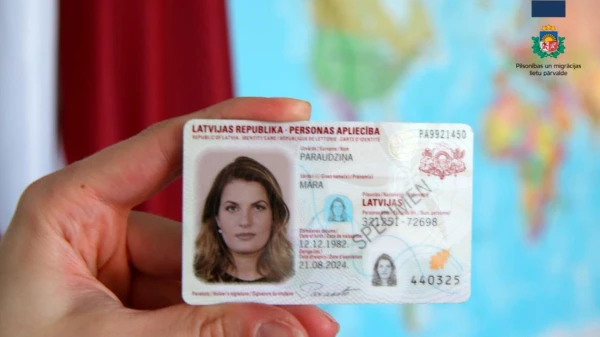
It is expected that as early as June of this year, approximately 400,000 issued ID cards in Latvia will no longer have the possibility to extend the qualified electronic signature certificate, reports Latvian Television.
What happened? The ID cards issued in Latvia between 2019 and 2021 contain a microchip, the support for which was discontinued by the manufacturer in the summer of 2022. The manufacturer officially stated that it would no longer certify it.
To maintain the status of a qualified electronic signature creation device (QSCD), such cards must undergo re-certification in June of this year. However, due to the microchip used, this is likely to be impossible.
"The problem is more related to the microchip than to the electronic signature certificates themselves. It is now necessary to work on several fronts at once. Firstly, the manufacturer is trying to undergo re-certification in its country — France. The second direction is national regulation that would allow the continued use of these ID cards," explained Karlis Silinsh, director of the commercial department of the Latvian State Radio and Television Centre (LVRTC).
Most of the ID cards regarding which there are doubts about further certification of electronic signatures were issued to citizens of Latvia between 2019 and 2022 — this is more than 355,000 cards, as well as 25,760 cards to non-citizens. The remaining cards continued to be issued until 2025 to citizens of the European Union, foreigners, and holders of residence permits.
According to LVRTC, about 130,000 cardholders actively use the electronic signature embedded in them.
Validity of ID cards
ID cards for adult citizens are valid for 10 years. Previously, institutions assumed that the status of the qualified electronic signature creation device would remain valid until 2028, that is, ten years from the date of initial certification, as was stipulated by the regulations at that time.
Now, the reason for the problem is attributed to changes in the regulation of the European digital identity: starting from May 2024, the certification period will be only 5 years.
Despite the active use of electronic signatures in Latvia and the long validity period of the issued cards, the country did not request a transitional period or special conditions when implementing the regulation and does not plan to do so now.
Revocation of ID cards is not considered a realistic option
A month and a half ago, in early February, the Office of Citizenship and Migration Affairs reached out to other agencies for advice on how to prepare for a possible development of the situation.
Mass revocation and replacement of ID cards are not considered a realistic option, as there would not be enough resources for this, including blanks for the cards. If the replacement were to be conducted for free, the losses for the agency would amount to about 11 million euros.
Given the seriousness of the potential problem and its impact on the entire digital environment, an emergency meeting of the Digital Security Oversight Commission, operating under the Ministry of Defense, took place last week.
Possible changes in legislation
The Office of Citizenship and Migration Affairs (OCMA) has already prepared amendments that will allow ID cards to be considered valid as identification documents, even if the embedded electronic signature certificates lose their validity.
In addition, the agency hopes to resolve the issue of using electronic signatures by legally establishing that such cards can still be used for signing documents.
According to OCMA's calculations, the full life cycle of ID cards — from ordering to expiration — is about 16 years. Due to the rapid development of the digital environment, the possibility of shortening the validity period of the cards to five years instead of ten is already being discussed.














Leave a comment