
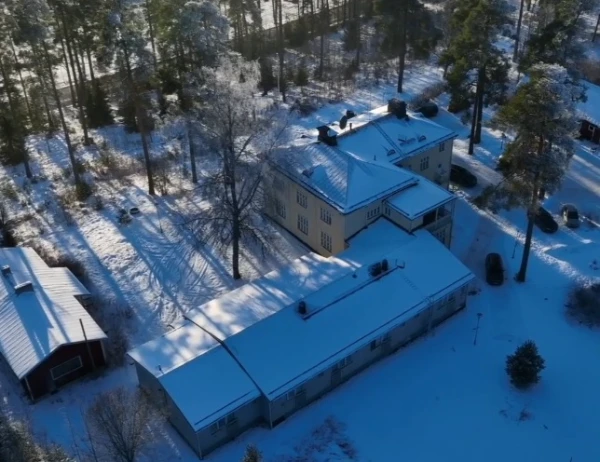
Drugs, crime, and violence are increasingly becoming part of the lives of minors.
The government plans to create a new type of closed institution for juvenile offenders in Finland. These will be intended for teenagers who have committed serious acts of violence or other serious crimes.
It is planned that the duration of stay in such an institution will be indefinite, and leaving it will not be allowed even for attending school.
Child protection specialists acknowledge that there is a need for such institutions. Pasi Turki, a caregiver at Villa Junior in Hämeenkyro, has observed over three decades how youth are becoming increasingly violent. Villa Junior houses children and teenagers who find it difficult to be placed in foster families.
"Before coming here, many children have already been in ten different placements," Turki says.
Drugs, crime, and violence are increasingly becoming part of the lives of minors in such institutions. According to Turki, there is a group of minors in Finland for whom it is impossible to find a place that can help them.
Issues with Basic Rights
In the new type of closed institution, the freedom of movement of minors and other basic rights will be severely restricted. Leaving the institution will not be allowed even for attending school, as education will be organized on-site. Contacts between children and the outside world will also be limited, and they will not be allowed to use their own phones.
A specialist from the THL (National Institute for Health and Welfare), Janna Tervo, believes that the government’s plan to create such institutions may raise issues related to basic human rights.
"The line between imprisonment and a closed institution for children is very thin. Of course, there should be strong interdisciplinary support and rehabilitation measures in such an establishment," Tervo notes.
THL criticizes the new model of the institution especially because minors are planned to be placed there indefinitely without the right to appeal.
"Assessing the necessity of placement is certainly important, but from the perspective of basic rights, this is not enough. The decision should be subject to appeal so that a court can verify whether there are grounds for placing a child in the institution," emphasizes Tervo.
The second issue concerns the age of the children who will be placed in such institutions. The default age threshold will be 12 years, but children younger than that may be admitted for 'special reasons.'
"We know that even a child under 12 can commit a crime. According to THL, such children can be helped in other ways, not just by locking them up in an institution," Tervo notes.
No Evidence of Preventive or Rehabilitation Effect
Currently, closed institutions for minors with restrictions, video surveillance, and fencing exist in Denmark and Sweden. According to THL professor Taina Laajasalo, there is no scientific data that such institutions effectively prevent crime or contribute to rehabilitation.
Children who lived in such institutions have been surveyed, and their experiences were mostly negative. They cited issues such as social isolation and limited visits with parents.
"We should think about how to provide opportunities for positive friendships and maintaining family ties," Laajasalo reminds.
One of the risks of closed institutions is institutionalization. If a child spends several years there, returning to normal life may become difficult. In the worst case, this vicious cycle may continue with a transition from a closed institution to prison.
According to plans, at least one of the current five state special educational institutions will begin to provide closed-type services. An allocation of 2.5 million euros has been set aside for the organization. The opening timeline for the new institution has not yet been determined.










Leave a comment