
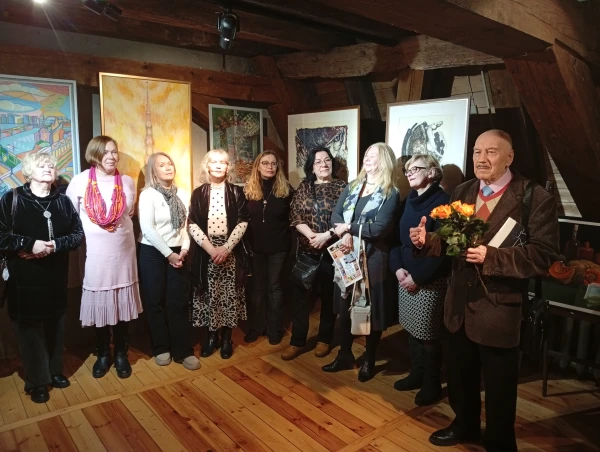
On the fourth floor of the historic Mencendorfs House (Old Riga, corner of Kungu and Grecinieku streets), a representative exhibition dedicated to the 35th anniversary of the Baltic Belarusian Artists' Union 'Maju Gonar' ('I Have Honor') has opened.
As the head of the union, artist Vyachka (Vyacheslav) Teleš, who at 86 years old is actively painting, explained, this organization was formed during the barricades in Riga in January 1991.
From Russia to the USA
Vyachka Teleš, among other things, is also one of the founders of the Belarusian school in Riga, a teacher, art historian, local historian, philocartist (collector of artistic postcards), public figure, and a member of the Artists' Unions of Belarus and Latvia. He was born in the village of Krasnoselsky, where his first works appeared. He has lived in Latvia since 1958.
In 1961, he studied at an art studio, and from 1961 to 1964, he served in the army in Vilnius, where he simultaneously attended the art studio of the Palace of Railway Workers.
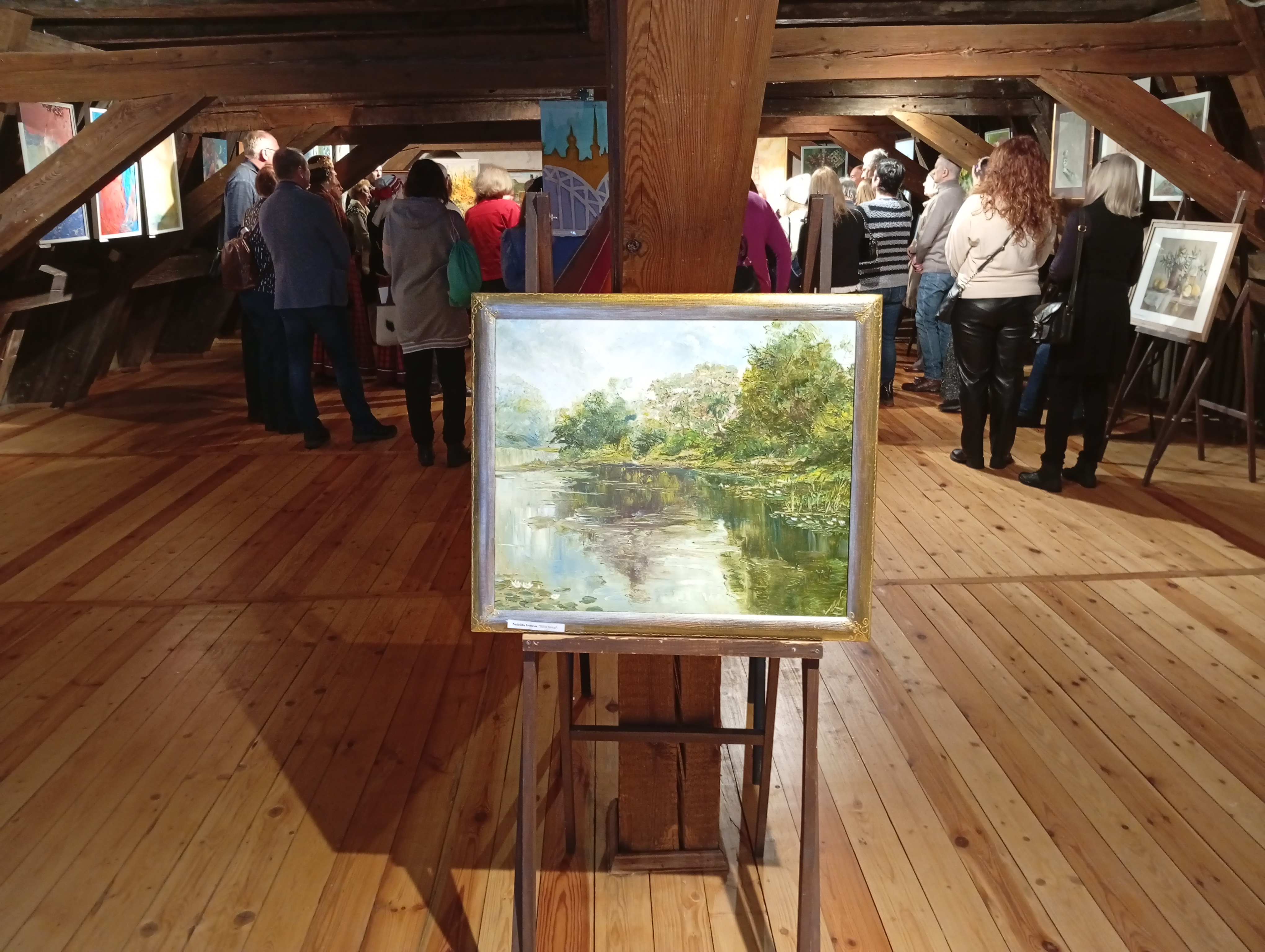
Photo: Andrey Shavrey.
In 1975, he graduated from the painting and pedagogy department of the Latvian State Academy of Arts named after T. Zalkalns (now the Latvian Academy of Arts). The artist has participated in over a hundred exhibitions, both in Latvia and Belarus, as well as abroad (including nearly thirty solo exhibitions). Teleš's paintings are in museums and private collections in Latvia, Belarus, Russia, Israel, Romania, the Czech Republic, France, China, Denmark, Portugal, Switzerland, Canada, and the USA.
Attitude Towards the State
"For every artist, an exhibition is a celebration; he prepares to show what he does," said Mr. Teleš. "And this celebration is very significant because 35 years ago, on January 12, 1991, our Baltic-Belarusian union 'Maju Gonar' was formed. This was the time of the January barricades when Latvia was fighting for its independence, and Belarusians did not remain on the sidelines. We, Belarusians, present our art, our culture, and, like Latvians and representatives of other nationalities, show our attitude towards the state."
The artist recalled how the idea of organizing the society came about. Just a year before its establishment, they celebrated the five-hundredth anniversary of the outstanding philosopher Francysk Skaryna. There was a trip of a representative diaspora of Belarusians from Latvia and other countries where representatives of this nationality live throughout Belarus - Minsk, Polotsk, where Skaryna was born.
"And there I met two Belarusian artists, one of whom was from Leningrad, and there were representatives from Estonia (Margarita Ostruumova). We already had a society of Belarusian culture 'Svitank' ('Dawn'), which had been operating since 1988, but the idea arose to create something similar on an international level.
And my colleagues agreed with my idea, and we arranged that on January 12 of the following year, they would come to my studio in Riga. We had no idea how dangerous and anxious this time would be. The time of barricades. My studio was at Brivibas, 60, where the 'Latvia' hotel is located, and there were barricades with numerous vehicles," recalls Teleš.
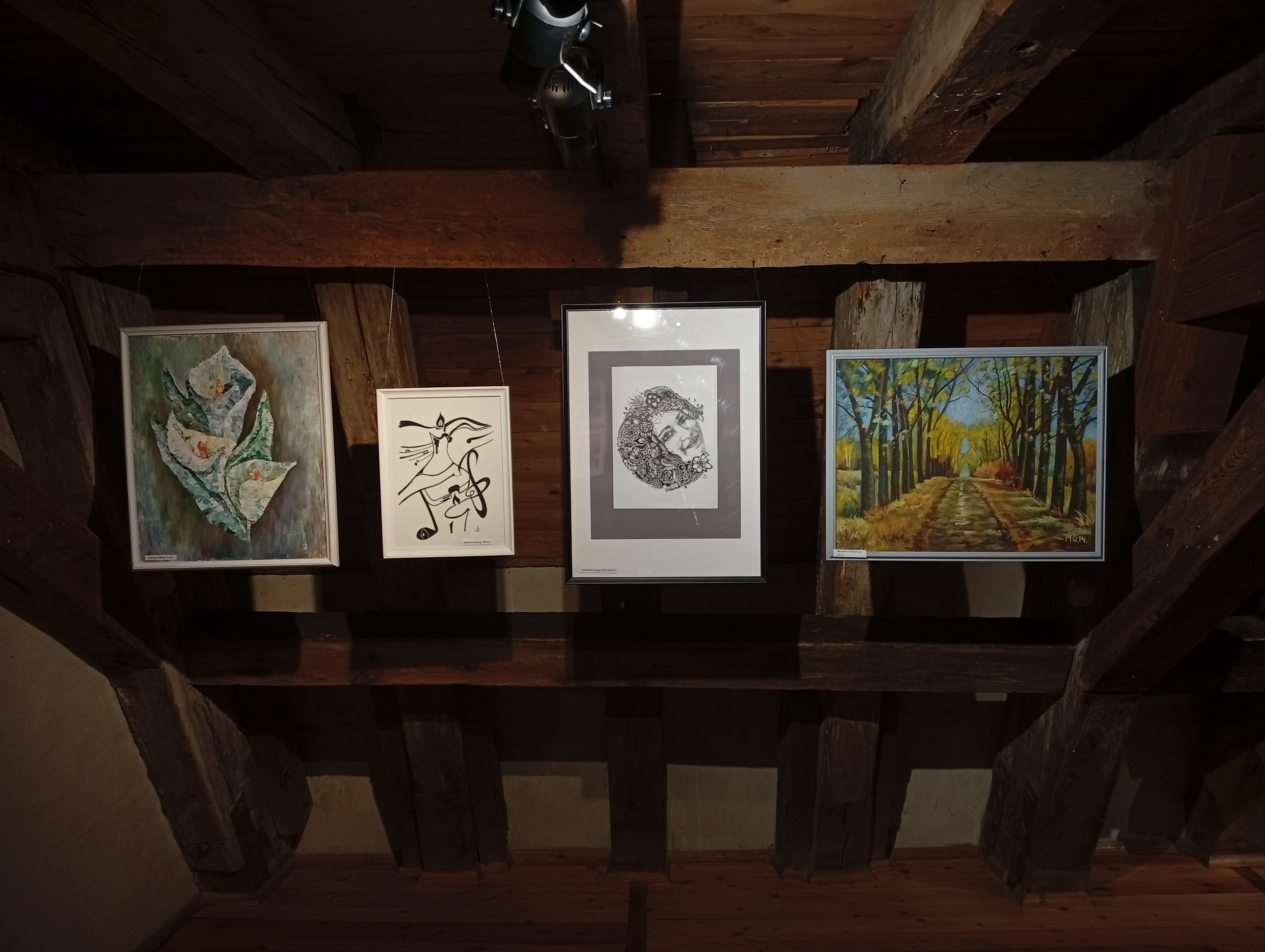
Photo: Andrey Shavrey.
They Were Everywhere in Latvia
On that day, Oleha Blazheya and Kristina Balakhovisha from Lithuania could not come; they were helping Lithuanians who were defending their television center. But they called and said they agreed with the idea of creating the society and decided to become its members.
"Later, artists from Sweden joined us. Our exhibitions were not only in Latvia but also in Minsk, as well as in Lithuania and Estonia, and in the Czech Republic. And in Latvia, we were almost everywhere - Daugavpils, Rezekne, Balvi, Limbazi, Jurmala, Ludza, Bauska, Varakļāni, Vīlāni, Jelgava, and other cities and museums.
Some of the founders of the society are no longer with us, and we would like to honor their memory with a moment of silence. We are happy to introduce our works to the public; we are glad that we help Latvia and integrate our culture. Thank you to the state, as well as to the director of the Mencendorfs House, Ilona Audere, the director of this charming place, such a beautiful museum, where we have exhibited before," says Teleš.
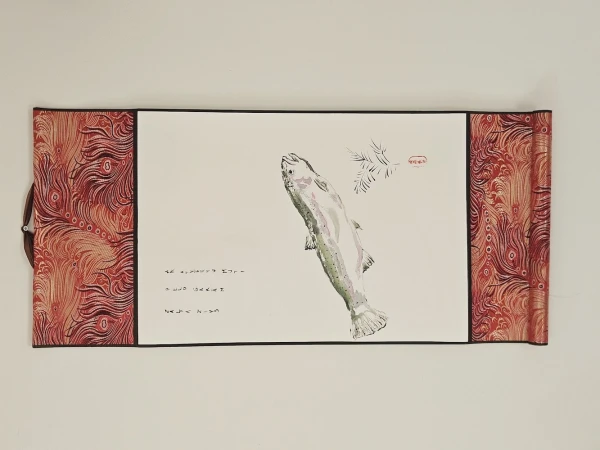
The exhibition features works by eighteen artists – Inga Vasilieva, Anna Peipina, Tamara Zhitkevich, Irina Yatnova, Nadezhda Izenova, Galina Zhelabovskaya, Leon Zhukovsky, Olga Yakubovskaya, Irina Trumpel, Irina Koroli, Valery Valukh, Nastassia Arais, Ekaterina Osberga, Vasily Malyshyets, Elena Lavrinovich, Larisa Loiko, Vyacheslav Teleš, Margarita Ostruumova – totaling over fifty works of art – paintings, watercolors, pastels, lithographs, artistic photographs, and works created in other techniques.
23 Artists
Since 2012, the Baltic-Belarusian Artists' Union 'Maju Gonar' has been registered in Riga as a separate creative organization. Currently, it unites 23 artists from Estonia, Lithuania, and Latvia. The artists' union regularly participates in joint exhibitions of national minority artists, which are organized annually by the Association of Latvian National Cultural Societies named after Itta Kozakevich.
Solo exhibitions of artists from the 'Maju Gonar' union have taken place in Latvia, Belarus, Lithuania, Estonia, Russia, Finland, France, Canada, and the USA.
Open until February 28.











Leave a comment