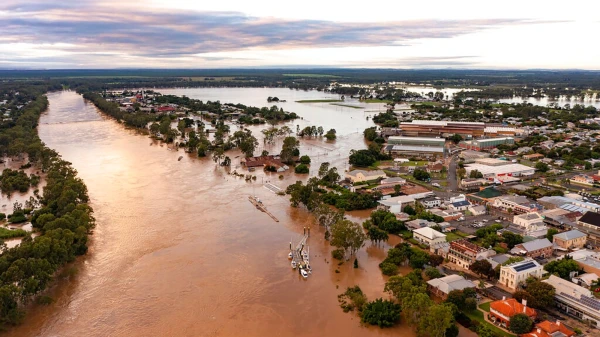
Although climate models diverge in details, they all point to one common trend.
As the problem of global warming worsens, abnormal precipitation leading to severe consequences will occur more frequently. And although they will affect regions unevenly, some countries will still have to prepare for 'extreme' downpours, according to a study published in the journal Nature Geoscience.
According to scientists, as global temperatures rise, more water evaporates from the surface of the oceans into the atmosphere, fueling clouds and leading to heavy precipitation. In this regard, some regions will face regular torrential rains, while others will experience moderate changes, and some may even become drier overall.
American scientists have developed climate models to more accurately predict where and how such powerful weather systems may develop. And their findings are difficult to describe as optimistic.
"Under a high carbon emissions scenario, daily extreme precipitation over land could increase by about 41% by 2100," the researchers say. In simpler terms, downpours capable of causing flooding could occur nearly twice as often by the end of the century.
According to the researchers' calculations, countries located in the Southern Hemisphere will predominantly face a sharp increase in 'extreme' precipitation. Scientists emphasize that while 41% is a global average, regional impacts will vary significantly. Although climate models diverge in details, they all point to one common trend: countries in South America, Southeast Asia, Central Africa, and northern Australia will be the least fortunate.
In the United States, a significant increase is expected in the southeast and along the eastern coast up to eastern Canada.
Europe, on the other hand, is not currently threatened by sharp changes in precipitation patterns. The region deemed the 'calmest' in this regard is France. However, some forecasts indicate slightly more intense rains in the southeast of the country, particularly in the Mediterranean coastal area.
In other regions—Arctic, Canada, Russia, and Scandinavian countries—relative stability is generally expected, with only minor changes.