
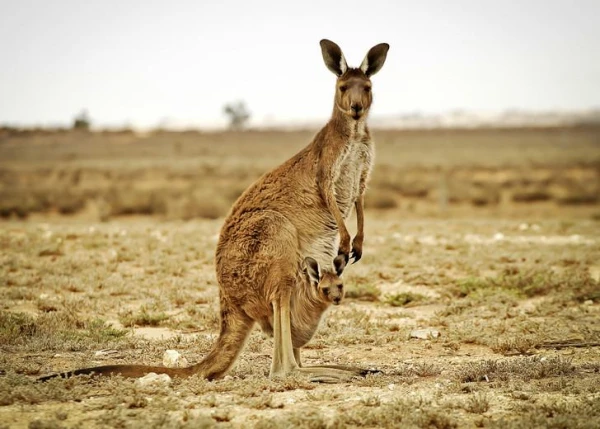
Marsupial mammals and placental mammals are different branches of the evolutionary tree, not ancestors of each other.
Humans, like most mammals, belong to the group of placental mammals. We have a highly developed placenta that provides the fetus with everything it needs and removes waste from its metabolism. Therefore, the offspring of placental mammals are born relatively developed.
Marsupials, on the other hand, do not have a fully developed placenta, which forces them to give birth to offspring that are essentially premature, and then carry them in a pouch.
Marsupials are not the ancestors of placentals; they represent, so to speak, a parallel branch. About 90 million years ago, live-bearing mammals split into two groups: marsupials and true beasts (eutherians), which include placentals.
The further evolution of each of these groups took its own path. Placental mammals turned out to be more adapted and displaced their competitors almost everywhere, except for isolated continents such as Australia and South America.
About 3–4 million years ago, the Isthmus of Panama formed, and placental mammals flooded into South America, displacing almost all local marsupials. Only a few species, such as the opossum, managed to withstand the competition. Thus, the only place where marsupials remained dominant became Australia.








Leave a comment