
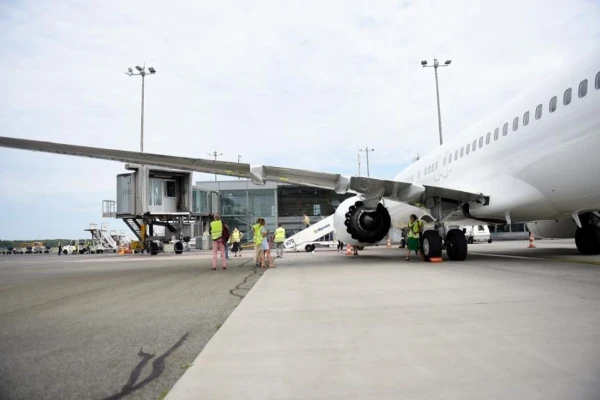
Fuel supplies for operational needs at Riga Airport are currently stable, the airport reported to the LETA agency.
The airport noted that it is in constant contact with both fuel suppliers — Gulfstream Oil LLC and Rixjet Riga LLC, considering the impact of geopolitical events on global energy resource supplies.
According to the suppliers' information, fuel supplies are currently stable, and the forecasted supply volumes for the coming months are sufficient to ensure fuel deliveries in accordance with the flight schedule, current consumption, and signed contracts, the airport emphasized.
Meanwhile, representatives of the Latvian national airline airBaltic informed the LETA agency that, considering the sharp rise in fuel prices at the beginning of the summer season, about 2% of flights from Riga were timely adjusted from the overall planned summer program.
According to the airline, these are individual flights assessed on a case-by-case basis across the airBaltic route network, including the route between Riga and Kaunas. The number of affected passengers was small, and they were offered alternative options to reach their planned destination.
The airline explained that decisions on adjusting the flight schedule are based on several factors simultaneously, including fuel costs, commercial demand, and operational efficiency.
airBaltic maintains regular communication with fuel suppliers and monitors the market situation. At the same time, the company stated that it currently plans to carry out the existing summer program.
It was previously reported that airBaltic's Chief Financial Officer Vitolds Yakovlev stated in March this year that the total fuel consumption of airBaltic for the remainder of the year is about 165,000 tons, of which 17,000 tons were hedged at a price of 567 euros per ton.
It was also reported that most members of the Saeima supported the provision of a short-term loan of 30 million euros to airBaltic by the state on April 16. The loan repayment term is August 31.
The loan was necessary for airBaltic due to the sharp rise in fuel prices. Its provision was supported by the government on March 31.
The Ministry of Transport indicated that at the end of March this year, the company officially approached the ministry, informing the shareholder about the impact of external factors on its financial and operational activities. The military conflict in the Middle East has caused a significant rise in aviation fuel prices, increasing the company's expenses and affecting profitability.
The ministry added that the company continues to ensure flights according to the planned program, and the loan will help maintain a stable route network, avoiding sharp changes and compensating for the pressure of rising fuel prices.
It was also reported that the turnover of the airBaltic group increased by 4.2% last year compared to 2024, amounting to 779.344 million euros. The group's losses amounted to 44.337 million euros, which is 2.7 times less than in 2024.
In 2025, the airline transported a total of 5.2 million passengers, which is 1% more than the previous year.
Last summer, the national airline of Germany, Lufthansa, became a shareholder of airBaltic. Currently, the Latvian state owns 88.37% of the shares of airBaltic, Lufthansa owns 10%, and Aircraft Leasing 1, owned by Danish entrepreneur Lars Tyusen, owns 1.62%, while 0.01% belongs to other shareholders. The company's authorized capital is 41.819 million euros.
After the initial public offering (IPO) of airBaltic, the size of Lufthansa's stake will be determined based on the market price of the IPO. The deal also stipulates that after a potential IPO, Lufthansa will own at least 5% of the capital of airBaltic. The Latvian government agreed on August 30, 2024, that after the IPO, the state should retain at least 25% plus one share in the company's capital.
In August of last year, the government also decided that Latvia, like Lufthansa, would co-invest 14 million euros in airBaltic before a possible IPO.
Considering the financial results of 2025 and the market situation, airBaltic has suspended any potential IPO and currently does not consider it as a potential source of capital in 2026, according to the company's annual report.
The report states that despite the expected improvement in operational and commercial activities, the airline will operate with a negative free cash flow in 2026, and based on current forecasts, management expects that additional funding of 100 to 150 million euros will be needed to finance operations in the winter season of 2026/2027.













Leave a comment