
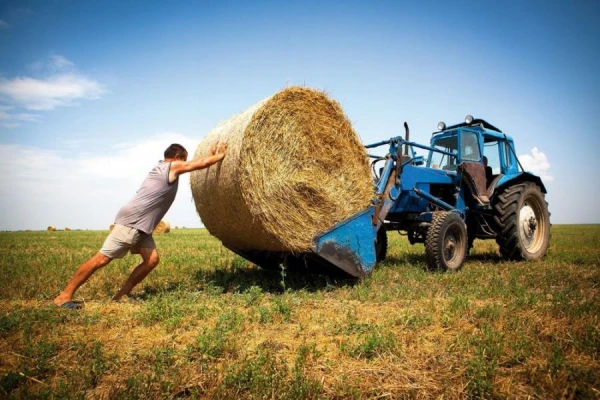
Residents of Latvia harshly criticize the advice of local experts to 'move to the countryside and survive.' One woman on social media described real rural life as expensive, hard, and isolated — and challenged politicians to try it themselves.
As reported by Otkrito.lv, against the backdrop of rising prices in Latvia, calls from experts for practical survival methods have become increasingly vocal — from moving to the countryside and growing vegetables to keeping chickens.
Thus, entrepreneur and former Minister of the Interior Maris Gulbis stated on TV24 that the key to survival is initiative and flexibility. As a simple example, he cites a practical solution: “After all, if there’s nothing to eat — build a greenhouse and grow your own cucumbers and tomatoes. I’m doing this myself right now.”
In turn, the head of the Agricultural Market Support Department at the Institute of Agrarian Resources and Economics, Inguna Gulbe, also stated that “there is no reason to panic,” but suggested that residents actively utilize connections with relatives in villages, grow their own food, and even keep chickens.
However, a resident of Latvia, Liga, harshly criticized such advice on social media, calling it detached from reality. “Of course, we have long gotten used to the fact that the TV talks complete nonsense and absurd slogans are voiced. Because those who speak live on another planet. Inguna Gulbe probably hasn’t been to a village in at least 30 years. Jurmala villas and affluent neighborhoods near Riga don’t count,” she writes. According to her, modern rural life is far from idyllic notions: “It’s something like life on Mars. It’s a lockdown. (...) A villager, like a monk or nun in their homestead, is still struggling for survival and faces a heavy existential crisis every month — to pack their bags or not, to leave?!”.
“Sometimes, after listening to the chatterers, it becomes clear that life in the village is only a fantasy — vegetables grow by themselves, chickens and cows grow by themselves, while you relax in a rocking chair with a glass of freshly squeezed juice. Yes, the village has its privileges — fresh air, the ability to grow organic food, peace and quiet, almost no crime because there are hardly any people left.”
Liga emphasizes that self-sufficiency today is not a cheap solution, but an expensive and labor-intensive endeavor: “In fact, it’s an extreme and costly pleasure. It’s cheaper to buy everything at the supermarket.” She details the expenses — from fuel and equipment to keeping animals — and concludes: “You work in the village to break even or even at a loss. Rural life is an expensive hobby.”
“And the main thing is — there are no longer those men in the village who could be hired and who knew how to do everything. Now you have to hire companies for big money, and the quality of work is not what it used to be. Where does a rural person get such money?! For example, to buy firewood for the winter, you need to shell out at least 1000 euros right away!”
She also highlights the issue of social isolation: “It should be noted that without live communication, you become strange, start to fear people, and generally go crazy because a person is not an asocial being — they need other people, their own, who will understand!”
“This is how I briefly described life in the village from my perspective as one of the last residents of Latvia — because after me, there’s only Russia.”
Liga issued a kind of “challenge” to politicians and experts, including Prime Minister Evika Silina: “I propose to take the challenge and show a living example.” She ironically describes the conditions of rural labor: “Now large farmers need stone pickers. This is a very ‘female’ job — to walk about 50 km in rubber boots through the mud, collecting stones that are ‘light as feathers.’ Moreover, to save on gas, you have to bike to work for about 25 km on broken rural roads! Get up at dawn and return home at dusk.”
She also suggests that Evika Silina work for a month as a milkmaid on a farm to understand how cream and butter are produced. “After all, Queen Marie Antoinette milked cows together with her ladies-in-waiting — she enjoyed it!”
She concludes with a rhetorical question about the gap between elites and society: “Is it possible today for even one princess... to work in the field or on a farm?










Leave a comment