
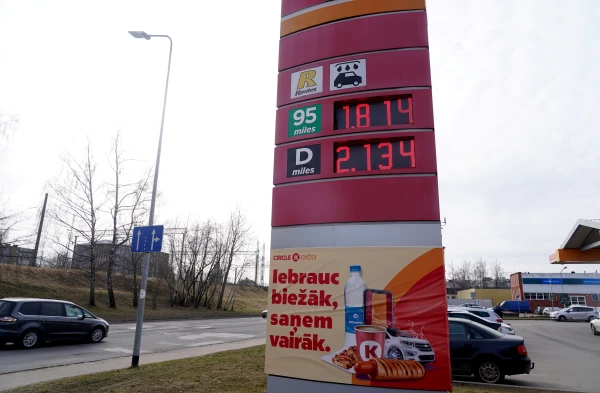
A slow procession of taxi drivers moved through the capital's streets in protest – while earlier, long, sad queues formed among Riga drivers at the gas station that provided the "pre-crisis" price for diesel. In this way, a previously little-known gas station gained recognition throughout the country. And now it can slowly raise its rates...
The draft Solidarity Payment Law for fuel traders aims to combat unfair commercial practices amid the crisis. The document was recently discussed at a government meeting by the Ministry of Trade.
The Speculators' Star Hour
"At this moment, there is no effective, transparent, and targeted mechanism that would limit excessively high fuel price increases and protect consumers," the ministry led by Viktors Valainis (Union of Greens and Farmers) admitted.
Indeed: "Fuel is an important component of transportation, agriculture, logistics, and everyday life expenses. A sharp rise in fuel prices increases the costs of goods and services, contributes to inflation, and reduces the purchasing power of the population, especially in regions and among low-income households. This situation affects households, particularly those with lower incomes and rural residents who have no alternative means of transportation, as well as logistics and transport enterprises that use fuel as a primary production factor amid rising costs – public sector expenses (transport, heating, security) are increasing. Although wholesale oil and fuel prices fluctuate on the exchange, the actual retail price does not always change in tandem with falling exchange prices. There are concerns that some retailers are using the geopolitical crisis to increase their margins and gain disproportionate additional profits."
The planned measure from the Ministry of Economics is "time-limited," i.e., it is set to expire on December 31 of this year. Perhaps the crisis in the Strait of Hormuz will have resolved by then – but if not, the new Cabinet of Ministers and the economic block will be responsible.
"Temporary Mechanism"
The application of the aforementioned payment will occur if "the actual retail price exceeds the objectively calculated estimated retail price by more than 3%."
In just the month of March, retail fuel prices in Latvia increased by approximately 30% – the highest price increase since the energy crisis of 2022. If in January-February, a liter of diesel fuel was sold for an average of 1.504 euros, by the end of March, it was 2.13 euros.
This figure has already surpassed the level of June 2022 – 2.04 euros, when supplies of diesel fuel from Russia and Belarus were completely halted.
Is There Nothing We Can Do?
According to a market study by the Competition Council, 93% of the retail price of fuel consists of components over which the trader has no influence at all – or can exert minimal influence:
- this is the purchase price, which directly depends on international exchange prices (about 46% of the final price),
- and taxes and fees for guaranteed reserves (a total of 47%).
Currently, all fuel in Latvia is imported (mainly from Lithuania and Finland), so domestic prices closely follow international exchange prices.
The physical availability of fuel in Latvia is not currently under threat. Data from the weekly monitoring by the public asset manager SIA Possessor (which performs the tasks of the central structure for maintaining reserves according to Part 1 of Article 72 of the Energy Law) confirm that there is enough fuel in the traders' excise warehouses. The main challenge now is the rise in fuel prices.
In Latvia, about 600 gas stations operate in the retail fuel market, owned by approximately 100-120 legal entities. However, the market is defined by 4-5 major operators who account for 70-80% of the total turnover.
What Will This Achieve?
If the law is passed, the fuel market will effectively become directive. The Ministry of Economics will set "benchmark retail prices" (OC), which will "include all justified expenses and economically proportionate profits." The entrepreneur will be able to vary their interest within 3% of the OC, and anything beyond that will be taxed at 100%.
The Ministry of Economics promises that all revenue from the new tax will be spent on the cause:
"Payments will be directed towards maintaining supply infrastructure, developing new capacities, forming reserves, and ensuring the stability of the system. As a result, this allows for timely investments in the supply system, maintaining necessary reserves, and ensuring uninterrupted delivery of resources, thereby minimizing risks in crisis situations and strengthening the energy and economic security of the country." The ministry, having a computerized database, is capable of developing the OC and applying the solidarity tax with minimal investment – less than 23,000 euros.
It is worth reminding about Viktors Valainis's previous initiative when he declared war on rising food inflation a couple of years ago. But just a glance at the nearest grocery store to see the price of tomatoes raises doubts about the effectiveness of the proposed measures. After all, we live in a liberal, open economy – and it is unlikely that any islands of planning and regulation are possible here. The market knows no mercy!
SHARE IN THE BUDGET
The overall increase in fuel prices in March was 21%. At the same time, fuel accounts for 5% of the average household's expenses. However, as banking economist Oskars Niks Malinex states, there are families where fuel plays a significantly more important role.
ABSURD
– It is extremely difficult to comment on the absurdity of the situation where a law is planned to be adopted without a mechanism for determining the "objectively calculated price."
Market participants have justifiably criticized this option, but a new mechanism for discussion and comments has not been proposed. The authors of the bill decided to take the simplest route – to adopt the law without a specific mechanism for determining the "objectively calculated price."
It is assumed that such a mechanism will appear only after the law is adopted, but its objectivity cannot even be assessed since it does not yet exist.
It is unclear how a fiscal regulatory act can be adopted without the mechanism that is its foundation. This is absurd!
(Gas station manager wishing to remain anonymous)








Leave a comment