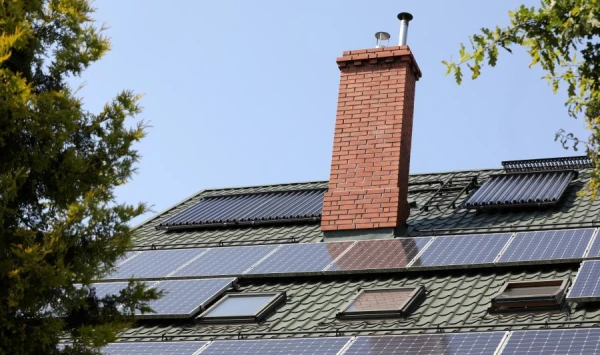
While Estonian politicians talk about the need to increase renewable energy capacity, many producers found in March that they now have to pay extra for operating in the market and selling electricity, writes Postimees.
Owners of small solar parks in Estonia, upon receiving their March bills, found that although they had done everything correctly, they were once again at a loss. The expected income from electricity sales was not coming in; moreover, they had to give away electricity for free, and on top of that, pay extra for its transmission.
Last year, producer Urmas Roht from Põlvamaa was forced to agree to yet another increase in the electricity sales fee from Eesti Energia: "Yes, I agreed to the price increase, but there was no mention of anything else! This offer was, in any case, in the style of 'take it or leave it.' I had to take it. Of course, all the terms are set up like in a casino: the house always wins, which means small producers are always 'shaved.'"
Roht noted that he was not informed that, in addition to the new, higher sales fee, a new charge would also apply to the supplied electricity. Therefore, in March, he had to pay extra for the electricity sold. The situation is somewhat akin to a bun seller having to pay the buyer for each bun sold every morning.
To understand why small producers, namely solar panel owners, are so angry, one must go back a couple of years. At that time, the war in Ukraine had just begun, Europe was hit by an energy crisis, and with it came high electricity prices.
Seeing this, politicians said the same thing as today: renewable energy production needs to be increased so that we have our own electricity. To accelerate the transition across Europe, including Estonia, a number of subsidies were launched so that private homes and apartment associations would also install solar panels.
An additional incentive was the proposal that producers could sell the solar energy they generated to the Estonian electricity grid and earn on every kilowatt-hour. Initially, it was so profitable that people shared posts on social media about how quickly their investments in solar parks paid off in the era of expensive electricity.
But then several events occurred. First, the price of electricity fell. Second, a lot of renewable energy entered the grid at once, and it turned out that this made it much more difficult to predict daily production and consumption.
The fact that the Estonian market is oversaturated with solar energy is also evidenced by the fact that when the government began preparing a new tender for renewable energy supply, politicians acknowledged that there was already enough solar generation and wanted to see only wind energy in the competition.
It is one thing when many small producers can supply energy to the grid simultaneously, but it is much more difficult to guess whether a specific producer plans to feed electricity into the grid in good weather or will use it themselves.
Although companies like Eesti Energia will probably never admit it, a large number of small producers creates an unforeseen load on the grid, which is a significant headache for the system operator – it is harder to manage the system when you do not know where and how much electricity may come into the grid and whether it will come at all. Therefore, companies that entered into electricity purchase agreements with small producers began to gradually increase their purchase fees.
For example, if last year Eesti Energia (Enefit) charged Urmas Roht a purchase fee of 1 cent for each kilowatt-hour sold to the grid, by the end of the year this fee had risen to 1.8 cents per kWh.
This so-called purchase margin has also increased for other suppliers: Alexela charges 1.5 cents, Terminal – 2 cents, and Elektrum – 3.1 cents per kWh. This means that, using Elektrum as an example, the market price of electricity at the time of sale must be above 3.1 cents for the seller not to incur a loss.
But that’s not all: those wishing to sell electricity must pay not only the purchase margin but also a new fee. "No microproducer should sell electricity to the grid for free – sales are made with the purchase margin in mind. The electricity sold to the grid is subject to the purchase margin, as well as a balancing power fee of €0.00373/kWh," explained Enefit sales manager Kristo Kiyvumägi.
However, Kiyvumägi did not want to say how much they paid small producers for their products in March. "Not only microproducers found themselves in this situation. Owners of large solar parks also had to limit production at certain times to avoid losses from electricity supplied to the grid. Often, the problem for large parks is even more serious because they have no local consumption to direct production to at certain hours. Since the size of electricity bills is also influenced by the volumes purchased from the grid, it is impossible to definitively state the total amount paid to microproducers for electricity sold to the grid. In the case of large producers, it also depends on specific hours and production volumes, which is confidential information," said Kiyvumägi.
Kiyvumägi confirmed that most Enefit microproducers agreed to last year's increase in the purchase margin from 1 to 1.8 cents per kWh, adding that this is a "rise in costs that has affected the entire market and all its participants."
Kiyvumägi said that mutual settlements are also made with microproducers, based on both market and fixed prices, depending on the chosen package.
"It is important to note that customers without energy storage generally produce and sell electricity to the grid during cheap hours when there is a lot of solar energy on the market, and buy from the grid, as a rule, during more expensive hours. Therefore, the income from produced electricity often does not cover the costs of electricity purchased from the grid," noted Kiyvumägi.