
The capital city's social affairs committee unanimously voted on Wednesday for a package of documents on providing services to the elderly and disabled. Additional budget allocations will amount to hundreds of thousands of euros.
What’s the cost
In the institutions under the Department of Welfare, the following rates will be established: the "Gailezers" Center (6 Hipokrata Street) – 50.84 euros per day; "Mežciems" (3a Maliēnas Street) – 55.73 euros; "Stella Maris" (54 Birzes Street) – 46.15 euros per day. On average, this means a price increase of 4-5% compared to the previous level set by the Riga City Council decision on July 13, 2023. The specified income of the institutions is directed exclusively to their own needs and is not subject to VAT.
It is worth noting that over the past 3 years, the average old-age pension in Latvia has increased from 530 to 680 euros, i.e., by 28-29%. As a result, seniors have more opportunities to pay for social care services, which are covered 85% by the pension, with the remainder paid by relatives or the municipality.
For example, the Riga social care center "Gailezers" is staffed with 3 duty posts, 2 of which are round-the-clock, with nurses working at each. Clients live in rooms, from 1 to 4 people in each, depending on their health condition. Social workers, social rehabilitation specialists, social care specialists, a family doctor (twice a week), and nurses take care of the residents. If necessary, they are attended to by specialized doctors – a dentist, physiotherapist, psychologist, podiatrist, occupational therapist.
What is canine therapy
The social service includes:
- providing a person with housing equipped with necessary inventory, blankets, bed linen, appropriate seasonal clothing and footwear;
- nutrition appropriate to age and health condition (at least 4 times a day);
- round-the-clock emergency medical assistance;
- registration with a family doctor and health care within the financial means of the Center;
- a comprehensive social care and/or social rehabilitation program, according to the physical and mental condition of the person;
- spiritual care, in accordance with the person's religious affiliation and wishes;
- meaningful leisure activities, cultural events in the Center and, if possible, outside it;
- providing the client with assistive technical devices; support in solving personal and social problems of the client, assistance in adapting to the physical and social environment;
- attracting and mobilizing resources in the client's interests, providing information about services, consulting the client on their rights and obligations, protecting the client's interests and ensuring human rights; creating and maintaining social contacts between the client and their family.
The Center provides opportunities for reading books and periodicals; board games and novus; handicrafts; cooking independently or participating in cooking classes; participating in group gymnastics with the use of a gym; participating in choir and music classes.
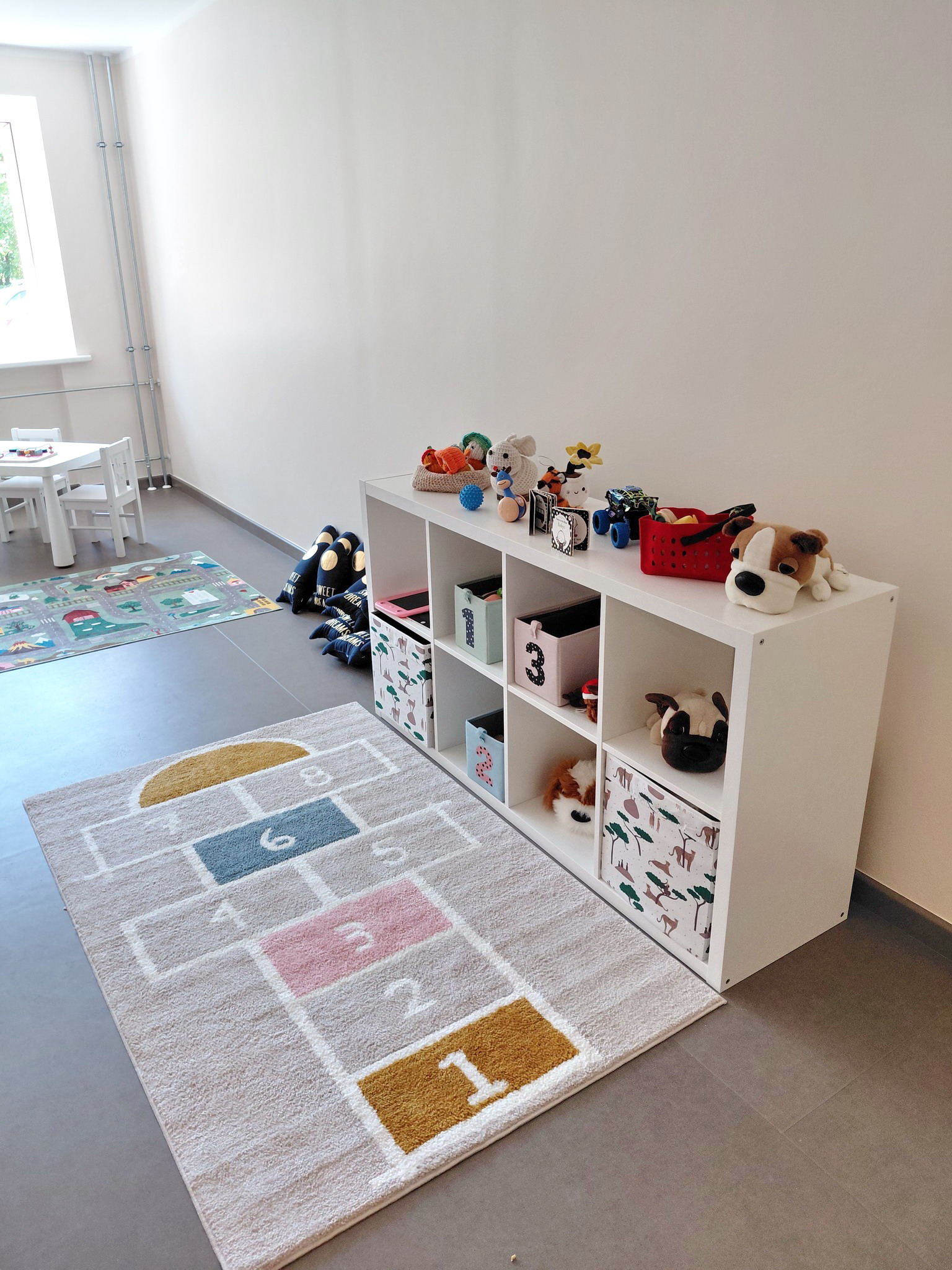
Children's corner in the social center on Burtnieku Street. Photo by the author.
In practice, canine therapy is also used – a method in which specially trained dogs are utilized for the socialization and psychological support of people.
New forms of work
For covering expenses in the first half of 2026, 26,898 euros have been allocated for so-called group homes (apartments). Your author recently visited such an establishment at 37 Burtnieku Street. This form of cohabitation for individuals with special needs promotes their socialization, as these are young and middle-aged people who are generally capable not only of self-care but even of working part-time. Of course, qualified social workers constantly assist them with their daily needs.
An additional 50,399 euros has been allocated from the municipal budget for the "respite" service for families caring for group I disabled individuals and those with mental health issues. This service is rated in the price list as the most expensive – 156.27 euros per day, twice as much as what is spent on elderly women in nursing homes.
Most of all – 450,000 euros, the city allocates for a universal program for children with functional disorders; 314,000 euros – for individual social rehabilitation programs; 194.4 thousand – for adults with mental health issues...
By December 31, 2027, another day care center will open in Riga – at 19 Spilves Street. There, specialists will care for those individuals with mental health issues who cannot be cared for by working relatives. Since "big" people need a lot of space – only 20 clients can be accommodated at the same time. A similar center was previously established at 11 Priedeines Street, supported by funds from the European Regional Development Fund, with very positive feedback.
An important point is that now Riga residents who wish to place their relatives in "adult care institutions" can count on co-financing from the municipality, even if the aforementioned centers and nursing homes are far from Riga (previously only capital institutions and those within a 40 km radius were covered). This is logical – as there is a traditional queue for social services in the capital, there are often many vacancies in the provinces. Again – nature and tranquility!
Children in line for care
Every year, Riga sees a population decline – but at the same time, the number of disabled children continues to grow. Thus, in 2024, there were 2,750, and in 2025 – 2,777.
The municipal social service assesses the situation in each family individually and can assign a whole range of services from a total of 13. It is planned to expand the range of city-funded activities for children with motor disorders. Fortunately, more and more non-governmental organizations are working in the field of assistance to minors – for example, the rehabilitation center Poga, the initiative Palīdzesim.lv.
"Social rehabilitation helps children develop skills, supports parents, and strengthens family functioning while promoting participation in education and reducing social neglect," the document from the Department of Welfare states. "The demand for social rehabilitation programs exceeds the current capabilities provided by the municipal contracted organizations, hence the queues..."
By the way, Riga's social standards consider individuals under 20 years old as children if a family doctor’s referral for a medical examination for special care has been obtained; and individuals under 24 years old if such a conclusion has already been issued. The limit for services provided by the municipality is set at 4,500 euros per year.









Leave a comment