
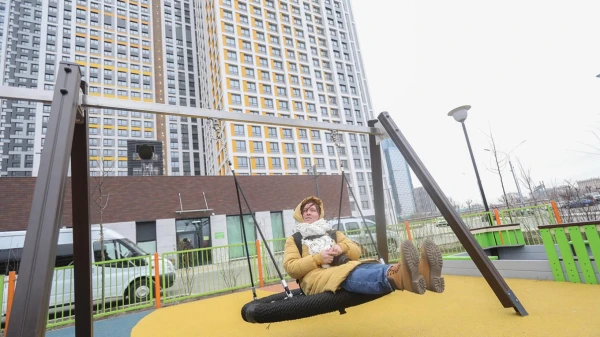
The housing market became active in the second half of the year: mortgage issuances, sales, and prices began to rise.
Last year, Russians invested 1.7 trillion rubles of their own funds in new buildings, according to the analytical center "Dom.RF". The total revenue of developers from the sale of new buildings amounted to 5.2 trillion rubles (about 55 billion euros).
The main part was provided by mortgages — 3.7 trillion rubles. Of the remaining 1.5 trillion, 0.4 trillion rubles, according to analysts from the state company, came from installment payments, while transactions for the remaining 1.1 trillion rubles were made entirely in cash. Own funds are also used in mortgages — for the down payment. With a 20% down payment, this is approximately 0.6 trillion rubles. "Thus, citizens invested 1.7 trillion rubles in new buildings: 1.1 trillion in cash and 0.6 trillion in the form of a down payment," explains "Dom.RF".
The housing market became active in the second half of the year: mortgage issuances, sales, and prices began to rise. Analysts from "Dom.RF" and other experts attribute this to the beginning of a decrease in the key rate. Along with it, interest rates on market mortgages and deposits decreased, which stimulated the flow of part of the savings from banks to the housing market.
Alexey Kiryukhin, a junior director for banking ratings at "Expert RA", noted back in the summer of 2025 that the decline in deposit rates pushes some of the population with savings to look for alternative investment methods, including investments in real estate. In the context of declining deposit yields, public interest in purchasing real estate has increased (most notably in the Moscow region and the southern regions), the Central Bank noted in its October regional economic review.
Central Bank officials, discussing the key rate in December, noted a change in the structure of savings growth: "The decrease in the inflow of funds into term deposits in recent months has been accompanied by an increase in investments in securities and real estate, which is a natural reaction to the decline in interest rates." The scale can be significant: the Central Bank writes that some participants in the discussion even expressed the opinion that an increase in real estate investments could affect inflation, as it is accompanied by an increase in demand for consumer goods and services (for example, repairs).
Natalia Orlova, the chief economist at Alfa-Bank, calls real estate "the second choice after deposits" for Russians as an investment: "There is a significant flow of savings into real estate." It is difficult to assess the scale of the outflow from banks, but the fact that holders of large deposits are transferring money to financial markets and the real estate market is, in her opinion, indirectly confirmed by data from the Deposit Insurance Agency (DIA): the largest deposits (over 10 million rubles) grew slower than others: only by 2.6% in volume and by 11.2% in number from January to September. At the same time, the total amount of deposits grew by 8%. As a result, over nine months, the share of such deposits decreased from 31.8% to 30.6%.
Housing may draw some funds from deposits, acknowledged Elizaveta Danilova, director of the Central Bank's financial stability department. To prevent the process from becoming avalanche-like, the regulator "will gradually lower the rate and monitor to ensure that the attractiveness of ruble deposits and the saving behavior of people are maintained," she said. With a cautious reduction in the key rate, some outflow of investors from banks to the real estate market is expected to continue, experts at Kept believe.
The 1.7 trillion rubles that Russians invested in real estate are comparable to the amounts they invested in other instruments. The Central Bank has not yet summarized the results, but according to its data, Russian households invested 1.3 trillion rubles in mutual funds and stocks and 1.2 trillion rubles in bonds over the 12 months up to November 2025.












Leave a comment