
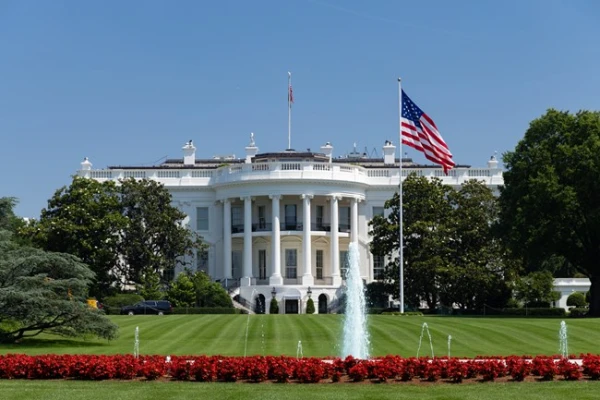
American corporations are also influenced by decisions in foreign policy.
It has already entered the history of the United States as the "businessman president." How a Republican made money for "his own" and what the business of the Oval Office represents.
Trump is Sponsored by "Lenin"
Even after winning the presidential election, Donald Trump continues to attract large donations. The funds are directed to his initiatives, including organizing the inauguration festivities, building a ballroom in the White House, and events for the 250th anniversary of U.S. independence.
For the construction of just the ballroom, donations were made by 37 sponsors. Among them is Konstantin Sokolov, a Russian émigré and founder of the investment company IJS Investments. The initial estimate from the White House was $200 million, which then grew to $300 million, and now the cost of building the ballroom is estimated at $400 million.
An important channel for raising funds for Trump remains the political action committee (Super PAC) MAGA Inc., specifically created in his support in 2022. Now, the funds in the committee's account will go to assist Republicans during the campaign ahead of the midterm elections. In the first half of 2025, MAGA Inc. raised nearly $200 million.
Overall, since Trump's reelection in 2024 and his return to the presidency, his donors have raised nearly $2 billion for the Republican's political projects, writes The New York Times. This rough estimate may exceed the amount raised in support of his 2024 presidential campaign (almost $1.5 billion).
As the newspaper notes, many of Trump's major corporate sponsors represent sectors interested in the White House's decisions, including defense, IT, and government services. In exchange for donations, donors can expect regulatory relief, appointments to government positions, the cessation of lawsuits, and direct access to the president — through participation in closed dinners and receptions or accompanying him on foreign trips.
An analysis by The New York Times shows that of the 346 largest sponsors of Trump (who donated $250,000 or more), at least 197 — more than half — either directly received preferences or represent industries that benefited from the White House's decisions. This includes pardons, government contracts, lobbying amendments to legislation, and special access to the administration.
Moreover, the White House literally "advertises" its sponsors, expressing gratitude to them to a wide audience on its social media. According to NYT estimates, at least 67 sponsors who donated funds after the presidential election received positive mentions in official channels of the U.S. government, including Trump's account on Truth Social.
For his inauguration in 2025, Trump raised a record amount — nearly $240 million. According to The New York Times, donations for this event came from representatives of industries such as:
-
technology (Nvidia Corporation, AMD, Meta*, Perplexity, Amazon, IBM, PayPal, Microsoft, Samsung Electronics America, Adobe, Google);
-
oil (Shell USA, Chevron, ExxonMobil);
-
defense industry (Lockheed Martin);
-
banking (Bank of America, JPMorgan Chase, Goldman Sachs);
-
automotive (General Motors, Hyundai Motor America, Toyota Motor North America);
-
aviation (Boeing, Delta Air Lines, United Airlines);
-
pharmaceuticals (Pfizer, Johnson & Johnson);
-
food (PepsiCo, Coca-Cola);
as well as Uber and McDonald's.
And even "Lenin" was involved in Trump's inauguration. A businessman mentioned in the NYT article as Lenin Peters (possibly actually North Carolina entrepreneur Lenny Peters) contributed to it. Additionally, money for the inauguration festivities was allocated by Belarusian émigré businessman Igor Tulchinsky and the current U.S. Secretary of the Treasury Scott Bessent.
Although it is impossible to prove a direct causal link between donations and the administration's decisions, the large donations from potentially interested parties make the question of conflict of interest inevitable, emphasizes NYT. The White House denied claims of providing Trump donors with special privileges, adding that they "should be welcomed, not attacked."
Family in the Black
"The main beneficiaries of Donald Trump's policies have been members of his family," said Maxim Cherkashin, a junior researcher at the North American Studies Center of IMEMO RAN, to RTVI.
Thus, the adoption of the GENIUS stablecoin law allowed Trump's sons to profit from participation in cryptocurrency projects.
According to Cherkashin, military contractors such as Palantir and Anduril also benefited — due to increased government spending on defense and rising stock prices.
As reported by NYT, during Trump's second term, Palantir received federal contracts worth hundreds of millions of dollars. These included software development for the Immigration and Customs Enforcement (ICE), which is very active under the Republican administration.
And large corporations like Lockheed Martin (manufacturer of F-35 fighters), Parsons, and Boeing can expect large government contracts for the creation of the "Iron Dome" missile defense project, the newspaper adds.
Moreover, the White House's decisions in foreign policy also positively affect American businesses. In particular, Washington's sanctions against "Lukoil" forced the Russian company to actively seek buyers for its international assets, the largest of which is a 75% stake in one of the largest oil fields in the world, West Qurna-2 in Iraq.
Among the interested parties are the large private equity firm Carlyle, which includes American energy giant Chevron in its portfolio, as well as the largest American oil company Exxon Mobil. According to Bloomberg sources, the White House prefers that Lukoil's international assets be transferred to an American entity.
"Overall, in the first year of Trump's second term, stock market indices rose, which increased the wealth of wealthy Americans," summarized Maxim Cherkashin.
And a vivid confirmation of this is Elon Musk, who worked in the Trump administration, whose net worth is estimated at nearly $800 billion as of January 19. Just over a year ago, in November 2024, the wealth of the world's richest person was just over $300 billion.
Ambassador for a Donation
Investments in Trump benefited not only large companies. Some sponsors of the current U.S. president received quite lucrative positions. Thus, 15 people were appointed to the posts of ambassadors of the United States.
For example, Warren Stephens, president and CEO of the private investment bank Stephens Inc., took office as U.S. ambassador to the United Kingdom in May 2025. He was nominated for this position by Donald Trump in December 2024. He had never been involved in international politics and diplomacy, yet he donated $6 million to Trump's presidential campaign.










Leave a comment