
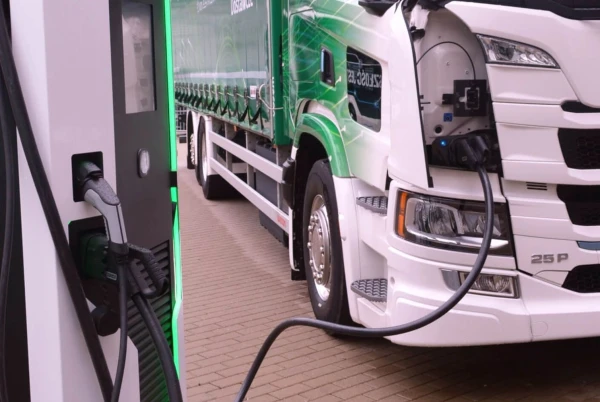
Recently in Riga, experts and government officials gathered to discuss the transition of freight vehicles to electric engines. Currently, freight transport emits about 2.3 million tons of CO2 into the environment annually.
Market research has shown that 70% of freight transport company owners would willingly purchase emission-free (electric) transport instead of diesel if the government could cover the price difference and provide tax incentives. Accordingly, additional investments in the infrastructure of electric charging stations are also necessary.
Justs Dimants, an expert from the Longevity Cluster, pointed out that the country would not need to purchase carbon dioxide emission quotas for 20,000,000 euros if only 10% of trucks were converted to electricity. Board member of the organization Armands Gutmanis emphasized that Latvia is capable of producing electricity itself, from many sources — water, wind, sun, biomass, biogas — thereby reducing dependence on imported fossil fuels. State and municipal-owned enterprises operating in the road construction and maintenance, waste collection, and forestry sectors could become the driving forces of change.
Daily costs for imported energy resources for the country's economy amount to 5-10 million euros, reported Krists Leishkalns, advisor to the Ministry of Climate and Energy. At the same time, while the fleet of passenger cars has been successfully updated with electric transport for several years, the situation remains unchanged for approximately 90,000 heavy trucks.
Janis Kalnins, Deputy Director of the Public Transport Services Department of the Ministry of Transport, stated at a meeting: "To achieve Latvia's established goal of reducing transport emissions by 21.5% by 2030, the freight vehicle fleet must be significantly more modern and efficient. This is no longer just an environmentally friendly choice — it is competitiveness. The industry operates at the intersection of fuel prices, customer demands, and international competition. The government must encourage solutions..."












Leave a comment