Aquaculture in Latvia has become a matter of political importance: last week, the Saeima subcommittee on environment, climate, and energy rolled up its sleeves and took on this sector.
New is Well Forgotten Old
According to the head of the subcommittee, Jana Simanovska (“Progressives”), fish production is planned to be launched in the Gulf of Riga soon, so it is necessary to develop compensatory mechanisms for the environment. According to the Ministry of Agriculture, one of the sites is designated opposite Roi, 2.2 miles from the shore, and the second opposite Mersrags, 2.6 miles from the shore. "Latvia's and the EU's economic breakthrough in the fishing industry is precisely linked to the aquaculture sector," emphasized the ministry of Minister Armands Krauze (Union of Greens and Farmers) in 2024.
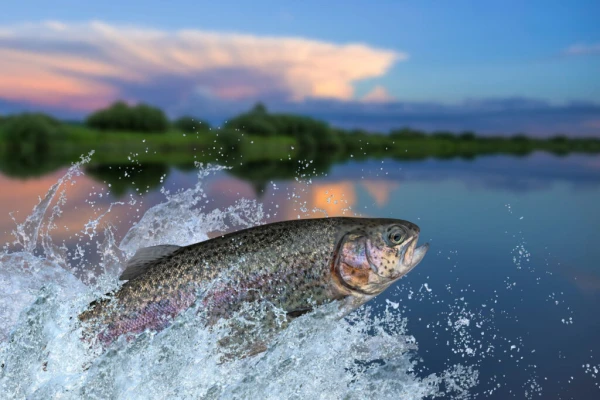
"Currently, fish is not farmed in the marine waters of Latvia," it was stated in the decision approved at the Cabinet of Ministers meeting. "The only known experience was in the 1980s when rainbow trout were grown in net enclosures in the Gulf of Riga (mainly near Kolka and Roi, one season — also near Carnikava). The experiment was generally unsuccessful due to the insufficient resilience of the enclosures to storms and waves, as winds sharply changed the inflows and outflows of cold deep-water and warm coastal water, which causes stress to the fish, and the trout suffered from specific infectious diseases."
Almost half a century later, they decided to try again. Inese Bartule, Deputy Director of the Fisheries Department of the Ministry of Agriculture, reported that a "union of individuals" won the competition for works in the Gulf of Riga.
Previously, the government database included Riga Bay Aquaculture JSC, Sudrablīns LLC, and Musholm (Denmark). The proposed species of fish was still the same Oncorhynchus mykiss (rainbow trout), and the total market volume was estimated at 40 million euros. The small ports of Mersrags and Roi are suitable in terms of logistics, availability of skilled labor, and the expected working depths (about 20 m). For its part, the Baltic Sea coast near Liepaja will not be comfortable for fish in cages, as strong westerly winds prevail there.
Olga Bogdanova, Deputy State Secretary of the Ministry of Climate and Energy, noted that candidates for economic activity submitted an application to assess the impact on the ecology. At the two planned farms, it was intended to grow up to 10,000 tons of trout per year. For comparison, the annual catch of sprat is 30,000 tons.
"Could There Be Seaweeds and Mollusks?"
However, local ecologists opposed the trout farming project. Kristine Veidemane, Chair of the Board of the Baltic Environmental Forum, pointed out that she had been alarmed since 2022 — "aquaculture will create pollution and degrade environmental quality." An additional effect will be the "physical destruction of the ecosystem." Fish cages will be fixed to the bottom of the Gulf of Riga, and "degradation will occur."
Engaging in economic policy, K. Veidemane reminded that it is necessary to think in terms of long-term sustainability. Therefore, "marine planning" needs to be updated.
Latvia is a member of the European Union and thus must exercise caution and eliminate the cause of environmental harm, based on the principle of "the polluter pays." In this regard, the placement of cages in the Gulf of Riga is unacceptable in the context of eutrophication.
What is eutrophication? It is the process of saturating water bodies with biogenic elements (primarily nitrogen and phosphorus), leading to excessive growth of algae and aquatic vegetation ("water blooming"). This phenomenon deteriorates water quality, depletes oxygen, and can lead to the extinction of fish and other aquatic inhabitants, destroying the ecosystem of the water body. The cause can be both natural aging and anthropogenic impact, such as the discharge of wastewater and fertilizers.
"It is not said that aquaculture is impossible at all," Ms. Veidemane clarified. "There can be aquaculture of seaweeds and mollusks, and we need to see where it is applicable."
Will the Fish Be Pulled Ashore?
It is worth noting that the Ministry of Agriculture is also not to be underestimated, and they have backed the trout resolution with the state scientific research institute BIOR and the Latvian Institute of Hydrobiology at Daugavpils University. Overall, the fish farmers' initiative received a positive assessment, with only additional measures mentioned to prevent nitrogen and phosphorus from entering the sea.
For her part, the leader of the environmental movement insisted that cages should not be installed deeper than 20 m, so that "our fish," which is in the Gulf of Riga, so to speak, in the wild — and supports coastal fishing — does not suffer. The two areas chosen by the Ministry of Agriculture are located in protected Natura 2000 regions.
It is worth noting that in Denmark such aquaculture parks were established in 1979 and 2002, precisely at a depth of 20 meters.
In Ms. Veidemane's opinion, fish in cages will not only pollute the sea with their waste products but will also die in them, creating additional ecological pressure.
As an alternative, entrepreneurs were suggested to create reservoirs for fish on the shore, filling them with seawater. Although this would require pipelines, pumps — in short, a completely different economic model.
Mussels Will Endure Everything
There is also an option — cages of a completely new design (not like in Denmark), and — alongside trout, to cultivate special mussels in the sea. Not for food, but solely for absorbing fish waste. The head of the Baltic Environmental Forum also pointed out the open Baltic Sea, where the activities of fish producers should be directed — rather than the closed bay.
Meanwhile, the materials from the Cabinet of Ministers reflect that the potential nitrogen input from both planned farms will amount to 400 tons per year (0.93% of Latvia's total quota under the Helsinki Convention), and phosphorus — 40 tons (3.77%).
Therefore, the sacred war for the rights of sprat in the Gulf of Riga against the invasion of the trout migrant should be viewed in the context of the vendetta of the "Progressives" and the SSK, which began around the Istanbul Convention and manifested in the refusal of subsidies to the Ventspils port.