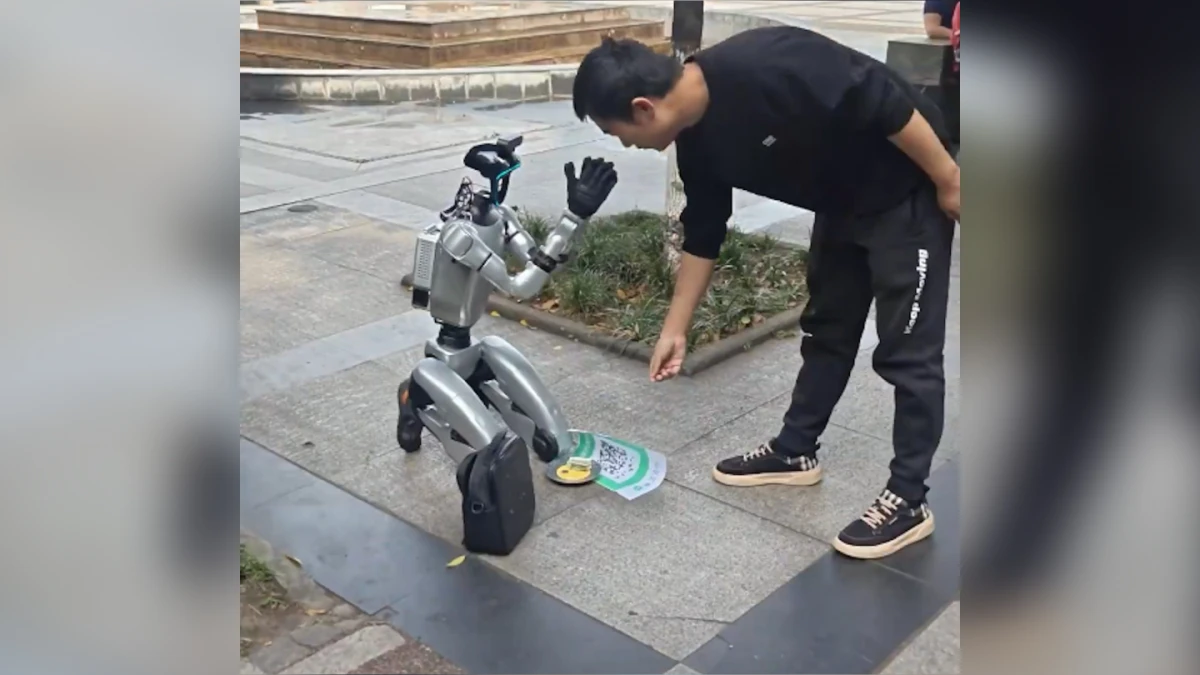
On the streets of several Chinese cities — Beijing, Chengdu, and Fuzhou — eyewitnesses have spotted humanoid robots engaged in begging.
Mechanical "beggars" hold signs that read: "I have no money to charge my phone" and "Please pay my electricity bill." QR codes for transferring funds are attached next to them, reports Oddity Central.
Artificial intelligence and robotics are increasingly penetrating everyday life, and judging by what is happening, even a sphere like street begging has not been left out. While some perceive these scenes as a troubling symptom — AI is displacing people even from the lowest social positions — others doubt the authenticity of what is happening.
The models spotted on the streets belong to advanced humanoid robots, such as the G1 and H2 series from Unitree. These high-tech devices cost tens of thousands of dollars. Using them for collecting alms is economically impractical — recouping the costs in this way is virtually impossible.
There is a theory that the begging robots may be part of an art installation or a social experiment. Their appearance prompts passersby to reflect on how far the relationship between humans and machines has come and what role AI will play in the society of the future.
Photos and videos quickly spread across social media, sparking heated discussions that juxtaposed anxiety about the future with skepticism about this story.
Regardless of whether these robots are real beggars or part of a performance, their presence on the streets serves as yet another reminder that the boundaries between the human and the artificial are blurring before our eyes. And even if this is just a joke or provocation, it raises serious questions about the place of humans in a world that is increasingly populated by machines.