
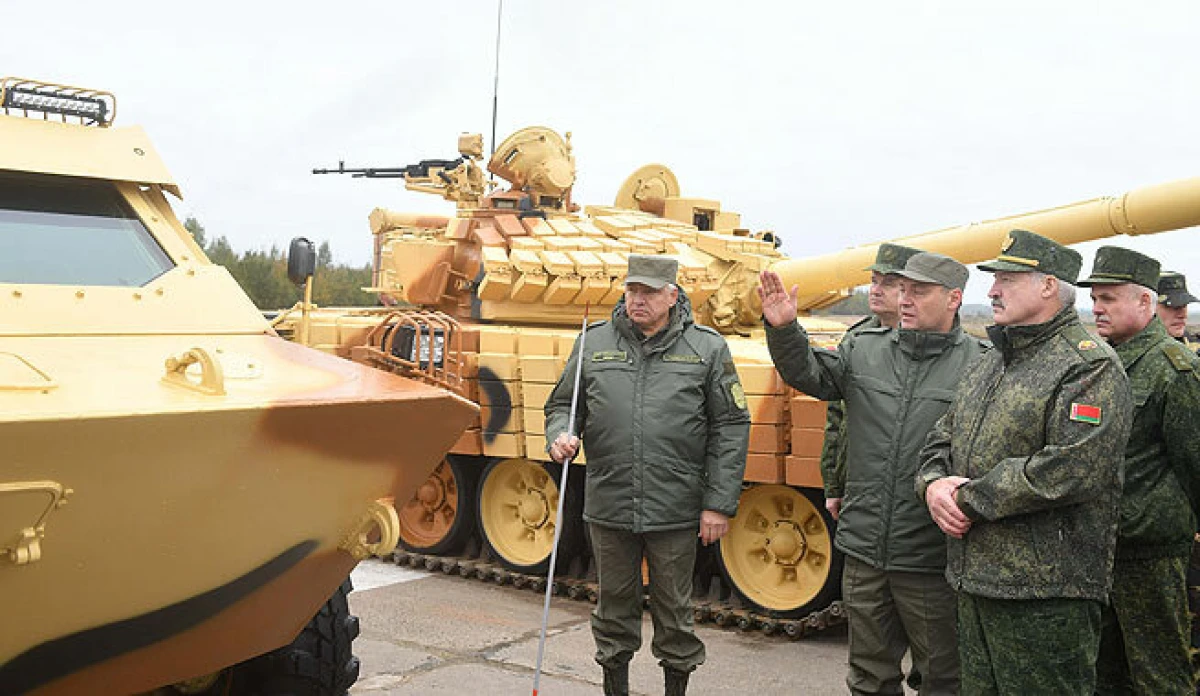
The low motivation of a significant part of society to participate in hostilities.
Belarus is no longer viewed by its neighbors solely as an ally of Russia. But is it ready to become a full participant in the war against Ukraine? This question was discussed by participants of an international roundtable at Ukrinform. Experts from Ukraine, Belarus, Lithuania, Latvia, and Poland reflected on the threat of opening a new front, the role of Minsk in Russian aggression, and the factors that are currently restraining Lukashenko from deeper involvement in the war. The report was published by Belsat.
"We Can No Longer Ignore What Is Happening in Belarus"
One of the main motifs of the discussion was the idea that after several years of relatively restrained policy, Kyiv has begun to pay much closer attention to the Belarusian direction.
The Ambassador of the Ministry of Foreign Affairs of Ukraine for special assignments on democratic transformations, interaction with democratic forces, and national movements of unfriendly countries, Yaroslav Chernogor, noted that after the onset of full-scale war in 2022, Ukraine's main focus was on the east and south of the country. However, now, according to him, it is impossible to ignore what is happening in Belarus.
"If after 2022 it was in Ukraine's interest not to escalate the Belarusian issue, since we had a front in the east and south, now we cannot ignore what is happening in Belarus. Again, because this time of relative calm was used by Lukashenko's regime to prepare. All the time they were preparing, accumulating forces and directing all their efforts to support the Russian army, unfortunately. Now the situation is such that Ukraine, in the course of defending its interests, cannot ignore, for example, the placement of the same relays," Chernogor noted.
According to the diplomat, the problem of relays has existed for a long time, but now it has reached a new level and has become a subject of frank conversation between Kyiv and Minsk.
"This problem is not new; it was present at the beginning of the year, and there were even quite successful measures taken to suppress them. But apparently, official Minsk, possibly due to its dependence on Russia, did not understand those quiet efforts of Ukraine. Therefore, now it has already reached a more public level and has come to a statement from the mouth of the President of Ukraine, Volodymyr Zelensky," he said.
Chernogor also noted the reaction of Belarusian state media after the latest statements from the Ukrainian side:
"It is interesting to observe, of course, the reaction of Belarusian pro-government media and their figures, and propagandists. But I think there will be a continuation."
Why a New Front Still Does Not Seem Inevitable
Despite the rising tensions, the representative of the United Transitional Cabinet of Belarus on defense and national security, Vadim Kabanchuk, believes that there are a number of factors restraining the Belarusian authorities from directly entering the war.
"Opening a new front from Belarus is not inevitable. First of all, it is the dictator's fear for his own life. The low motivation of a significant part of Belarusian society to participate in the war against Ukraine. The capabilities of the Belarusian army for offensive operations are quite limited. There is a significant risk of internal destabilization of the regime in the event of entering the war. And, of course, the high likelihood of severe international consequences for Minsk," Kabanchuk emphasized.
According to him, in this situation, both Ukraine and its European partners should play an important role.
"Ukraine has now taken an active position and is strengthening the deterrence of the regime from entering a new phase of escalation. It is very important to make a distinction between the regime and Belarusian society. This is support for the democratic forces of Belarus. Interaction with such structures as the United Transitional Cabinet and other democratic institutions is of significant importance," he noted.
Kabanchuk separately mentioned Belarusian volunteers fighting in Ukraine:
"Belarusian volunteer formations will show an alternative for Belarusian security forces and generally demonstrate the existence of such a pro-European Belarus that seeks to build a new security factor in a democratic Belarus. The strategic goal for Europe as a whole is not only to prevent a new offensive from the territory of Belarus but to preserve the prospect of a sovereign and independent Belarus outside of Russian military and political control."
"Not to Prevent Aggression, but to Remove Belarus from the Space of Aggression"
Former Deputy Minister of Economy of Poland and former Secretary of the Polish Delegation to the NATO Parliamentary Assembly, Piotr Kulpa, believes that the discussion about Belarus should go beyond the question of a possible new offensive against Ukraine.
In his opinion, Belarusian territory has already been used for Russian aggression, so today the focus should be on how to change Belarus's role in regional security.
"Lukashenko has already made the decision for aggression from Belarus to occur against Ukraine. Therefore, we should not be discussing how to prevent aggression from Belarus. We should think about how to remove Belarus from the space of aggression against Ukraine. There is a 1080 km border between Ukraine and Belarus. This is a border that has already been used for aggression," Kulpa noted.
The Polish expert also pointed out the geographical position of Belarus, which, in his opinion, makes it one of the key elements of security in Eastern Europe.
"If you look at the map, Belarus looks like a balcony created to simultaneously threaten Vilnius, Riga, Warsaw, Tallinn, and Kyiv. That is why the Belarusian direction is today a key factor for the security of the entire space of Eastern Europe," he emphasized.
"Lukashenko Has Sold Belarusians the Same Narrative for 30 Years"
The head of the mission of democratic forces of Belarus in Ukraine, Svitlana Shatylina, suggested looking at the situation not only through the prism of security and the army but also through how it is perceived by Belarusian society.
In her opinion, for decades, Belarusians have been offered a simple formula: yes, there is no democracy in the country, but there is no war.
"This is the narrative that I am a dictator, yes, but we do not have our own democracy in the country, we do not have war. It is precisely Belarusian society that is now in a state of misunderstanding of what is happening. And I would like us to pay attention to Belarusian society within the country. So that we could reach the people working at military enterprises, producing shells for the Russian army, treating Russian soldiers, who sew clothes for the Russian army," Shatylina noted.
She believes that the responsibility for the future of the country lies not only with politicians:
"Lukashenko, in order to continue sitting in his chair, is ready to sell everything, including his country and his people. Therefore, I address this part of the audience. Think about what we will have to tell our children after some time."
"The Balcony That Will Suffer First"
Lithuanian media ombudsman Dainius Radzevičius used an image that was mentioned several times during the discussion – the so-called "Belarusian balcony."
According to him, the geographical position of Belarus indeed makes it one of the key elements of security in Eastern Europe. However, in the event of new aggression, the main blow may fall precisely on Belarus itself.
"From this vast balcony, one can harm many, but the balcony itself will suffer the most. Any aggression, new aggression, I emphasize, would be a tragedy for it personally, first of all, and for this regime, and of course for the people. Therefore, we must understand: if something happens from this balcony, the response will also come to the balcony itself," Radzevičius noted.
In the opinion of the Lithuanian expert, Lukashenko understands well the possible consequences of direct involvement in the war, which is why he is currently trying to avoid a scenario that could threaten the existence of his regime.
For Latvia, the Threat Already Exists
Latvian Radio observer Eduards Liniņš suggested looking at the Belarusian factor through the prism of hybrid threats. According to him, this is not only about a possible new front or troop movements. Belarus has been used for many years as a tool of pressure on neighboring countries.
"Belarus is a significant threat, specifically for Latvia in terms of hybrid forms of warfare," Liniņš believes.
He recalled the migration crisis at the borders of the Baltic states, attempts to recruit people, intelligence activities, and other forms of pressure that neighboring countries are already facing from Belarus.
From Relays to Fuel for the Russian Army
The head of the research laboratory for countering disinformation at the Kyiv National Economic University, Vitaliy Kulik, pointed out that Belarus's role in the Russian war has been increasing lately. He particularly links this to the issue of relays and support for the Russian military machine.
"Now this is a systemic factor. It has become a matter of security importance. Belarus has transitioned from being the third supplier of fuel, spare parts, and servicing of Russian military equipment to the category of the first," Kulik stated.
According to the expert, Minsk today plays a more significant role in supplying the Russian army than it did a few years ago. At the same time, he expressed hope that the Belarusian authorities would not go for even greater involvement of the country in the war.
The roundtable participants assessed the risk of opening a new front differently, but they agreed on one thing: the deeper Minsk gets involved in supporting Russian aggression, the heavier the consequences may become for Belarus itself.








Leave a comment