
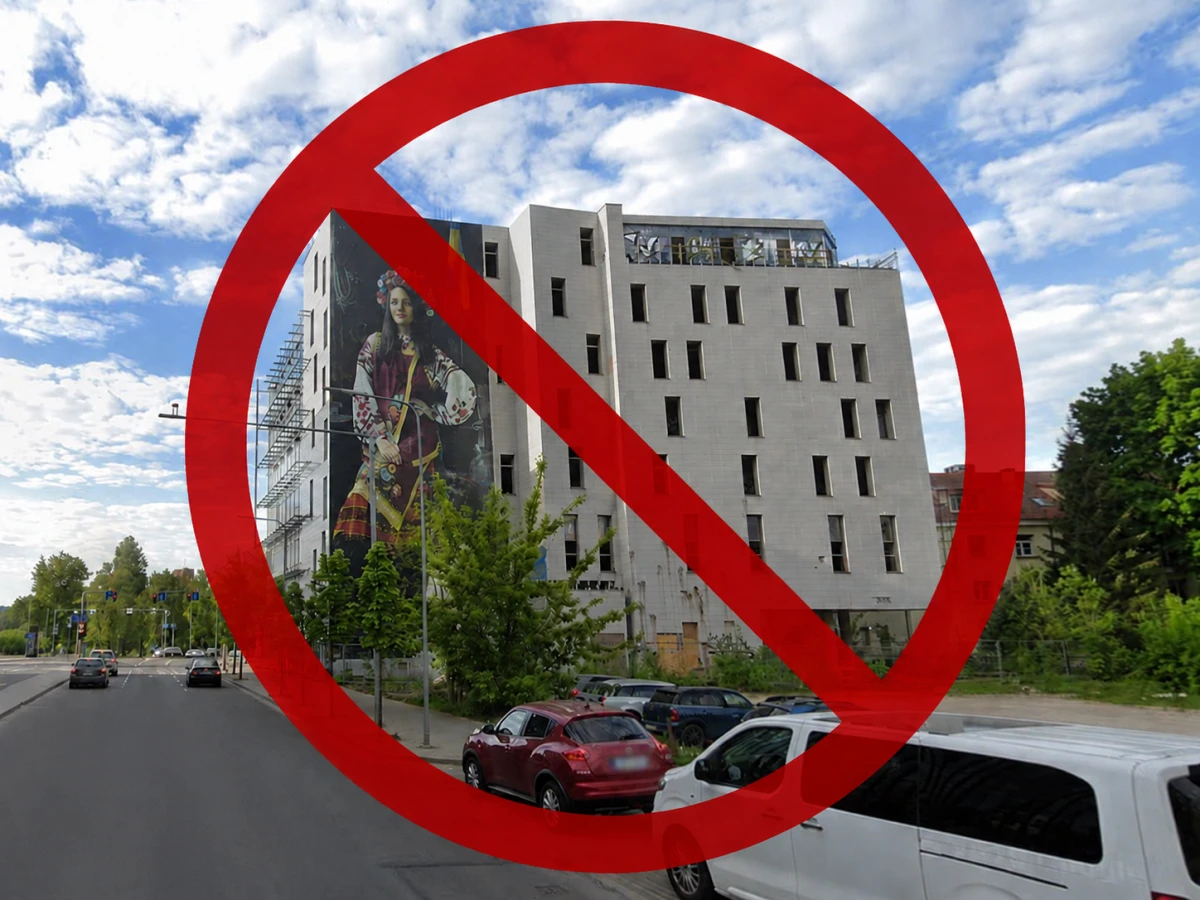
The authorities of Vilnius have turned to the court to challenge the decision of the creditors of the liquidated 'House of Moscow' to transfer the building to the municipality. At the same time, the city continues to insist on the prompt demolition of the property, which has been the subject of legal disputes for many years.
The authorities of Vilnius have questioned the legality of the decision to transfer the so-called 'House of Moscow' to the city and have turned to the court. This concerns an unfinished building in the center of the Lithuanian capital, the fate of which has remained unresolved for almost ten years.
According to the municipality, lawyers have raised doubts about whether the creditors of the liquidated institution had the right to write off the property and transfer it to the municipality. In the opinion of the city authorities, the question remains open as to whether such a decision complies with the requirements of the legislation.
Moreover, the municipality draws attention to the special status of the building. Since the court previously recognized the construction as illegal and ordered the building to be demolished, questions arise about the possibility of its transfer into civil circulation.
The first court hearing on the complaint is scheduled for June 12.
Previously, the creditors of the liquidated institution — the State Tax Inspectorate and the social insurance fund Sodra — decided to write off the property and transfer it to Vilnius in accordance with the legislation on the insolvency of legal entities. However, the city authorities believe that the issue requires further legal assessment.
At the same time, the municipality's position regarding the building itself remains unchanged. The main goal of Vilnius is still the demolition of the property. The municipality emphasizes that consultations with the Ministry of the Environment are ongoing, and the authorities are looking for the fastest and most economically justified way to dismantle the building.
In fact, the dispute now is not about preserving the building, but about who should take responsibility for its future fate and the costs of demolition. At the same time, the possibility of a settlement between the parties to the process is being discussed.
According to Lithuanian authorities, a scenario is being considered in which a private company or another interested party will take on the organization and financing of the demolition. After an agreement is reached, it will still need to be approved by the court.
The history of the 'House of Moscow' in Vilnius has been ongoing for more than two decades. The project began to be developed back in 2004, but in 2016, the court declared the issued construction permit invalid. The developer was obliged to either legalize the property or bring it into compliance with new requirements. After this was not done, the court ordered the building to be demolished.
In 2022, the State Construction Inspectorate was granted the right to organize the demolition of the property. Despite this, four years later, the demolition decision remains unfulfilled.
Now the further fate of one of Vilnius's most famous long-term constructions is once again to be decided by the court.
It is worth noting that in Latvia, the issue of the Latvian 'House of Moscow' is being resolved differently. The Riga building was successfully completed and used at one time, and after the events of 2022, it was nationalized by the state and put up for auction, but a buyer has not yet been found. To date, eight auctions have ended without results, despite a price reduction of about 40% (details here).














Leave a comment