
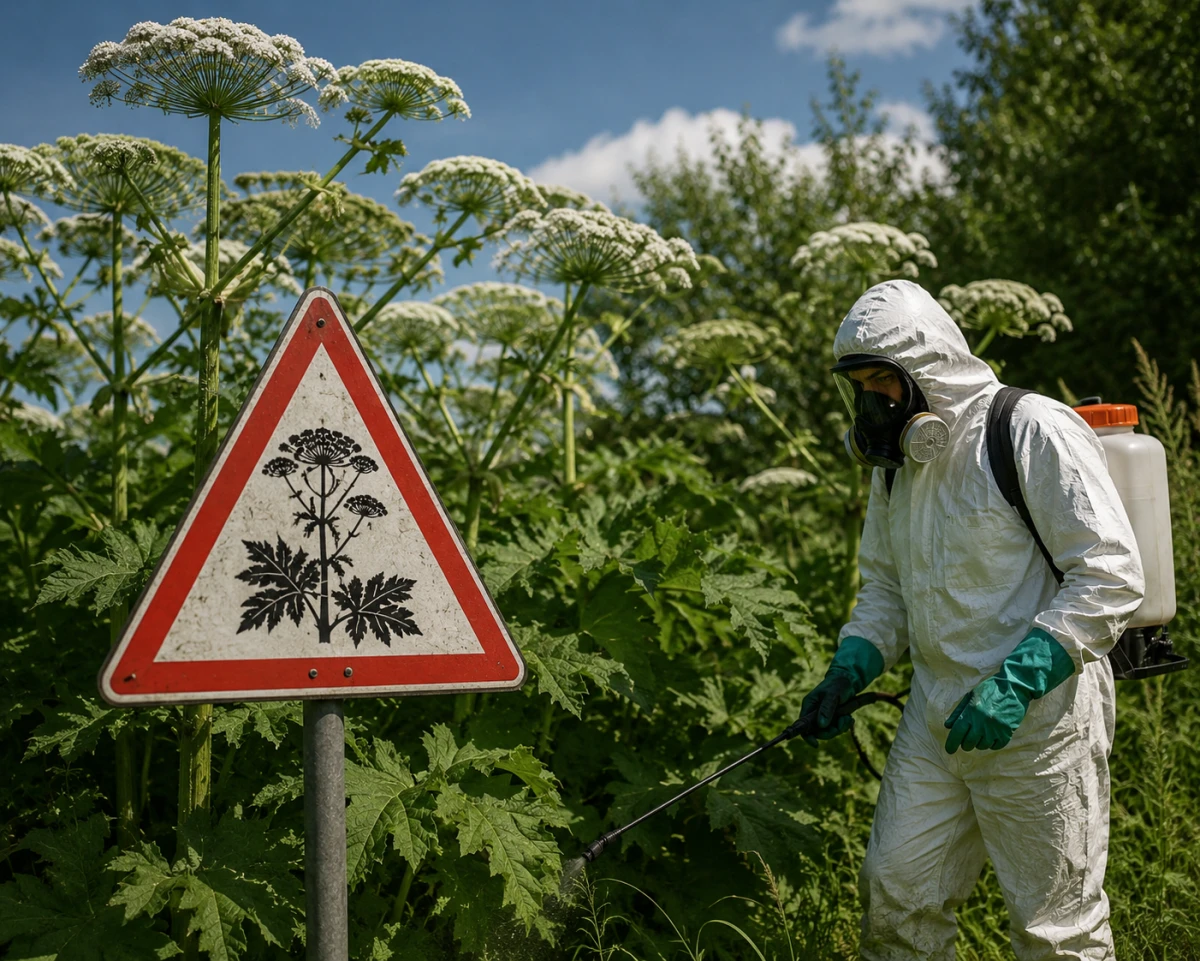
Despite years of struggle, giant hogweed remains one of the most serious ecological problems in Latvia. The state has placed the responsibility for its eradication on landowners, but experts acknowledge: it is still not possible to completely stop the spread of the plant.
Giant hogweed has long become a familiar part of the Latvian landscape, although its presence is still considered a serious threat to both nature and humans.
Today, the main efforts are focused on limiting the spread of the plant and its eradication; however, the issue of practical use of the vast amounts of biomass remains unresolved. Scientists continue to search for ways to utilize hogweed, but no significant breakthroughs have occurred so far.
In fact, the only ones who have learned to use the plant are bees, which collect nectar from it for honey, as well as some artists and craftsmen who create interior items and decorative objects from its stems, writes Latvijas Avīze.
At the same time, the problem has long gone beyond Latvia. Giant hogweed is included in the European-wide list of invasive species that pose a threat to the environment. The European Union's list includes 114 species of animals and plants that require special control measures.
In Latvia, specific Cabinet of Ministers regulations have been developed only for two particularly problematic species — giant hogweed and the Spanish slug. The main responsibility for combating hogweed is placed on landowners and local governments.
Currently, no state funding is allocated for these purposes. According to the Ministry of Agriculture, support programs were only in effect in 2006 and 2007. After assessing the results, it was decided to discontinue further funding. The ministry explains this by stating that continuous subsidies may reduce landowners' interest in completely eradicating the plant. Additionally, this concerns expenses amounting to several million euros.
Particular difficulties arise in areas where combating hogweed is complicated or restricted. The plant actively spreads on abandoned lands, near water bodies, in protected natural areas, and other places where chemical control methods cannot be freely used.
For ordinary landowners, the problem also has a financial aspect. Latvian legislation provides for administrative liability for allowing the spread of hogweed. The fine for individuals can reach 1500 euros, while for legal entities, it can be 3000 euros.
At the same time, specialists emphasize an important detail: if a plant with a fully formed inflorescence is found on the site, it is considered that the measures to limit its spread were insufficient.
However, in practice, fines are applied relatively rarely. According to the State Plant Protection Service, in 2024 and 2025, only seven individuals and four companies received penalties. In most cases, these were warnings or fines of up to 100 euros.
So far, specialists do not expect that hogweed will completely disappear from Latvia in the foreseeable future. Rather, it is a matter of ongoing control and containment of its spread so that the dangerous plant does not seize new territories.











Leave a comment