
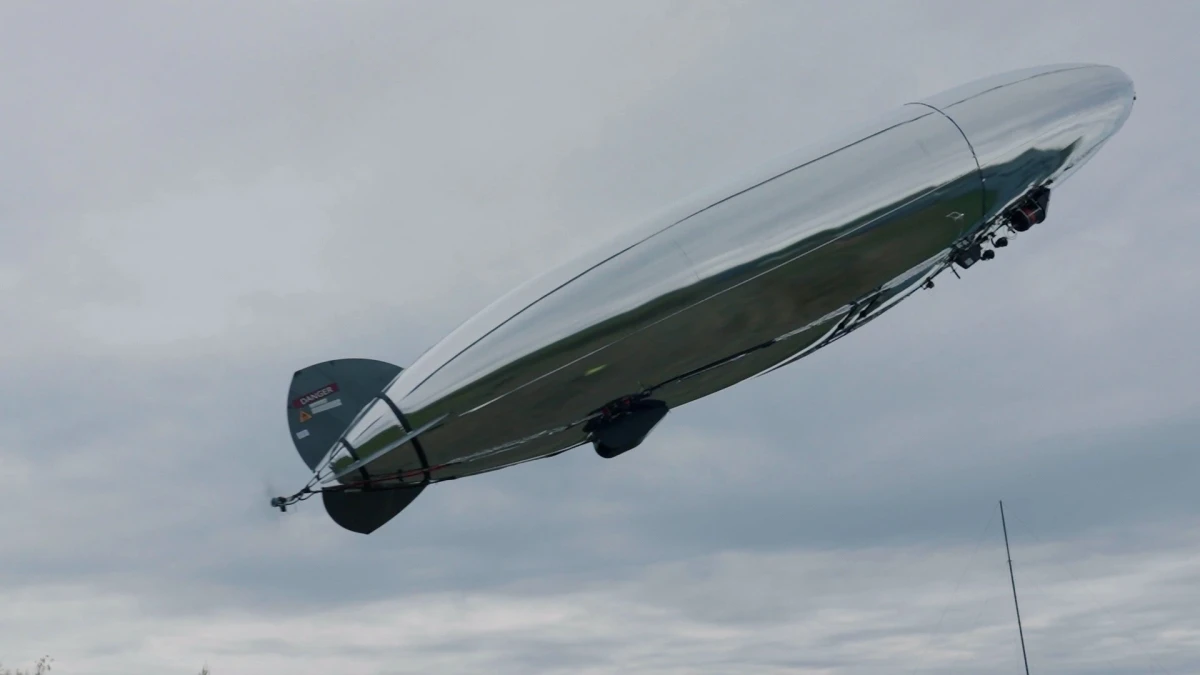
Finland is betting on an unusual military technology: modernized airships from World War I.
In the Finnish countryside near the border with Russia, a World War I-era aircraft has been revived — an airship, reports NOS. Its modern version is intended for reconnaissance, observation, and information gathering. These aircraft will be deployed in NATO exercises in Finland as early as next week.
On the premises of the Finnish company Kelluu in the city of Joensuu, there is a 12-meter airship secured to a special trolley. Balloons filled with hydrogen allow it to ascend into the air like a helium balloon. Movement and control are provided by a hydrogen engine with a propeller at the tail.
"We wanted to create an aircraft that would fill the niche between satellites and drones," says inventor and manufacturer Juri Jormakka. "And suddenly we remembered airships from a century ago."
Modern airships can stay in the air for up to 12 hours at a time, significantly longer than most drones. They can cover much larger areas, conduct surveillance, and gather intelligence. Unlike satellites, these aircraft can remain over a single point for extended periods.
Russian Interference Spurred Technology Development
Jormakka and his partner began working on the project eight years ago. The first years were a series of experiments, mistakes, and new attempts.
"We had almost no money, and we were allowed to use part of an old farm for free," he recalls.
One of the advantages was the company's location in the countryside, where there was ample space for testing various prototypes. Additionally, proximity to the Russian border proved beneficial for development.
"In this region, we constantly encounter Russian interference with electronic signals," says Jormakka. "Thanks to this, we have gained significant experience and are prepared for many scenarios."
Finland has a land border with Russia that stretches over 1,300 kilometers. The rising tensions in the eastern direction are driving the development of defense technologies within the country, especially in the field of aerial reconnaissance and observation.
Focus on Defense Technologies
In collaboration with one of the Finnish universities, a Finnish-Polish company called Iceye was established, which produces next-generation satellites. Instead of traditional cameras, they use radar technologies that allow them to observe the Earth's surface even through clouds and in poor weather.
Today, Iceye is considered the largest company in the world in the microsatellite segment and is actively working on defense projects.
Europe Aims to Reduce Dependence on the U.S.
The development of such technologies is crucial for Europe, which is trying to reduce its military dependence on the United States.
According to Iro Särkkä from the Finnish Institute of International Affairs, European countries need to distribute responsibilities among themselves.
"It makes no sense for each country to try to develop all areas of the defense industry simultaneously," the expert believes. "Cooperation is necessary. Sometimes a country has to set aside its own ambitions and acknowledge: if partners can produce something better, faster, and cheaper, then we should focus on another task."
NATO Exercises and Artificial Intelligence
At Kelluu, preparations are already underway for large NATO exercises that will take place at several sites in Finland. Today, airships are capable of flying without a pilot, using artificial intelligence technologies to navigate predetermined routes.
Jormakka smiles as he says that during the exercises, the airships will surely attract a lot of attention.
"Some people think they are flying saucers and that aliens have come to Earth," he jokes.
The revival of airships shows that modern armies are increasingly turning not only to the latest technologies but also rethinking old ideas. Finland hopes that such aircraft can occupy an important place between satellites and drones, providing prolonged observation over large areas. Against the backdrop of rising tensions in relations with Russia and Europe's desire to strengthen its own defense capabilities, such developments could become an important part of future intelligence and security systems.












Leave a comment