
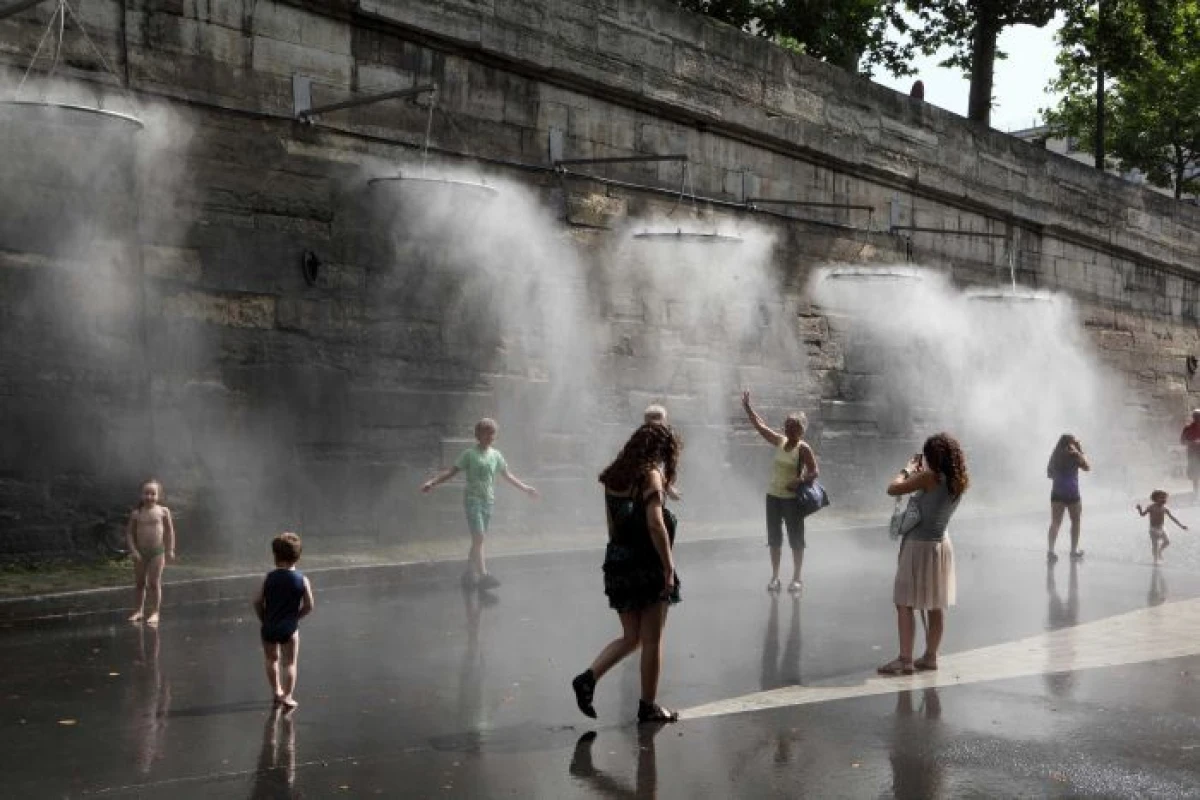
"The climate we live in today is no longer the one we grew up in, and our buildings and infrastructure are completely unprepared for the future."
Record heat in May has engulfed a significant part of Europe: countries remain under a "powerful" heat dome, and experts warn that the worst is yet to come.
The French meteorological service Météo France reported on Monday, May 25, that new monthly highs have been recorded at more than 350 weather stations, with the highest temperature of 37.1 °C noted in the Osségor area near Biarritz. This extreme heat has already been linked to several fatalities and shows no signs of retreating.
The record for the hottest May date in the UK was broken again yesterday — for the second consecutive day, as temperatures in some areas of London exceeded a blistering 35 °C.
According to the weather forecasting service WFY24, temperatures in dozens of European capitals significantly exceeded the climatic norm for this time of year.
The greatest deviation from the norm was recorded in London, where temperatures surpassed the average May values by more than 16 °C, while Paris (+14 °C), Berlin (+11 °C), Lisbon (+10 °C), and Madrid (+10 °C) also faced exceptional heat. Even cooler regions, such as Oslo, enjoyed mild weather: it was 18 °C, 3 °C above average for late May.
Is climate change to blame for the May heat engulfing Europe? Meteorologists explain the prolonged extreme heat by a heat dome that traps hot air; however, this phenomenon is becoming increasingly frequent due to human-induced global warming.
"This record heat is literally all stamped with the imprint of climate change," says Friederike Otto, a professor of climatology at Imperial College London.
"Such temperatures were recently an exception even in the height of summer. To see 35 °C in the UK in spring is truly astonishing, but the science is clear: climate change is making these heatwaves hotter, longer, and much more frequent."
What is a heat dome and why is Europe suffocating from record May heat?
Otto warns that the string of temperature records will continue until global emissions are reduced and countries achieve carbon neutrality.
"The climate we live in today is no longer the one we grew up in, and our buildings and infrastructure are catastrophically unprepared for what lies ahead," she adds. "Although we have managed to reduce emissions somewhat, it is happening too slowly."
Which countries will be most affected by rising temperatures in 2026?
The Copernicus Climate Change Service (C3S) of the European Union and the European Centre for Medium-Range Weather Forecasts (ECMWF) predict that the summer of 2026 is likely to be influenced by a "relatively weak atmospheric pressure pattern."
This could significantly impact temperatures, weakening winds and often leading to hot, stagnant days.
Seasonal temperatures are expected to be above normal this year across all regions, with the most confident signal given for the southeastern parts of the continent, while C3S also points to less abundant rainfall than usual in Eastern Europe.
Ioanna Vergini, founder of the global weather forecasting service WFY24, told Euronews Earth that Europe should prepare for a "combination of heat and drought in the south, a belt of wildfires from Portugal to Greece, and then sudden floods in the fall."
For every 1 °C increase in air temperature, the atmosphere can hold about 7% more moisture, leading to more intense and heavy precipitation.
"Southern Europe remains the most vulnerable region, but Central and Eastern Europe are warming the fastest and are the least adapted to days with temperatures above 35 °C, which have now become routine for them," says Vergini. "It is in cities where the most people perish."
Infrastructure such as concrete and asphalt retains heat and maintains high outdoor temperatures, especially in urban areas. This phenomenon is called the urban heat island effect.
How can Europeans survive extreme heat this summer?
European cities are increasingly working to protect residents from heat stress. For instance, Spain has the world's largest network of climate shelters, providing access to public buildings with free resting places, water, and air conditioning.
In Barcelona alone, there are already 400 climate shelters in public buildings — from libraries and museums to sports centers and shopping malls. Other cities are adopting this initiative: the General Council of Bucharest approved the creation of climate shelters earlier this month.
Cities like Paris have been preparing for rising temperatures for decades, striving to turn scorching streets into "green oases." Since 2020, they have removed over 6,000 parking spaces and eliminated 1.3 hectares of asphalt to free up space for greening the streets.
By 2024, Paris had nearly 100 streets with flowerbeds and green plantings, where nature coexists with urban life. Trees and plants improve air quality, which is especially important for polluted cities.
Since 2020, more than 100,000 trees have been planted in Paris to provide more shade for residents and increase the absorption of greenhouse gases.
"Know the heat warning system in your country, visit elderly neighbors, and don’t count on it getting cooler at night," adds Vergini.
"Tropical nights, when temperatures do not drop below 25 °C, have now become the norm in Southern Europe and intensify daytime stress on the body."
The expert urges authorities to stop treating the planning of heat protection measures as purely "reactive" and to ensure that such measures are planned in advance. "Seasonal forecasts provide a lead of several months, but they are not being used effectively," she says.














Leave a comment