
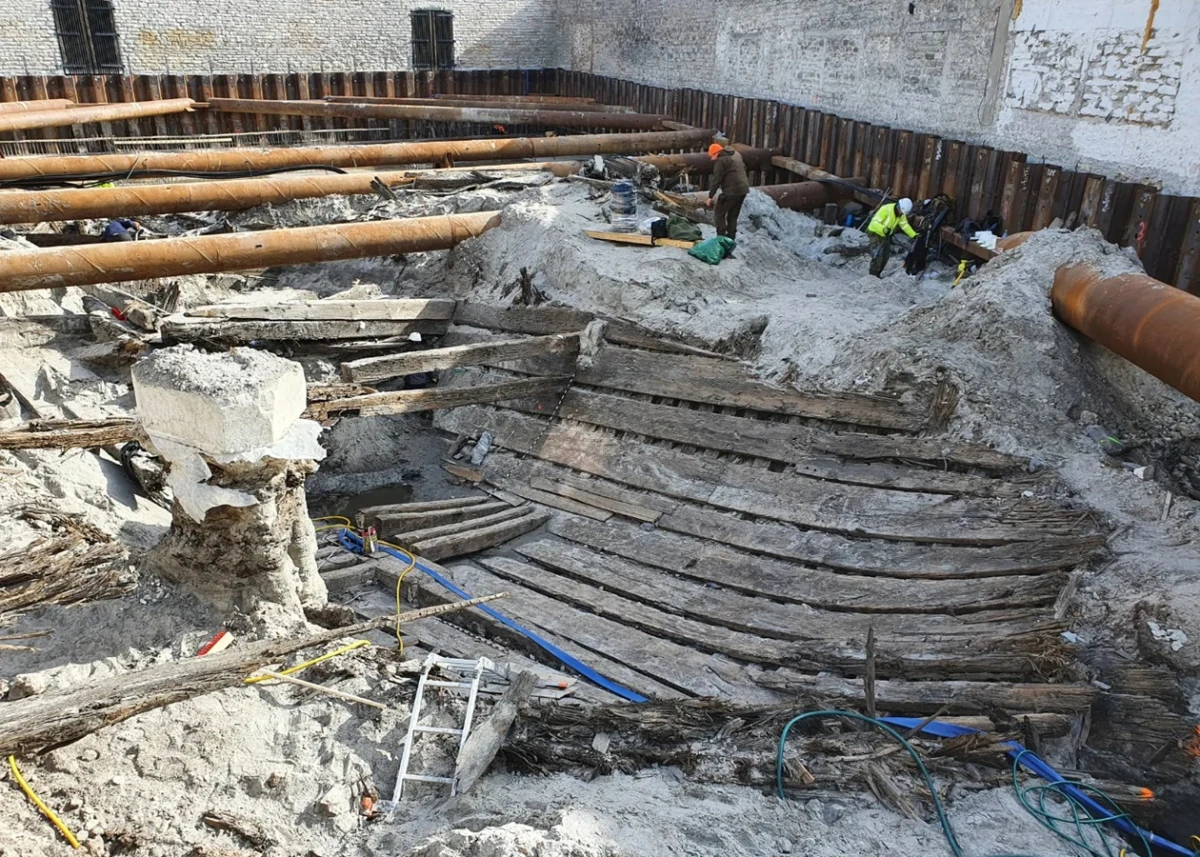
During the construction of an office building in the center of Tallinn, archaeologists discovered a unique 14th-century trading ship that had lain underground for over 600 years. The vessel, named Lootsi 8 cog, has become one of the best-preserved medieval finds of its kind in Europe, reports Arkeonews.
The discovery was made in 2022 during excavation work on Lootsi Street near the old port of the city. Builders stumbled upon a wooden structure at a depth of about one and a half meters, after which the work was immediately halted and archaeologists were called in. Instead of separate fragments, specialists discovered nearly an entire large trading cog - a type of vessel that was actively used in the Baltic Sea during the Hanseatic League era.
The ship is approximately 24.5 meters long and 8.6 meters wide. Due to its large size and the fragility of the structure, the vessel had to be raised from the ground in four separate sections. It is currently being studied and preserved at the Estonian Maritime Museum.
The most attention from researchers was drawn to the dry compass from the 14th century found on board. Archaeologists believe it may be the oldest surviving compass of its kind in Europe. According to researchers, the mechanism is still operational. The find indicates a high level of navigational technology among medieval seafarers in the Baltic region.
Along with the compass, tools, weapons, leather shoes, remnants of tar, and even the remains of two ship rats were discovered on the ship. Some items showed signs of repair and active use, providing better insight into the daily life of the crew.
Scientists also conducted dendrochronological analysis of the wood. The study of the growth rings showed that the oaks used for building the ship were felled in the winter of 1370–1371 and 1371–1372. This allowed for a nearly precise determination of the ship's construction time. Part of the wood was likely sourced from what is now Lithuania, confirming active trade connections in the Baltic region at that time.
Archaeologists note that other medieval ships may remain under modern Tallinn. Nearby Lootsi 8, another older vessel has already been discovered, which has not yet been raised in order to preserve it until more advanced research methods become available.
The find is already being called one of the most significant archaeological sensations in recent years in the Baltic region, writes bb.lv. Scientists hope that the study of the ship will help better understand shipbuilding technologies, trade, and daily life during the Hanseatic League era.













Leave a comment