
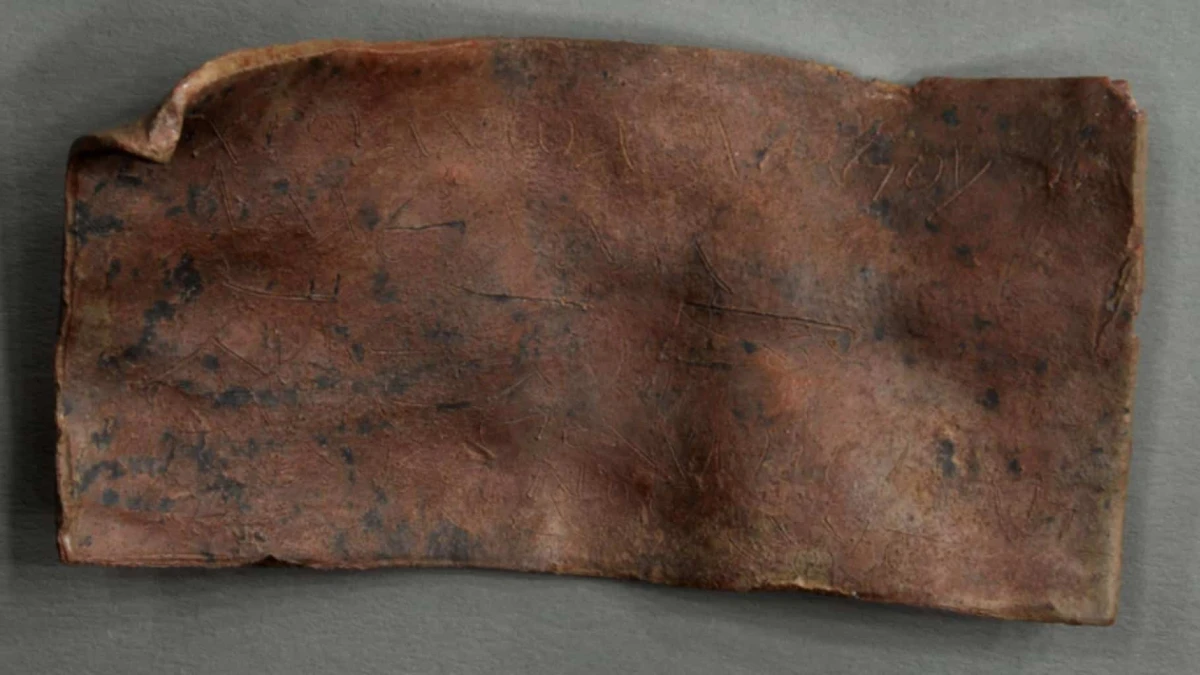
These symbols were likely used to convey messages to supernatural forces.
Small tablets with curses, known in Latin as defixiones and in Greek as katadesmoi, were extremely common in antiquity. Archaeologists regularly find them in various locations—from Egypt to Britain. They were typically made of lead—a heavy, cool-to-the-touch material that was easy to scratch inscriptions into and which was believed to possess magical "binding" properties.
Typically, the tablets contained appeals to gods, demons, or the deceased (as intermediaries for contacting supernatural forces) with the aim of causing harm to a particular person or people. Curse tablets and spells were usually rolled or folded, sometimes pierced with a nail, and then buried in the ground.
Sometimes symbolic objects are found inside such lead bundles: hair, bones, small figurines, pierced with nails. They were likely placed there to enhance the effect of the curse.
During excavations in the city of Herleen (Netherlands), where the Roman military settlement of Coriovallum was located two thousand years ago, archaeologists discovered a lead tablet measuring 9.3 by 4.8 centimeters in a pit beneath the square in front of the town hall. The find was dated to the 2nd century AD.
Analysis conducted at the Heidelberg University Institute of Papyrology (Germany) revealed that the appeal to supernatural forces inscribed on the tablet from Herleen was not in Latin, as on other similar defixiones found in Northern Europe, but in ancient Greek. Moreover, it was in an Egyptian style, the university announced in a press release.
Researchers established that the artifact contains three separate groups of symbols. Thus, the tablet features a group of three magical symbols known as characteres. According to Rodney Ast, the scientific director of the Institute of Papyrology, these symbols were likely used to convey the desired message to the supernatural forces.
Following the characteres, the names of two men and two women are listed, referred to as fellow slaves. The tablet contained either a curse directed at these four slaves or a curse on their behalf against an unnamed individual, Ast suggested.
According to the scholars, the composition of the group of people mentioned on the tablet is also unusual: it includes two men with Latin names and two women with Greek names. "It cannot be ruled out that one of the two women was the author of the inscription and brought the presumed ability to communicate with divine forces through such curses from Roman Egypt," explained Yulia Lugovaya, a research associate at the Institute of Papyrology.
In the advanced civilization of Ancient Egypt, magic played an important role. Some magical practices, especially those related to protection and healing, were officially recognized and were an integral part of religious life. Other practices, in which personal interests were pursued at the expense of others, were typically carried out in secret.
"In the early centuries of our era, Near Eastern, Egyptian, Jewish, and sometimes even Christian traditions increasingly merged and spread throughout the Roman Empire of that time, which is impressively demonstrated by the tablet from Herleen," noted Professor Joachim Kwak, director of the Institute of Egyptology at Heidelberg University.















Leave a comment