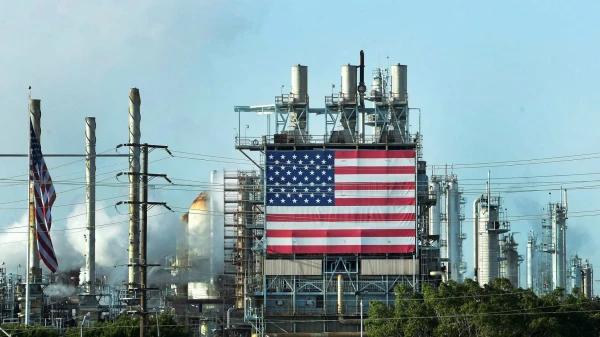
The global conflict in Iran has triggered a sharp rise in fuel prices, leading to a significant strengthening of positions and unprecedented super-profits for American oil refining companies.
American oil refineries (refineries) are among the few who have benefited from the conflict in Iran. High prices for diesel and aviation fuel, along with easy access to North American oil, have provided them with colossal profits, writes the Financial Times.
The war in Iran has triggered a reduction in production in the Gulf countries, disrupting the operations of refineries both in the region and beyond. Asian countries, which traditionally depend on Middle Eastern oil supplies, have been particularly hard hit.
European refineries, despite access to raw materials from other regions, have been unable to take advantage of the situation. The rapid rise in global crude oil prices has almost completely absorbed their potential profits from selling finished fuel at increased prices.
Favorable Position of American Refineries
Unlike their European counterparts, American refineries find themselves in a significantly more advantageous position. They have access to cheaper domestic oil, as well as imports from Canada and Mexico, which significantly reduces the cost of raw materials.
Robert Campbell, head of product development at the consulting firm Energy Aspects, emphasized: "American refineries have long enjoyed the advantage of cheaper domestic oil; for the past ten years, they have been working to expand access to this raw material." He added: "Now we see what this advantage gives."
American refineries are operating at nearly full capacity, striving to make the most of the current market conditions. They have significantly increased exports of diesel and aviation fuel to Europe and Asia, even sending shipments to Australia.
According to Rystad, the margin for American refineries has surged to $20–25 per barrel, nearly double the figures from early March. Shares of giants ExxonMobil and Chevron, which have large refining capacities, have risen by 21% and 18%, respectively, since the beginning of the year.
Shares of refineries focused on the domestic market, such as Valero Energy, HF Sinclair, Marathon Petroleum, and Phillips 66, have shown even more impressive growth. On average, their stocks increased by 27% over the same period.
Thus, American refineries are reaping the benefits of what the Trump administration calls "U.S. energy dominance." The shale boom has turned the country into a leading exporter of refined petroleum products.
Venezuelan Support Factor
Andy Walz, president of Chevron's refining, transportation, and chemicals division, noted that the increasing import of crude oil from Venezuela is also benefiting the United States. Chevron is the largest private oil operator in Venezuela.
Since the Trump administration seized President Nicolás Maduro, the company has only increased its stake in local projects. Walz stated that Chevron is focused on "supplying as much gasoline, diesel, and aviation fuel as possible."
"If 2026 has taught us anything, it’s that the world needs more energy," Walz said. He added that "increased supplies from Venezuela help American consumers as well as Venezuelans."
According to the U.S. Energy Information Administration, imports of crude oil from Venezuela have tripled over the past year. It reached 412,000 barrels per day, accounting for about 3.5% of the total oil imported by the U.S.
Susan Bell, senior vice president of refining at Rystad, explained that refineries are likely making super profits since crude oil prices in North America have not risen as sharply. This contrasts with the prices of physical oil shipments in Asia, which are much more dependent on exports from the Gulf.
She clarified: "American refineries are in a winning position because for them, the prices of physical oil deliveries have not soared as high as prices in the Pacific region."
Potential Risks and Challenges
However, American refineries are not completely immune to sharp price fluctuations caused by the conflict in Iran. Last week, Exxon and Chevron reported billion-dollar "paper" losses.
These losses arose from the revaluation of derivatives following the March spike in oil prices. Companies were forced to realize losses on hedges related to yet-to-be-delivered cargoes.
At Phillips 66, such losses reached $900 million. However, companies are confident that these losses will be offset as fuel will ultimately be sold at higher prices.
Campbell from Energy Aspects warned that despite the short-term gains, American refineries may face increased competition. This will happen if Asian buyers start to aggressively compete for American supplies in the event of a closure of the Strait of Hormuz.
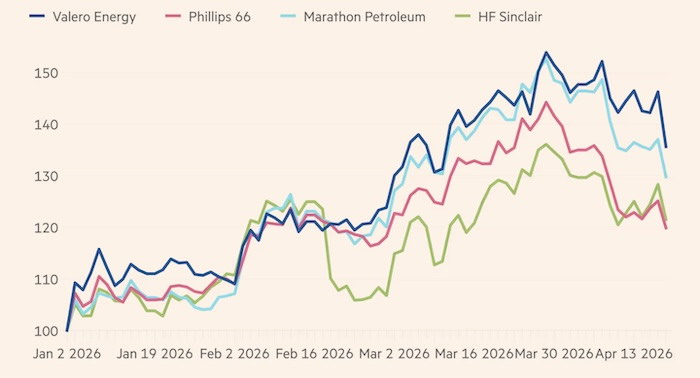
Dynamics of stock prices of American refineries. Source: Financial Times
"Let’s see if tension arises in the American crude oil market in the coming months," Campbell noted. Additionally, American motorists have already felt the effects of the global crisis in the oil and petroleum products market.
High prices at the pump may impact the outcome of the upcoming midterm elections in the U.S., scheduled for November.