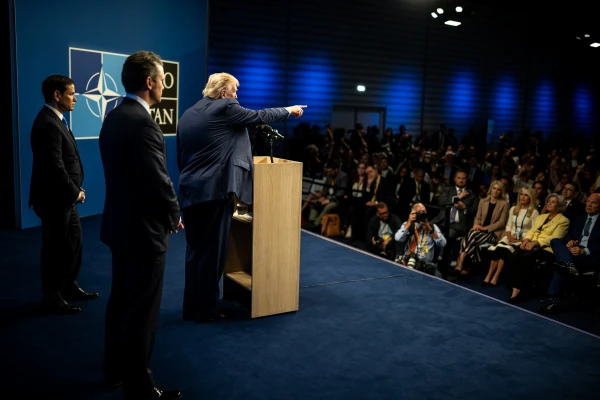
Frequent threats by US President Trump to withdraw from NATO, as well as the active use of costly military resources by the US military in Iran, have weakened the alliance, said the former US ambassador to NATO to Euronews.
Former US Ambassador to NATO Ivo Daalder stated that the repeated threats by US President Donald Trump to withdraw from NATO, as well as the confrontation with America's European allies over their refusal to join the war, have led to the "worst crisis" NATO has ever faced.
"The last six weeks have been extremely destructive for NATO," Daalder said in an interview with Euronews correspondent Shaun Murray.
"We see a divided NATO, which has been the goal of the Soviet Union first and then Russia for most of the last 80 years," he pointed out.
According to Daalder, Trump's statements that the US may not defend NATO allies against future military aggression from Russia or other adversaries have destabilized the alliance and shaken the world order.
He added that the six-week war against Iran has depleted US military resources, as large stocks of interceptors and other missiles were destroyed during the bombing campaign.
"An alliance that is truly in disarray, NATO, where the President of the United States says: 'I’m not going to protect you,' is a good time to test NATO if you’re sitting in Moscow," he said.
"It’s also a good time to test what you might get away with in Taiwan if you’re sitting in Beijing, because much of the US military capability has been shifted to the Persian Gulf," he warned.
Daalder, who served as the US ambassador under former President Barack Obama from 2009 to 2013, called the war between the US and Iran a "strategic mistake of historic proportions."
His comments came as NATO Secretary General Mark Rutte is in Washington for a series of talks, including with Trump, Secretary of State Rubio, and Defense Secretary Pete Hegseth.
Meanwhile, Daalder believes that, at first glance, Iran has a "decisive advantage" regarding the terms of the ceasefire agreed upon on Tuesday to prevent complete "civilization collapse."
An agreement has been reached to resume international shipping routes through the Strait of Hormuz; however, it is reported that vessels will require permission from the Iranian armed forces to pass.
Iran is holding the strait hostage as part of its revenge against the US and Israel. Its effective closure has caused a sharp rise in gas and oil prices, as well as significant economic uncertainty worldwide.
It remains unclear how security in the strait will be ensured for all international shipping, including the transportation of oil and gas from the Persian Gulf.
"The Strait of Hormuz was open before the bombing began," Daalder said.
"Now ships can pass through it. We don’t know how many. We don’t know when. We don’t know where. And in any case, the Iranians say they will maintain control," he said.
"This is a massive change in favor of Iran and to the detriment of not only the United States and Israel," he stated.