It is expected that 400 missiles will be produced for combat duty and another 234 for testing and as backups.
The American nuclear deterrence strategy relies on three components: strategic aviation, submarines with ballistic missiles, and ground missile systems. The essence of this "triad" is that the presence of three independent means of delivering a strike virtually eliminates the possibility for an adversary to disarm the U.S. with a surprise attack.
Since 1970, the ground component has been primarily represented by Minuteman III missiles: of the 550 built, about 400 remain in service, deployed in 450 silos across the states of Wyoming, North Dakota, and Montana. However, these systems have significantly aged: their reliability is decreasing, and maintenance is becoming increasingly complex.
They are planned to be replaced by Sentinel missiles — three-stage solid-fuel ICBMs approximately 18 meters tall. It is expected that 400 missiles will be built for combat duty and another 234 for testing and as backups.
Initially, it was planned to use existing Minuteman III silos. However, most of them are as old as the missiles themselves. These structures were built individually, from monolithic reinforced concrete, using outdated technologies.
Their electronics are based on analog systems with hard wiring, so any modernization requires significant reconstruction. Communication is conducted via copper cables and telephone lines, climate control systems are outdated and contribute to increased humidity, and the internal spaces are cramped and inconvenient for repairs. Moreover, many silos are physically worn out, and the new Sentinel missile is larger than its predecessor, which further complicates the task.
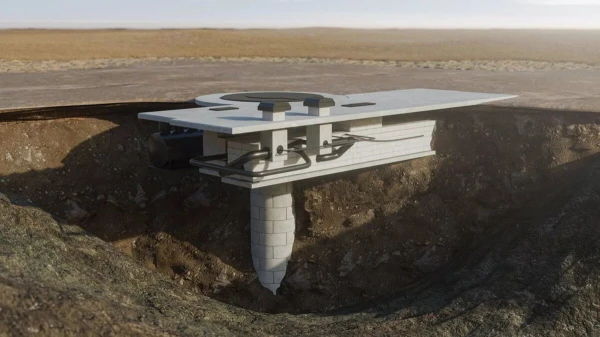
As a result, it became clear that modernizing the old silos would be more expensive and complicated than building new ones. Therefore, Northrop Grumman, in collaboration with Bechtel, received a contract to develop a prototype of the new silo. The official start of construction took place on March 27, 2026, at the Promontory site in Utah.
The new Sentinel silo is fundamentally different from the previous ones: it is standardized, modular, built faster, and easier to upgrade. Instead of monolithic concrete, factory-prefabricated sections are used, which are delivered to the site and assembled — similar to tunnel segments. This modular approach is applied to the entire infrastructure, facilitating repair and updates.
The electronics are now built on a digital architecture with software-defined systems. Communication is conducted via secure fiber-optic lines with high bandwidth. Life support systems take into account decades of technological progress, and the layout has become more ergonomic, providing quick access to equipment.
According to the U.S. Air Force, all 450 new silos will be built in the same areas where the existing ones are located. As with the Minuteman III, the difference between the number of silos and missiles is related to international agreements and the need for testing. Transitioning to new silos will allow for maintaining the full combat readiness on duty.
The Sentinel missile has already undergone live-fire tests of all stages, and flight tests are scheduled for 2027. Initial operational capability is expected in the early 2030s.