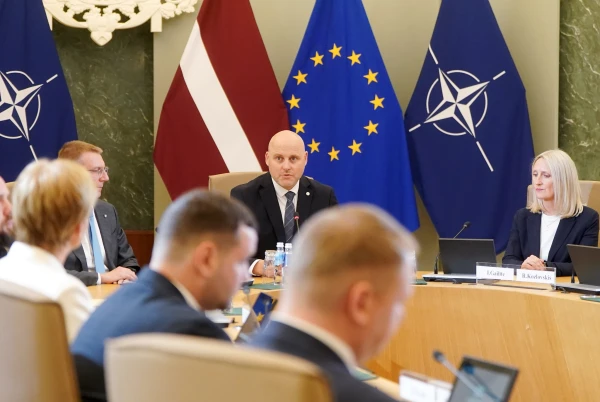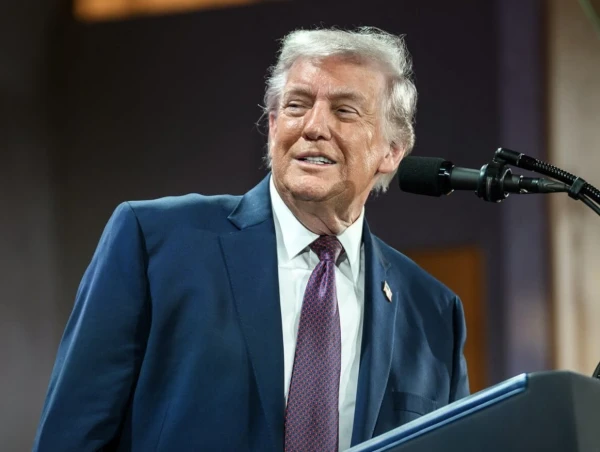
U.S. President Donald Trump applied his characteristic intimidation tactics toward Iran; however, so far it has only worked in the short term, said political scientist and professor at the University of Latvia Janeta Ozolinya in an interview with Latvian Radio, commenting on the two-week ceasefire reached between the U.S. and Iran, LETA reports.
She admitted that in the next two weeks, Iran or Israel might violate the ceasefire; however, the U.S. is likely to adhere to it. Even if some final agreement on the further development of the process is reached after two weeks, no one can be sure that it will proceed peacefully and acceptably for the international community, the expert believes.
In response to a question about what Trump might have meant when he publicly threatened the destruction of an entire civilization, she said that this should probably not be taken literally. However, the U.S. could carry out bombings that would cause a very serious crisis for Iran's economy and the entire region, the political scientist explained.
Ozolinya believes that there is no winner in the current situation. It may be a relief to breathe easy that, for a time at least at first glance, there is no military threat; however, a two-week relief for shipping in the Strait of Hormuz does not mean that fuel prices will drop and supplies will no longer be delayed, noted the professor of the University of Latvia, adding that the region as a whole has lost stability, and this will have far-reaching, unpredictable consequences.
The political scientist reminded that the initial goal of the U.S. was to neutralize Iran's nuclear program; however, this is hardly mentioned now, and attention has shifted to shipping in the Strait of Hormuz. After this issue is resolved, the question of the future of Iranian society and governance will arise, where many internal and regional conflicts are expected, which the U.S. will have to engage in resolving, predicts Ozolinya.
As reported, the U.S. and Iran agreed on a two-week ceasefire on Tuesday, about an hour before the expiration of the ultimatum issued to Iran, and Tehran agreed to temporarily reopen the Strait of Hormuz for shipping.
Iran characterized this ceasefire as its victory and announced that it had agreed to negotiations with the U.S., which will begin on Friday in Pakistan, about a path to ending the war.
Trump stated that he spoke with leaders of Pakistan, who "asked me to delay sending destructive force to Iran tonight."
"If the Islamic Republic of Iran agrees to the complete, immediate, and safe opening of the Strait of Hormuz, then I agree to suspend bombings and attacks on Iran for a two-week period," Trump stated on his social media platform, Truth Social.
Iran's Foreign Minister Abbas Araghchi confirmed safe shipping through the Strait of Hormuz for two weeks.
"If attacks on Iran are stopped, our powerful armed forces will cease their defensive operations," Araghchi said.
Pakistani Prime Minister Shehbaz Sharif, who played an important mediating role, stated that the ceasefire should begin immediately.
He noted that the U.S. "with its allies" agreed to the ceasefire everywhere, including Lebanon. This means that Israel agreed to cease its invasion of Lebanon.
Following the announcement of the ceasefire, global oil prices dropped by more than 17%, while stock prices rose in morning trading on Asian exchanges on Wednesday.
Trump stated that the U.S. has made "very far progress in reaching a certain agreement for long-term peace with Iran and peace in the Middle East." "We received a 10-point proposal from Iran and believe that this is a workable basis for negotiations," Trump said.
Iran published these 10 points, which, however, contain maximalist demands, including the lifting of U.S. sanctions, guarantees of Iran's "ownership" of the Strait of Hormuz, and the withdrawal of U.S. armed forces from the region.
The draft plan calls for a permanent cessation of hostilities, maintaining further Iranian control over the Strait of Hormuz, and enshrining Iran's rights to enrich uranium, the Iranian news agency Tasnim reports.
Tasnim indicated that Tehran also demands the lifting of harsh international sanctions and measures from the UN Security Council.
The plan includes a demand to revoke resolutions from the Board of Governors of the International Atomic Energy Agency (IAEA), pay military reparations, and withdraw American troops from the region. It also calls for the cessation of hostilities on all fronts, including Lebanon.
The Fars news agency reported similar information, adding that Iran commits not to develop nuclear weapons. In further negotiations, uranium enrichment will be limited, and Tehran will cooperate with other countries in the region to achieve peaceful agreements.
On Sunday, Trump demanded that Iran agree to reopen the Strait of Hormuz by Tuesday at 8:00 PM Washington time (Wednesday at 3:00 AM Latvian time). He threatened to destroy all bridges and power plants in Iran within hours if Tehran does not comply with the ultimatum's demands.
On Tuesday, Trump intensified these threats, warning that an entire civilization would perish in Iran if Tehran rejected the U.S. ultimatum.
Pope Leo XIV stated that "these threats to the entire Iranian people" are "truly unacceptable."