“All four elements that the U.S. built after World War II are being destroyed by Trump.”
Trump embodies the decline of the West, claims Professor Acharya in an interview with The Hindu. The world is returning to a historical norm, to a multi-civilizational system. In it, multiple powers, norms, and institutions operate simultaneously, and no single country sets the rules for all, explains the expert.
Amitav Acharya is a distinguished professor of international relations at American University and the author of the book "The End of the Liberal World Order: Why Global Civilization Will Survive the Decline of the West" (2025).
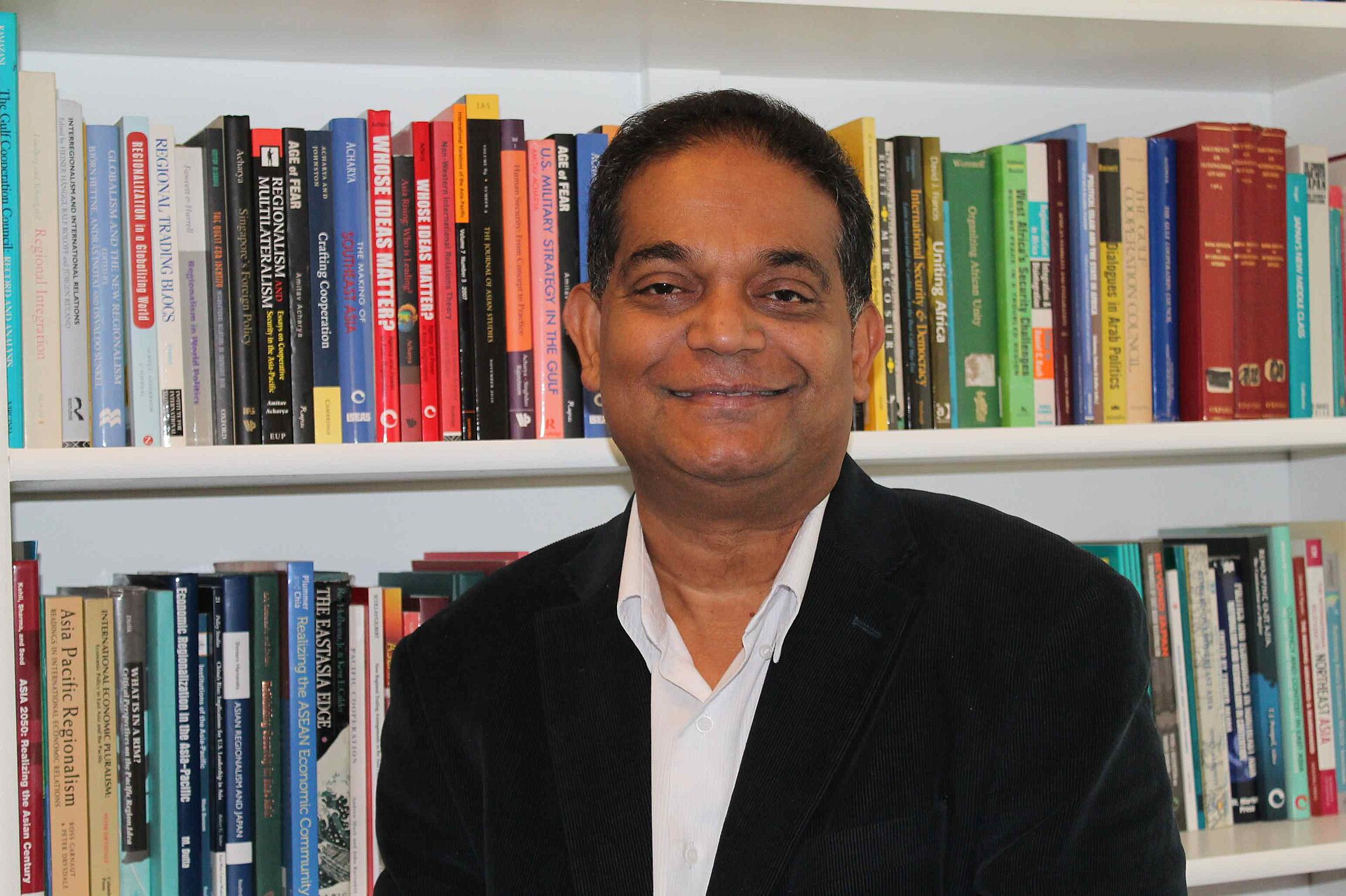
He turns to 5,000 years of history to show that the world order has never been a Western monopoly. Its decline is not a collapse, but a return to historical norm, to a multi-civilizational system. He calls this a "multiplex world": multiple powers, norms, and institutions operate simultaneously, and no single country sets the rules for all.
- You have been asserting since 2014 that the American world order is experiencing structural decline. Yet Trump bombs Iran, organizes regime change in Venezuela, and extracts significant concessions from India. If this is decline, what would dominance look like?
- The key distinction is between the decline of the United States as a power and the end of the order they established. I have never claimed that the U.S. is in decline. By military, financial, and technological metrics, the country remains number one. The liberal world order has ended: multilateralism, collective goods, promotion of democracy. What Trump is doing is not that. It is a transactional, unilateral, personal approach. When he uses tariffs as a weapon, he cashes in the institutional legacy of the liberal order. This is not strength. This is a hegemon taking advantage of what is left of its credit of trust.
— You described the liberal order as resting on four pillars: free trade, multilateral institutions, promotion of democracy, and alliances. Trump systematically attacks all four. But does he have any coherent system in return?
— He hates all four. Free trade: a scam that cost Americans jobs. Institutions: the UN, IMF, WTO are robbing the United States. Democracy: he doesn’t care. Alliances: he threatened Canada and Denmark. All four elements that the U.S. built after World War II are being destroyed by Trump. As for a replacement, there is none. Only chaos as a tool of foreign policy. He said he would never attack Iran, but he attacked Iran. He said regime change was a thing of the past, but Venezuela happened. The Western world kept insisting this was a temporary deviation. It is not. The order is gone.
— So Trump is a product of systemic decline, not its cause?
— Exactly. When he was elected in 2016, I supplemented my book with this argument: he is a consequence of decline, not its cause. He tapped into genuine grievances about globalization, about institutions, about the liberal establishment. Joe Biden came in wanting to revive the order. Donald Trump finished it off for good. What surprised even those of us who anticipated this was the speed and scale of the destruction.
— India signed a trade agreement with the U.S. under heavy pressure from tariffs, allegedly abandoned imports of Russian oil, and committed to $500 billion in purchases. Does this signify a defeat for Indian strategic autonomy?
— India rushed. I was in the office of Foreign Minister Subrahmanyam Jaishankar in New Delhi on the very day tariffs were announced. He told me: "We will weather this. India held its position, like other BRICS countries." But Prime Minister Narendra Modi apparently overturned this decision. If India truly abandoned Russian oil and agreed to the removal of tariffs on American goods, and in return only received 19% on its exports — this is not a deal, but a loss. India should have waited. The U.S. Supreme Court would likely have overturned many of these tariffs anyway. Trump has such influence because every country has become dependent on access to the American market. This dependency is the real problem.
— Aside from the trade deal, what would you recommend for Indian foreign policy in this era? Where is India making major mistakes?
— India’s biggest strategic problem is its obsession with Pakistan. This energy should be directed towards pragmatic engagement with China. Not to stick out, build resilience, and take advantage of China’s economic opportunities — that is how the latter behaved with Japan for decades before asserting itself. There is no need to boast about strength that you do not yet have. The normative opportunity is also not being utilized. Democratic authority and the instinct of non-alignment allow India to take the place vacated by the U.S. But the current government is not interested in this role. India also needs to build relationships with its neighbors. It cannot allow them to constantly complicate the situation.
— Your multiplex model is noticeably different from multipolarity. Given that Trump uses brute force and subjugates countries one by one, does the multiplex model remain relevant?
— A multiplex is not multipolarity. Multipolarity simply counts great powers and measures military and economic weight. A multiplex world describes the real architecture of order: corporations, non-state actors, regional associations, civil society, climate coalitions — all operate simultaneously. And here is the crucial point: Trump cannot determine outcomes in many spheres. He can destroy. But he cannot change regimes, as seen in the case of Venezuela. The U.S. in 1990 had hard and soft power, could mobilize allies, write rules, shape outcomes. Today’s reality is: a power can destroy, but cannot create. This is what the end of order looks like.
— How might the war in Iran change the world order: does it strengthen or weaken U.S. dominance, and how?
— I would say that the U.S. has already suffered losses in trust and soft power, even if it manages to somehow exit the conflict. Iran will survive, its government will remain. There may be a regime change in the U.S. due to internal rejection of the war. Unlike the victory over Iraq in 1991, which produced the "unipolar moment," the current war will result in a state of "world minus one" in the short term: the U.S. will find itself in almost complete isolation on the world stage. The end result: acceleration of the end of American global hegemony and the emergence of a multiplex world — a concept I introduced. In it, not only great powers but also middle and regional powers will gain more autonomy. And a share in global leadership. Despite its enormous military power, America will face distrust and will have to settle for a less prominent role on the global political, economic, and diplomatic stage than it has had since World War II.
— What will U.S. foreign policy look like after Trump? Is it possible to restore the institutional system that Trump destroyed?
— Trust is lost. Every major partner during Trump’s presidency was working to reduce dependence on the U.S. The deal between the EU and India, the EU’s agreement with Mercosur, Canada’s pivot towards China — this restructuring will not be reversed even after Trump leaves. If a future president wants to restore the old system, they will find that the architecture is already destroyed. The WTO is weakened, NATO is fractured, normative authority is lost. American participation will henceforth be, at best, non-participation: self-serving, selective, unpredictable.
— Looking ahead to 2035: what structural challenge will be the main one for the international system?
— I am most concerned about two things. First, nuclear war: not U.S. — Iran, but India — Pakistan, North Korea, or Russia if it is cornered. If the latter perceives an existential threat of defeat, it will use tactical nuclear weapons. Second, climate change. Aside from these two challenges, I look to the future with more optimism than many expect. The fear of chaos is strongest in the West, not in the Global South. China, India, Indonesia, Vietnam continue to sleep soundly. When you hear someone say the world is on fire, ask who started those fires. In almost every case after September 11, the answer is Western intervention.
<iframe width="560" height="315" src="https://www.youtube.com/embed/d2uwzU8kRZs?si=Hb6Su6ZFxHLarjQE" title="YouTube video player" frameborder="0" allow="accelerometer; autoplay; clipboard-write; encrypted-media; gyroscope; picture-in-picture; web-share" referrerpolicy="strict-origin-when-cross-origin" allowfullscreen></iframe>