
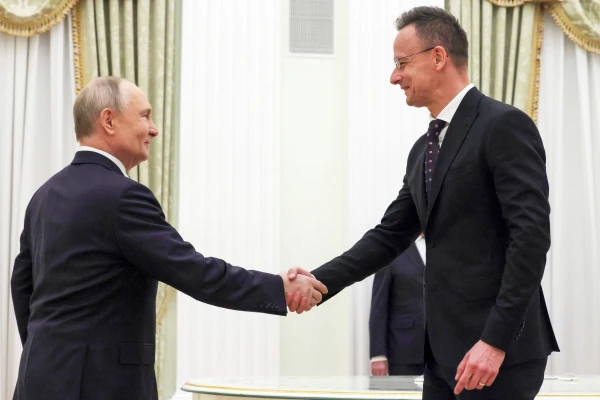
"Orbán's team reports to Moscow on the EU Council meetings in minute detail."
Negotiations among European leaders on security and energy issues have been accompanied by information leaks to Russia. Hungarian Foreign Minister Peter Szijjarto confirmed that he regularly discusses what happens at European Union meetings with Russian Foreign Minister Sergey Lavrov. As noted on Czech Radio by political scientist Tomas Weiss, Peter Szijjarto had access to a wide range of information.
According to The Washington Post, the head of Hungarian diplomacy, Peter Szijjarto, regularly informed Russia about the progress of negotiations at EU representatives' meetings during breaks in discussions with his European colleagues. According to Euronews, Szijjarto mentioned his contacts with the head of Russian diplomacy at a campaign event, noting that EU decisions directly affect Hungary's relations with countries outside the EU.
According to a report on Politico's website, five European diplomats and officials stated that the EU is trying to exclude Hungary from important negotiations due to concerns that it may disclose information. Polish Prime Minister Donald Tusk called Szijjarto's actions a disgrace, while Czech Foreign Minister Petr Maixinka saw nothing reprehensible in his Hungarian colleague's contacts with the Kremlin: "Is this true or was it said on television?" he mockingly responded to a question from Novinky.cz.
Since the beginning of the war in Ukraine, Peter Szijjarto has made 16 official visits to Moscow, met with Vladimir Putin in March of this year, and Hungary's position regarding Russian aggression is well known. The European Commission is now demanding explanations from Hungary.
According to Tomas Weiss, a political scientist at the Department of European Studies at Charles University’s Faculty of Social Sciences, it has long been known that Hungary seeks to maintain good relations with Russia for economic reasons, specifically in the interests of the current Hungarian ruling elite. On Czech Radio, he also noted that the Hungarian government has long tried to pressure the rest of the European Union, effectively delaying the adoption of certain decisions and "blackmailing" the EU, largely by seeking more favorable access to funds from the European budget, which Hungary has been deprived of due to threats to democracy in the country. However, this aspect of Hungarian foreign policy has been known for a long time.
According to Tomas Weiss, some active coordination and transmission of information from European negotiations to Russian representatives is a completely different matter. He believes that to negotiate with Russia and pressure the EU, it is not necessary to actively coordinate actions with the Russian side.
"This is yet another, I would say, step too far, which significantly undermines the legitimacy of Hungarian representatives."
"No one should be surprised that Orbán's team reports to Moscow on the EU Council meetings in minute detail. We have long had suspicions about this. That is why I only take the floor when it is absolutely necessary and say exactly as much as needed," stated Donald Tusk.
How sensitive was the information that the Hungarian Foreign Minister could have passed to Russia, and how detailed are the plans of the European Union discussed directly at the negotiations of European leaders?
"It was a meeting of ministers, in which Peter Szijjarto also participated and represented Hungary. Of course, it is the ministers who make the final decisions. This means that technical negotiations are conducted at a lower level, dealing with technical, bureaucratic issues, but of course, the ministers have access to all the information, as their decision is the final legal decision. So he had access to any information."
- Can the EU exclude Hungary from some negotiations? How can it react in such a situation? What options does it have to protect itself against a member state behaving like a foreign agent?
"I would say that the options are quite limited because European treaties do not foresee such a situation at all. A member state cannot be excluded. If a state violates some fundamental principles, theoretically, it may lose its voting rights. However, it cannot be excluded from negotiations. The only thing the rest of the EU can do at the moment is to move sensitive negotiations to other forums, to other rooms. But this also means that such negotiations cannot take place. It is impossible to make formal decisions that the Council approves, in which Peter Szijjarto, as Hungary's Foreign Minister, is present."
As Tomas Weiss emphasized, Hungary, like any other EU member state, is valuable.
"We would be happy if Hungary managed to stay in the European Union, as we have seen what problems Brexit has brought to all other EU members, not just the United Kingdom. So, of course, we want Hungary to remain part of the European Union. It is in our interest that the Hungarian government behaves in a way that gives us the impression that it really wants to be part of the European Union."
- Hungary is not the only country friendly to the Kremlin. Even in the European Parliament, there are parties that do not hide good relations with Russia. Do you think new leaks of sensitive information are possible?
"I believe that such leaks are certainly always possible. I also think that there is a difference between political leaks and legal definitions like treason and so on. I believe that we live in a democracy. This means that everyone has the right to be elected and to advocate for the interests they represent. Then there is the criminal code, and it has certain limits. So I am not an expert who could say where criminal liability begins and ends," concludes political scientist Tomas Weiss from the Department of European Studies at Charles University’s Faculty of Social Sciences.






Leave a comment