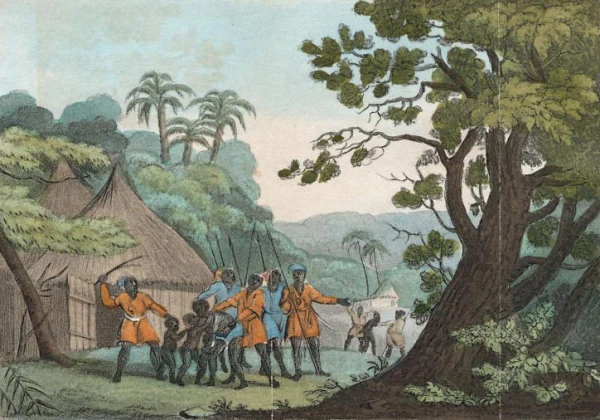
The decisions of the General Assembly are advisory.
The UN General Assembly recognized the enslavement of Africans as a grave crime against humanity and raised the issue of reparations: why they should not be expected?
At the initiative of Ghana, a resolution was presented recognizing the trade in enslaved Africans as a grave crime against humanity. The document was supported by 123 countries, 3 states (the USA, Israel, Argentina) voted against, and 52 abstained.
An important point: unlike the Security Council, the resolutions of the UN General Assembly are advisory and not legally binding. UN Secretary-General António Guterres emphasized the need for real actions: from expanding the participation of African countries in global financial structures to "reparative justice."
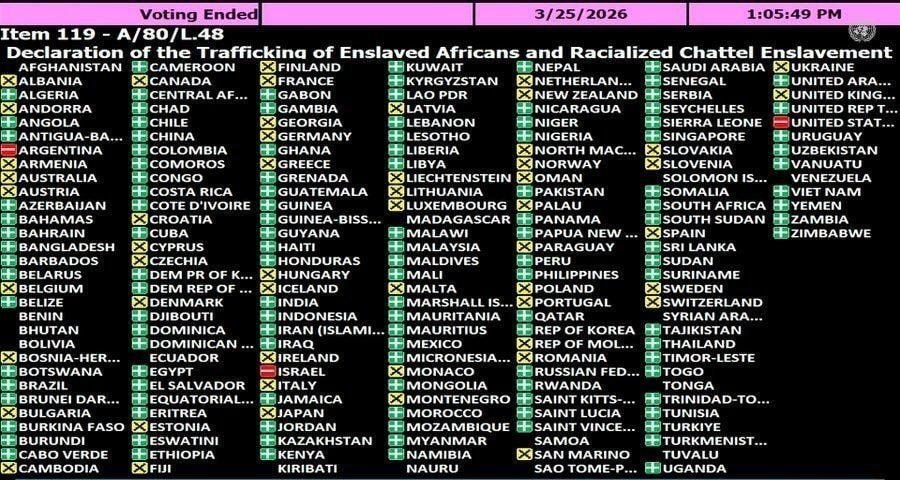
An examination of the voting list shows that the "FOR" votes mainly came from Global South countries, while Western countries made up the majority of abstentions and votes against the resolution. The United Kingdom even issued an official explanation for its decision to abstain, which largely aligns with the positions of the USA and EU countries on this issue.
The main "Western" arguments against the resolution are:
-
The UN was not established to promote narrow interests
-
A hierarchy of crimes against humanity cannot be created
-
There is no obligation to compensate for historical actions that were not violations of international law at the time they were committed
-
This is a cynical use of historical wrongs in an attempt to redistribute modern resources in favor of people and nations that are distantly related to historical victims
Currently, there are simply no conditions under which countries responsible for the enslavement of Africans would begin to pay hundreds of billions or even trillions of dollars (either directly or into a common fund). Modest precedents may arise, but each will carry specific domestic or foreign policy motives, rather than being part of a "great repentance."
The current position of former colonial powers can be summarized in a simple thesis:
"Those who have never been slaves cannot demand money from those who have never engaged in the slave trade."
Changing this in modern realities will be extremely difficult.
<iframe width="560" height="315" src="https://www.youtube.com/embed/PvDxutA7CdY?si=kmxcbsGsFnxHFzuj" title="YouTube video player" frameborder="0" allow="accelerometer; autoplay; clipboard-write; encrypted-media; gyroscope; picture-in-picture; web-share" referrerpolicy="strict-origin-when-cross-origin" allowfullscreen></iframe>