
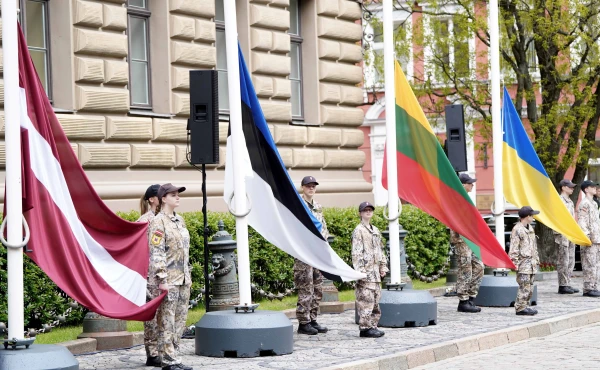
"Many of us are accustomed to the term 'Baltics', however, its use today is considered incorrect and undesirable in modern Ukrainian language," Ukrainian media reports.
"The word 'Baltics' is a common example of a colonial view of geography. As linguists explain, such a name reflects an imperial perspective — the region is defined as the territory 'by the Baltic Sea' in relation to the center of the state. As a result, independent countries are somewhat defined as a periphery or an appendage to another empire," the media points out.
This name became firmly established in Soviet administrative and journalistic language after 1940. For the residents of Estonia, Latvia, and Lithuania, the term 'Baltics' is associated with the period of Soviet occupation, which is why the citizens of these countries do not use it themselves.
Today, the commonly accepted, neutral, and politically correct term in official and public discourse is the Baltic states, Baltic countries, or Baltic nations.
This approach is primarily due to the naturalness of these words for our language, as the very name 'Baltics' comes directly from the name of the Baltic Sea. The use of the phrase 'Baltic states' is a geographically accurate and understandable term that corresponds to modern linguistic norms.
The international context is also important, as the internal self-designations of these peoples, as well as the widely recognized English-language terms, literally mean 'Baltic states'. This emphasizes the subjectivity of each country and their unity as a region.
An additional confirmation of the correctness of this designation was the change in the official classification by the UN in 2017. At that time, these states were moved from the Eastern Europe group to Northern Europe, which finally solidified their cultural and economic closeness to Scandinavian neighbors and distanced them from the Soviet legacy.
"Getting rid of Russisms and errors in proper names is a way to relate to regions more accurately and respectfully. The refusal to use 'Baltics' is an expression of solidarity with Estonia, Latvia, and Lithuania, which are among Ukraine's most devoted allies. Respect for the name chosen by the peoples themselves for their self-identification is an acknowledgment of their independence," Ukrainian media writes.






Leave a comment