
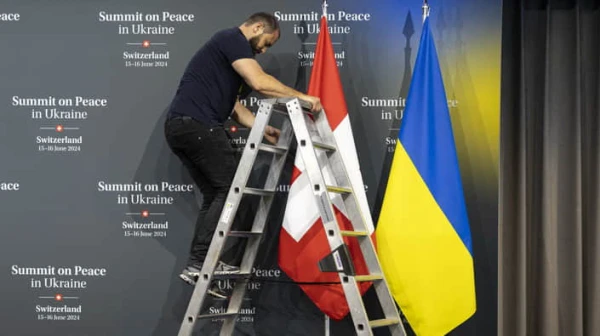
The Federal Council uses the powers provided by the constitution to introduce measures under emergency law.
In relation to Russia, Switzerland adheres to the EU's sanctions policy, regularly imposing new sanctions that are identical to the packages adopted by the European Union.
At the same time, the fact that trade restrictions from Switzerland also apply to Ukraine is much less publicized.
Moreover, the Swiss government does not want the trade sanctions against Ukraine to expire, and therefore plans to change their legal regime. Specifically, it intends to replace their regulation from the format of emergency legislation to federal law.
This law is expected to be a test for Swiss politicians as well as for society.
Are they ready to effectively equate the aggressor and the victim for the sake of neutrality principles?
Sanctions for the Sake of Neutrality
After the onset of the full-scale aggression of the Russian Federation against Ukraine, the European Union imposed sanctions against the aggressor country.
Switzerland joined most of these measures.
The sanctions against Russia concern not only military equipment (tanks, ammunition, or combat aircraft) but also a wide range of goods and services.
In addition to weapons, this list includes dual-use technologies used in both civilian and military spheres. These include, for example, bulletproof vests, protective helmets, or camouflage nets. Certain types of aviation fuel and specific chemicals are also included in this list.
The goal of the EU sanctions is to prevent the supply of such goods to Russia and thereby force it to cease its aggressive war against Ukraine.
However, additionally, albeit in a limited scope, Switzerland extends their effect to Ukraine.
The Federal Council (the country's government) explains this by the requirements of neutrality. The government notes that Switzerland simply "has no other choice."
In particular, the legal principle of "equal treatment," stemming from the legal foundations of neutrality policy, obliges Switzerland to treat all parties to an international armed conflict equally in terms of the export and transit of goods of military significance. This includes situations where these exports and transits are carried out by private entities.
As explained by Professor of Public and International Law at the University of Bern, Jörg Künzli, the Federal Council followed the EU regarding sanctions against Russia, but did not want to make any concessions regarding Swiss neutrality.
"Therefore, the Federal Council felt obliged to impose trade restrictions on Ukraine as well in the area of goods of military significance," says the expert. However, not everyone agrees with this logic of the government.
Professor Künzli clarifies that in the case of an overtly aggressive war, the Federal Council could interpret neutrality in light of the prohibition of the use of force enshrined in the UN Charter.
In such a case, Switzerland would limit itself to banning the supply of military equipment to both sides of the conflict. "This would be consistent with the essence of neutrality policy," says Jörg Künzli.
And this would mean that while Ukraine would not receive military equipment from Switzerland, it could still receive other goods, including those necessary for defense.
The End of the Temporary Regime
There is another clear inequality in Switzerland's approach. While sanctions against Russia are imposed based on a clear legislative framework – the Embargo Act, there is no such legislative basis for sanctions against Ukraine.
In this case, the Federal Council uses the powers provided by the constitution to introduce measures under emergency law and issues a corresponding government decree with each package of EU sanctions.
However, there is one nuance: Swiss legislation limits the duration of the emergency law regime to four years. This means that Switzerland must either repeal this provision or legislate it.
That is why the Federal Council intends to transition the trade sanctions against Ukraine, introduced under emergency law, into the form of federal law.
The corresponding draft law is currently in the stage of public discussion and interdepartmental coordination. Only after that will it be presented to Parliament.
Equating the Aggressor and the Victim?
The consultation procedure for the draft law on trade sanctions against Ukraine will show whether political parties in the country, as well as public organizations and businesses, support such an initiative.
Mauro Tuena, a member of the National Council (the lower house of Parliament) from the right-wing Swiss People's Party (SVP), welcomes the preparation of such a law.
According to him, sanctions should apply either to both sides or to neither, and a unilateral approach is impossible. All of this, in his opinion, stems from the legal foundations of neutrality.
"It is very correct that this law is now emerging," says Mauro Tuena.




Leave a comment