The complete air dominance of the United States and Israel over Iran allows for constant surveillance of the underground launch bases built by the Islamic Republic. As a result, launch attempts are thwarted in advance, and strategic bombers destroy the entrances to the bunkers.
Iran has spent decades building underground bunkers to protect its vast missile arsenal from aerial destruction. Less than a week after the war began with its two strongest adversaries, this strategy is starting to look like a mistake.
In an extensive article on the subject published in the American newspaper Wall Street Journal, it is reported that American and Israeli fighter jets, as well as drones, are circling over dozens of massive bases and striking missile launchers at the moment they emerge from their shelters to launch. Meanwhile, heavy bombers are dropping bombs — and simply 'burying' the Iranian missile arsenal.
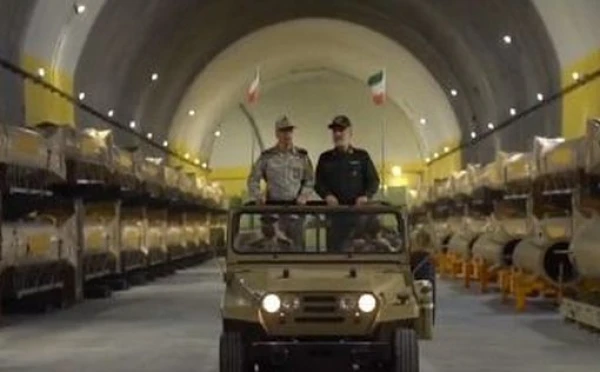
Satellite images taken in recent days show burning remnants of several Iranian missiles and launchers destroyed by American and Israeli airstrikes near the entrances to the 'missile cities,' as Iranian sources call these underground facilities.
Since the beginning of the war, Tehran has launched over 500 missiles at Israel, American bases, and other targets in the Persian Gulf region, many of which have been intercepted. Since the early days of the conflict, large salvos have become less frequent, which is a sign that American-Israeli strikes are damaging Tehran's ability to respond.
'We are hunting for the last remaining ballistic missile launchers in Iran to eliminate what I characterize as their sustaining ballistic missile capability,' said Admiral Brad Cooper, commander of CENTCOM. 'We see that Iran's ability to strike us and our partners is decreasing.'
It appears that Tehran moved some of its launchers and missiles out of the bunkers even before the war began, hoping to protect them from strikes by dispersing them. Cooper stated that the U.S. and Israel have destroyed hundreds of missiles and drones. U.S. Central Command, which oversees the air campaign, reported on Wednesday that Iranian missile launches have decreased by 86% over four days.
Analysts stated that a significant portion of Tehran's remaining arsenal of thousands of short- and medium-range missiles is likely still located in underground bases, the locations of which are mostly known to the U.S. and Israeli militaries. This underscores a fundamental flaw in the concept of 'missile cities': 'What was once mobile and hard to detect is no longer mobile and easier to strike,' says Sam Laer, a researcher at the James Martin Center for Nonproliferation Studies, a research organization in Monterey, California.
<script async src="https://platform.twitter.com/widgets.js" charset="utf-8"></script>⚡️BREAKING
— Iran Observer (@IranObserver0) March 25, 2025
Iran has unveiled perhaps its largest missile city ever that can destroy all US assets in the region
The new underground missile base houses thousands of precision-guided missiles such as Kheibar Shekan, Haj Qasem, Ghadr-H, Sejjil, Emad and others pic.twitter.com/QYR24ZN7TS