
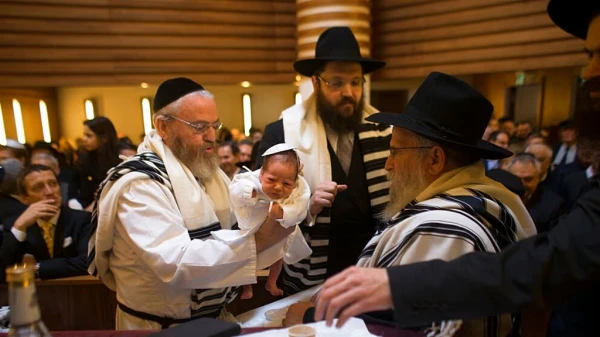
The investigation into three mohels in Antwerp has sparked a diplomatic dispute between Brussels and Washington. What are the rules in Belgium and beyond, and how has the religious community reacted?
After U.S. Ambassador to Belgium Bill White accused the host country of anti-Semitism due to laws regulating circumcision, Belgian authorities found themselves at the center of a loud public dispute.
White's criticism was triggered by a court case initiated last May, when Antwerp police conducted searches in the homes of three mohels — individuals performing circumcision according to Jewish religious rites — suspected of carrying out the procedure without the involvement of a licensed medical professional.
"In Belgium, the law clearly states that circumcision and any similar procedures can only be performed by doctors," said Dirk Devroey, a professor of family medicine at the Free University of Brussels, to Euronews.
In addition to cultural or medical motives, circumcision is a fundamental religious practice in both Judaism and Islam. In Islam, it can be performed by trained medical professionals, while in Judaism, circumcision, known as brit milah or bris for short, is traditionally performed by a specially trained mohel.
Although most mohels are either doctors, rabbis, or both, they are expected to undergo serious training specifically in the methods of circumcision prescribed by Judaism.
According to Jewish tradition, a boy should be circumcised on the eighth day after birth. During the bris, the mohel places a special instrument on the foreskin as close to the head of the penis as possible, after which he removes the foreskin with a scalpel.
Proponents of the ritual argue that religious circumcision is less painful and less traumatic for the newborn than medical circumcision; however, critics question whether all medical protocols are followed in such cases when a licensed specialist is not present.
"(Circumcision can be) dangerous if done in unsterile conditions and without anesthesia," Devroey says. "The pain subsides over time, but the risk of infection remains, and in some cases, part of the penis is lost as a result."
The debate over who should perform circumcision has also stirred the Jewish community in Belgium.
Moshe Friedman, an Antwerp rabbi whose complaints led to the investigation, stated on the air of the Flemish public broadcaster VRT NWS that there have been cases of children contracting severe illnesses as a result of ritual circumcision. According to him, in some instances, children have died.
Rabbi Menachem Margolin, chairman and founder of the European Jewish Association, refutes these concerns. "This is done by trained professionals who undergo very serious training," he told Euronews.
"It is very important for the authorities to check that everything is done properly," Rabbi Margolin noted.
"But when they start talking about something that has existed for over four thousand years and through which millions of children have passed — my father did it to me, and I did it to my children — it essentially means: 'We do not trust you to care for your children,'" he emphasized.
Euronews contacted the prosecutor's office for evidence supporting Rabbi Friedman's claims. They reported that a judicial investigation into "illegal circumcisions" is underway, concerning medical interventions carried out by men who are not doctors.
Euronews also requested information from the Belgian Public Health Service regarding whether hospitals had reported infections in infants or related fatalities, but no response was received by the time of publication.
There is no publicly available aggregate statistics on the number of infectious complications following circumcision.
Meanwhile, part of the Belgian Jewish community fears that the investigation into Antwerp mohels will de facto lead to a ban on the bris.
What Does the Law Say?
Currently, no other European country has a legal ban on non-medical circumcision of boys. Iceland made headlines in 2018 when it discussed the possibility of being the first in the world to ban this practice, but the bill was never passed.
Many countries have rules similar to those in Belgium — circumcision must be performed by trained specialists. In others, anesthesia or the most effective pain relief is mandatory. In Scandinavian countries, there have previously been calls to establish a minimum age at which boys could consent to the procedure themselves.
The absence of a direct ban is partly explained by concerns that circumcisions would then be performed outside medical facilities. However, Nicolas Mober, co-chair of the Droit au Corps association, which focuses on prevention, believes the issue is more about political and religious pressure.
"As soon as any country tries to ban circumcision, religious and/or American pressure begins — as we see now with Ambassador Bill White," Mober told Euronews.
He recalled Germany, where in 2012 the Cologne court ruled that the circumcision of minor boys for religious reasons constitutes bodily harm and is illegal, which sparked outrage among Jewish and Muslim organizations.
Following this wave of protests, the German government and opposition parties prepared a bill explicitly confirming the legality of such practices.
In 2013, the Council of Europe (CoE) also sparked controversy by adopting a non-binding resolution expressing concern over violations of children's physical integrity and calling for the regulation of such practices to ensure they are medical and painless.
The document faced sharp criticism from religious organizations, after which it was clarified that it did not refer to a legally binding ban.
Concerns for Freedom of Religion
For religious communities, discussions about tightening legislation or bans essentially touch on the question of their very existence.
"This is about freedom of religion, which the entire democratic world has recognized and committed to respecting," Rabbi Margolin says.
"Any attempt to impose restrictions in this area is a clear signal to us of an intention to infringe upon our basic rights. Naturally, we cannot accept this."
One representative of the Belgian Jewish community, who wished to remain anonymous, questions how far such an approach can go.
"When someone says that children should choose for themselves when they reach the age of 18, I always ask a counter-question: so you want to say that as a parent I cannot make decisions for my child at all?"
According to him, this can be interpreted as a statement that "the state knows better." "And that is a very, very, very dangerous precedent."
He also wonders why there is such a fuss around the topic when it concerns only "about 500–700 boys" a year undergoing circumcision.
However, according to Devroey, the discussion in Belgium, which he calls "one of the world champions in circumcision," goes far beyond religion and comes down to the practice itself, regardless of faith.
"Almost nowhere is circumcision done as frequently as in Belgium, and often without necessity," he explains, noting that about 26,000 circumcisions are performed in the country each year. "Only about 1% of them can actually be medically justified."
As for those who choose circumcision for their children for religious reasons, Devroey notes that they are "free to practice their religion," but he is concerned about the issue of consent.
"Circumcision should be postponed until a person becomes an adult or at least mature enough to make decisions for themselves. Then they can choose this religion for themselves," he says.
In turn, Rabbi Margolin believes that if Belgian authorities are genuinely concerned about the health of Jewish children and the sentiments of the Jewish population as a whole, they should discuss these issues directly with the community.
"We have really serious, real problems. Both circumcision and sanitary requirements for mohels are absolutely not among them," Rabbi Margolin stated.







Leave a comment