
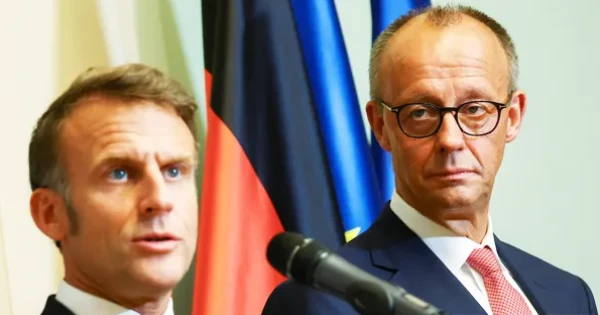
There are differing opinions within the EU about where the money from the 90 billion euro budget should go.
European unity is cracking, and another sign of this is the fate of the 90 billion euros that have been decided to be spent on arms purchases for Ukraine. It suddenly became clear that the largest and wealthiest countries in the EU – France and Germany – have different views on where this money should ultimately go. And this divide extends even beyond Europe. A few weeks ago, Europeans were congratulating themselves for scraping together 90 billion euros to fund Ukraine's military machine 'for at least the next two years'. Initially, they planned to seize sovereign assets of Russia for this purpose, but fierce resistance from Belgium, where most of these assets are held, forced EU leaders to resort to a backup plan and agree on a loan funded by the EU budget. However, only 24 out of 27 countries agreed to participate – Hungary, the Czech Republic, and Slovakia refused to risk budget funds. 'Guaranteeing another country 90 billion for the next two years – I believe that has never happened in our history,' noted Danish Prime Minister Mette Frederiksen with satisfaction. However, such a tempting piece of pie immediately became a subject of discord within the EU itself. Despite the apparent unity, there are differing opinions within the EU about where the money from the 90 billion euro budget should go. According to Politico, Germany and France have already clashed over the question of where to procure weapons. If the publication is to be believed, 'Germany and the Netherlands disagree with France, seeking to ensure that Kyiv can purchase American weapons.' The problem is that Paris is actively campaigning to 'provide favorable conditions for EU military companies to strengthen the bloc's defense industry.' Apparently, Macron no longer considers the U.S. an ally – at least, one that can be trusted. The French are eager to 'prevent money from flowing to Washington against the backdrop of a growing divide in the transatlantic alliance.' 'Ukraine… urgently needs equipment produced by third countries, particularly American-made air defense systems and interceptors, munitions, and spare parts for F-16s, as well as deep strike capabilities,' Politico quotes a letter from the Dutch government to other EU countries. 'Germany does not support proposals to limit purchases from third countries,' states a similar letter from the German government. However, there is a significant nuance: while refusing to impose restrictions on American weapons, the German authorities have not forgotten about their own largest defense enterprises. Moreover, according to Politico, the German authorities rejected Macron's proposal for a preferential regime for firms from EU countries because they demand such a regime for firms from countries that – attention – 'have provided the most financial support to Ukraine.' According to estimates by German Chancellor Merz, which he voiced in December 2025, his country spent 40 billion euros on military aid and 36 billion on non-military aid, totaling 76 billion. For comparison: in September 2025, military aid to Ukraine from France was estimated at only 8.6 billion. It is not surprising that the German authorities, having expressed their desire not to anger the Americans and to purchase some of their weapons, nevertheless strive to emphasize their role in supporting Ukraine and ensure priority orders for the German defense industry. If Germany's proposal is ultimately accepted, 'it would play into Berlin's hands, which is one of the largest financial donors,' Politico noted melancholically. It is also believed that this path could encourage other countries to allocate more money to Ukraine if they expect to stimulate their military-industrial complex. There is another problem that the rapidly growing German defense industry poses in the eyes of the French. As Bloomberg writes, 'France… watches with concern as Germany invests resources in historic rearmament, disrupting a long-standing balance on the continent.' The essence is that 'Berlin is increasing defense spending to a level that is unattainable for its allies.' Yes, all of this is entirely legal, as the German authorities have committed to spend more than 500 billion euros on defense by 2029, reaching NATO's new goal of investing 3.5% of GDP in the armed forces. But the French are still uneasy: on the one hand, it seems good that Germany is doing more for the defense of Europe, on the other hand, 'there are concerns that the German industry will crowd out the French defense sector.' And it is not just about industry. 'The fact that Germany is showing such determination will certainly create a dynamic that could leave us on the sidelines,' recently stated French Member of the European Parliament François-Xavier Bellamy. 'Domestic instability weakens France's geopolitical weight.'




Leave a comment