"In China, things are rarely purely scientific."
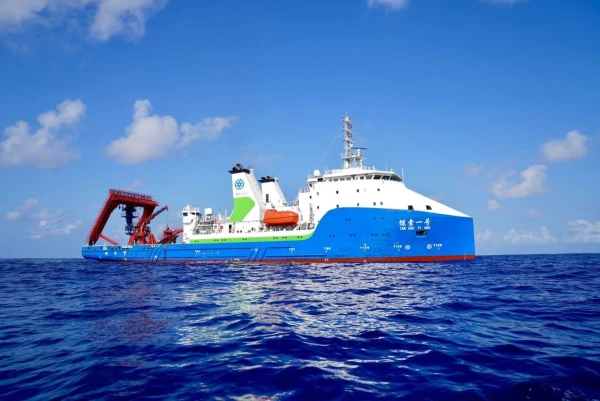
The Chilean Navy is preparing to closely monitor the arrival of the Chinese research vessel "Tan Suo Yi Hao" in Valparaíso. Although the vessel is part of a joint scientific expedition with Chilean institutions to study the Atacama Trench, its history has raised concerns in several countries due to potential dual-use activities, including reconnaissance capabilities.
"Tan Suo Yi Hao," operated by the Institute of Deep Sea Science and Engineering (IDSSE) of the Chinese Academy of Sciences, is a vessel equipped with 11 advanced laboratories, high-precision probing systems, and capable of deploying the manned submersible "Fendouzhe," which can reach depths of over 10,900 meters, as demonstrated in the Mariana Trench in 2020.
The JCATE expedition (Joint Chinese-Chilean Expedition to the Atacama Trench) aims to study the unique ecosystems in the Atacama Trench by establishing oceanographic stations in Chile's exclusive economic zone. Researchers from the Millennium Institute of Oceanography (IMO) at the University of Concepción, as well as experts from other institutions such as the Pontifical Catholic University of Chile, the University of Valparaíso, and the National Geological and Mining Service of Chile (Sernageomin) are participating in the initiative.
According to the approved Navy schedule, the vessel departed from Valparaíso on January 19, will stop in Antofagasta on February 9, continue to the trench area, and return to Valparaíso on March 3 before heading back to its base in Hainan, China.
Background for International Concern
The vessel "Tan Suo Yi Hao" is no stranger to defense authorities in the Indo-Pacific region. Throughout 2025, Australia closely monitored it while it was near undersea communication cable routes — critical infrastructure for the internet and military communications. Australian Prime Minister Anthony Albanese publicly stated that he "would prefer that vessel not be there," although he confirmed that the Defense Forces were tracking its movements without disclosing operational details.
Experts point to the dual nature of these Chinese vessels. Malcolm Davis, an analyst at the Australian Strategic Policy Institute (ASPI), explained that such vessels can conduct mapping of bathymetric and oceanographic conditions, useful for both science and future underwater operations. According to Ray Powell from the SeaLight project (Stanford University), "in China, things are rarely purely scientific"; information about underwater terrain is valuable for underwater forces, including those equipped with ballistic missiles.
A 2024 study by the Center for Strategic and International Studies (CSIS) analyzed 64 Chinese research vessels operating in the Indian Ocean from 2020 to 2023 and classified several of them, including "Tan Suo Yi Hao," as "representing a risk" due to their ties to the People's Liberation Army of China (PLA), visits to military ports, and anomalous patterns of behavior. Aidan Powers-Riggs, one of the report's authors, emphasized that the vessel met all three established threat indicators.