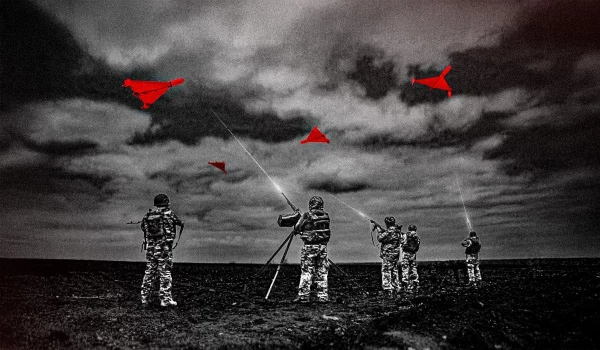
Recently, President Zelensky publicly acknowledged the Air Forces' performance regarding the Shaheds as unsatisfactory.
The day before, there was another air attack by Russia on the territory of Ukraine. Ukrainian President Volodymyr Zelensky emphasized that during the repulsion of the massive Russian air attack, the performance of the Air Forces of the Armed Forces of Ukraine, specifically in shooting down Shahed-type strike drones, was unsatisfactory. Furthermore, the head of state noted that Ukraine has not reduced its air defense missiles, but the number of missiles with the Russians has increased during the attacks. He pointed out that the Russians have significantly increased the number of Shaheds, while Ukraine has not increased the number of interceptors and mobile fire groups.
I spoke with Anatoliy Khrapchynskyi, a reserve officer of the Air Forces of the Armed Forces of Ukraine and the director of development at a defense enterprise, about the criticism of air defense performance and the current problems in this area.
The president publicly acknowledged the Air Forces' performance regarding the Shaheds as unsatisfactory. Is this a failure of a specific night or a consequence of accumulated errors in the air defense system?
This is not a failure of one night, but a consequence of accumulated strategic errors at the state level. It is enough to recall the beginning of 2025 when personnel were massively transferred from the Air Forces to the Ground Forces. And they took specialists from mobile fire groups first, that is, from the unit that directly works on the Shaheds.
Secondly, it is important to honestly say: there is no ready-made, universal system in the world that can guarantee to close the sky from massive drone attacks. We are currently in a mode of searching for solutions and tools, rather than exploiting an "ideal model".
The third point is the critical shortage of interception means. The president has acknowledged this directly: recently we received only partial reinforcement of the missile component, and before that, we objectively did not have the opportunity to fully cover the airspace.
Fourthly, there are resource limitations. We are limited both financially and technologically, and Western partners are not in a hurry to provide us with the necessary number of the exact means needed to combat the Shaheds. For example, the radar in the IRIS-T system detects a target like a Shahed at a distance of about 30 km, but the cost of such a radar is approximately 17 million euros. This is not a scalable solution.
Moreover, most classical radar systems were not designed for such targets at all. For them, a Shahed is noise, a bird, or interference that is automatically filtered out by algorithms.
As a result, we have a systemic problem: the state has not allocated sufficient financial resources for building a comprehensive, multi-level air defense system. Western partners provided what they deemed appropriate, but not always what we directly requested. Our basic request is simple - mass detection and inexpensive interception means.
Yes, we are looking for alternatives - in particular, solutions for drone air defense. But there are objective limitations here as well: at sub-zero temperatures, such systems lose efficiency sharply, and their tactical and technical characteristics drop by up to 50%. This means that solutions require refinement, not declarations.
And one more key problem is the lack of a clear technical assignment. Most of the solutions that Ukrainian companies offer today are their own initiatives, born from direct interaction with specific combat units, rather than the result of a systematic state order.
For comparison: the UK acts differently. It formulates a clear technical assignment, for example, a missile with a specified range and a price of up to one million dollars - and openly offers this to the market. Companies are allocated funding, deadlines are set, and the state receives results. In Ukraine, however, most defense solutions were created by private companies essentially "at their own risk", without systematic funding from the state.
And those people who replaced those who were transferred have not yet learned enough to shoot down targets, or are there simply fewer people overall?
Overall, there is a shortage of personnel. If there were no staffing shortages, the state would not be creating initiatives to form mobile fire groups from volunteers and would not allow private companies to independently purchase interception means to enhance protection. These solutions directly indicate that the burden on the air defense system exceeds the available human resources.
Returning to the question of air defense in general: if interceptors, mobile fire groups, and F-16s are involved, where exactly does this chain "break"? Could it be that the Air Forces know about the problem but are afraid to acknowledge its scale? And why is that?
This chain "breaks" not at the level of the Air Forces. They cannot come out and call for donations for Patriot or IRIS-T, demand the construction of factories for producing AIM missiles for F-16s, or publicly criticize state decisions - this is the army, not a political entity.
The Air Forces operate within the framework of the tools provided to them: state resources, support from the "coalition of the willing", and assistance from partners. Even regarding F-16s - their involvement became possible primarily due to initiative, not due to an excess of resources.
It is easiest to blame the military for not shooting down everything. But the key question is different: did they receive enough interception means and was an institutional framework created that systematically seeks and scales solutions against air threats? This is where the main gap lies.
Has Russia adapted to such an extent that the current model of protecting Kyiv is already outdated? The "Shahed" routes essentially remain the same. If the approach routes of the Shaheds to Kyiv are repeated time and again, is this a miscalculation in defense planning or a conscious risk taken due to a lack of resources and personnel?
After each shelling, headlines appear stating that "the enemy has changed tactics". In reality, the tactics have not changed since the first mass strike. This is a systematic terrorist model: attacks on critical energy infrastructure and strategic facilities with maximum calculation for damage to the civilian population.
It is not the tactics that change, but the scale and technical component. Russia is constantly increasing the number of means of destruction and modernizing them: ballistic missiles are becoming more complex, the production of Shaheds is growing, and an increasing number of drones are used simultaneously in attacks.
At the same time, Ukraine does not produce its own surface-to-air missiles and does not have a full-fledged serial production of air defense systems. Everything we work with is the assistance of Western partners, including ammunition even for Soviet systems. For example, British Raven systems are an important reinforcement, but their range is 5-10 km. To cover the space, dozens, if not hundreds, are needed.
Therefore, the thesis about "the same routes" is incorrect. Drones approach from the same directions, but in significantly larger numbers. And the key question is not why they fly to Kyiv, but from where they take off and why we are not systematically working on the storage, assembly, and formation of strike groups.
And this is no longer a question for the Air Forces. This is a question for the overall architecture of the war: for the capabilities of our deep strike and mid strike across the territory of Russia and how the state builds the logic of eliminating the threat even before it reaches the route.
Who can change this system? Who should change it?
We hope that the newly appointed Minister of Defense will succeed in this. He is the one who must change the system as a whole. Because air defense is not just about intercepting targets in the air.
Let’s remember that part of the massive shelling has already been thwarted thanks to the correct actions of the Defense Forces. Operation "Web" significantly limited the capabilities of Russia's strategic aviation; we see a reduction in both the number of launches and the number of sorties of strategic aviation.
It is precisely the new approach, asymmetric actions, and the technological nature of warfare that provide the opportunity to change the situation in our favor.
Regarding energy. Could improper logistics and distribution of air defense means between regions have led to strikes on the energy infrastructure of Kyiv Oblast? Why has the capital now seemingly become more vulnerable? Is it due to the quantity of what Russia is launching?
The key reason is not logistics, but the number of means of destruction that Russia is launching. If the first mass shellings were distributed across the entire territory of Ukraine, now the strikes are targeted at regions. If it is Kyiv - they hit Kyiv Oblast. If it is the west - they concentrate means there, while simultaneously stretching the air defense system, overloading the center of the country.
Every night, the maximum load also falls on the frontline and border regions - Donetsk, Dnipropetrovsk, Zaporizhzhia, and Odesa oblasts. Conditionally speaking, we have 10 means, but we need 100. And the enemy deliberately "drives" our air defense across the country, forcing it to react in a state of constant shortage.
Therefore, it is incorrect to say that everything comes down to improper distribution. The problem lies in the scale of the threat. Only in October, Russia used about 95 Iskander-M missiles. For comparison: about 500 PAC-3 missiles (for countering ballistic threats) are produced worldwide each year. And we are only talking about statistics for one type of missile for October, while the enemy uses other types of ballistic missiles as well. In such conditions, the question is not about a separate sector, but about a systemic shortage of means.
Another interesting point regarding how you have already noticed that the Russians are launching more of their targets. Zelensky also stated that Ukraine has not reduced its air defense missiles, but the number of missiles with the Russians has increased during the attacks. Does this not mean that the defense system of Kyiv no longer corresponds to the scale of the threat and requires a fundamentally different architecture, rather than some targeted reinforcements?
The restructuring of the air defense system is indeed necessary, but it must be reasonable. It is not about the classic logic of "detected - shot down", but about a different architecture: detection, classification, prioritization of targets, and selection of adequate interception means. It is such a system that corresponds to the scale of the current threat.
The president rightly notes: the Russians have more missiles, and we do not. The reason is simple - Europe has not been able to ramp up production capacities to provide Ukraine with the necessary number of surface-to-air missiles.
We already have European air defense systems that are sitting without ammunition because the corresponding missiles are no longer produced there. Europe was not prepared for a protracted war of this scale. And this is definitely not a question for the military - it is a question for industry and strategic planning as to why the production of surface-to-air missiles has not been ramped up to the necessary volumes.
In your opinion, what specific elements of Kyiv's air defense system are failing, if we can say so: placement of means, management, response to changes in drone routes, or interaction between units? Is there something specific or several things that can be highlighted?
The key problem is the colossal shortage of personnel and interception means. We are often offered interceptor drones as a universal solution, but at a temperature of around -15°C, their tactical and technical characteristics drop by almost 50%. This is an objective physical limitation.